

Why Professional Watch Degreasers Differ: A Clear Guide
Professional watch degreasers are specialized cleaning solutions formulated with distinct pH levels and chemical properties to safely remove old lubricants and contaminants from watch movements. The reason why professional watch degreasers differ from general-purpose cleaners comes down to one core fact: watch movements contain materials that react very differently to chemistry. Brass gears, steel pivots, nitrile seals, and anodized aluminum all demand different treatment. Using the wrong solution does not just leave residue. It destroys the very components you are trying to protect. Major manufacturers like Rolex, Omega, and Breitling endorse scheduled servicing precisely because the chemistry of cleaning matters as much as the cleaning itself.
Why do professional watch degreasers differ from general cleaners?
Professional watch degreasers are not simply stronger versions of household cleaners. They are engineered for a specific chemical task: breaking down oxidized lubricants without attacking the metals, seals, or surface coatings inside a movement.
The industry standard for watch movement cleaning uses alkaline concentrates at pH 9.0–10.0 to dissolve old grease and oil residue. That pH range is effective on brass and steel without triggering corrosion or surface degradation. Go above pH 10.5, and the chemistry turns destructive. Nitrile and EPDM seals, which are the gaskets that keep moisture out of your movement, begin to break down within a handful of cleaning cycles.
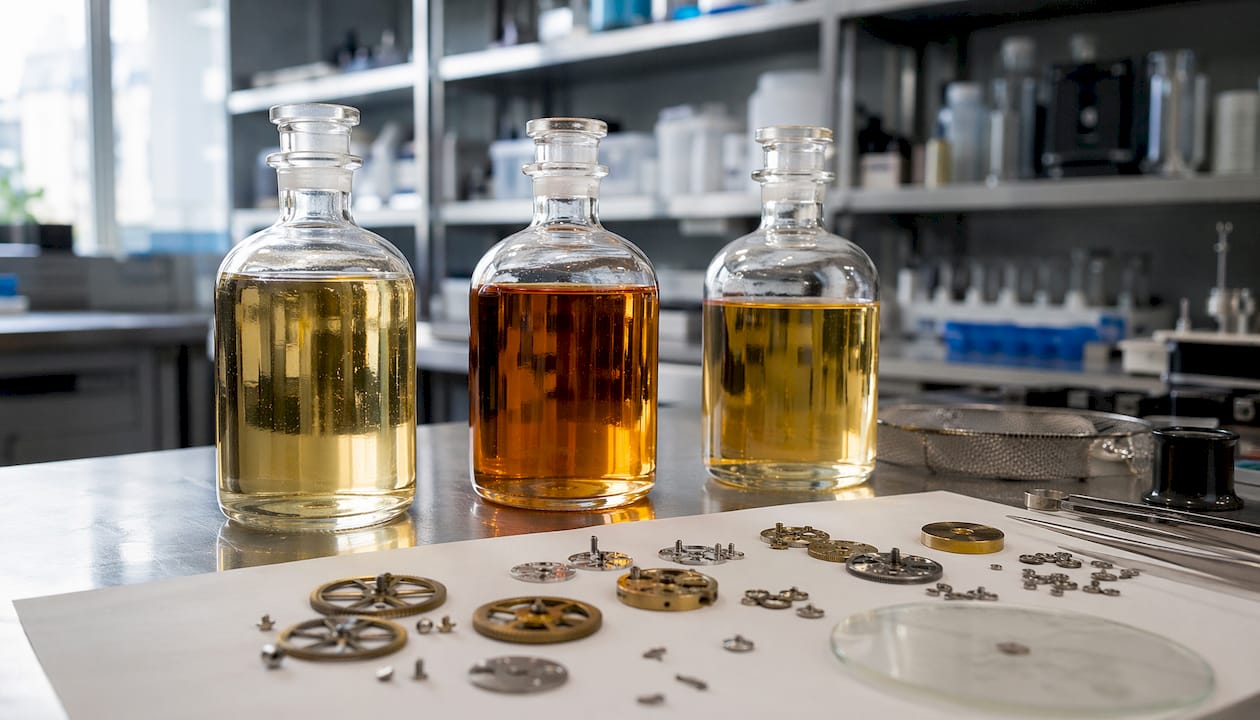
General household degreasers are formulated for tiles, engines, or kitchen surfaces. They carry no obligation to protect rubber gaskets or preserve the micro-tolerances of a Swiss lever escapement. That difference in design intent is exactly why the two categories cannot be swapped.
Water-based alkaline degreasers and solvent-based degreasers also serve different roles in professional servicing. Alkaline solutions emulsify and lift grease. Solvent-based fluids, used in the rinse stage, evaporate cleanly and carry away residual surfactants. Each type handles a distinct part of the cleaning sequence. Neither can substitute for the other.
- Alkaline concentrates (pH 9.0–10.0): Break down oxidized lubricants on brass and steel parts
- Solvent-based rinse agents: Remove surfactant residue left by alkaline cleaners; evaporate fully
- pH-neutral rinse solutions: Neutralize alkaline traces before drying
- Drying agents (e.g., Suprol Pro): Displace moisture and prevent corrosion after rinsing
Pro Tip: Never use a single-stage “all-in-one” cleaner on a disassembled movement. Cleaning and rinsing are chemically distinct steps, and combining them into one product leaves residue that interferes with new lubricants.
How does the watch component type affect degreaser choice?
The material being cleaned determines the degreaser, not the other way around. This is the principle that separates professional watch servicing from DIY attempts.
Brass and steel movement parts tolerate alkaline degreasers well within the pH 9.0–10.0 range. These metals are dense and relatively chemically stable, so an alkaline solution can work on them for the standard cycle time without causing surface damage. Vintage components with aged plating or gilding require lower temperatures during cleaning, typically well below 50°C, to prevent thermal stress from lifting surface treatments.
Rubber seals, nitrile gaskets, and EPDM O-rings are a different story entirely. Alkaline pH above 10.5 degrades these materials within 2–5 cleaning cycles. A seal that looks intact after one aggressive cleaning may fail under water pressure six months later. Anodized aluminum, found on some modern case components, also reacts badly to high-pH solutions, which strip the anodized layer and expose bare metal to corrosion.
Ultrasonic cleaning adds another layer of complexity. The cavitation process, where microscopic bubbles collapse against surfaces to dislodge contaminants, is powerful and effective on disassembled metal parts. However, ultrasonic cleaning of assembled watches risks damaging seals, crystals, and delicate shock settings. Temperature must stay under 50°C to avoid thermal stress on vintage components.
- Brass and steel parts: Use alkaline degreaser at pH 9.0–10.0 for standard cycle times
- Rubber seals and gaskets: Avoid degreasers above pH 10.5; use pH-neutral solutions only
- Anodized aluminum: Restrict to low-pH or neutral solutions; high pH strips the anodized layer
- Vintage components: Lower temperature controls (well under 50°C) protect aged surface treatments
- Assembled watches: Never use ultrasonic cleaning; disassemble fully before any chemical degreasing
Pro Tip: When in doubt about a component’s material, test the degreaser on a sacrificial part first. Seal degradation is invisible until it fails under pressure.
What are the professional cleaning protocols for watch servicing?
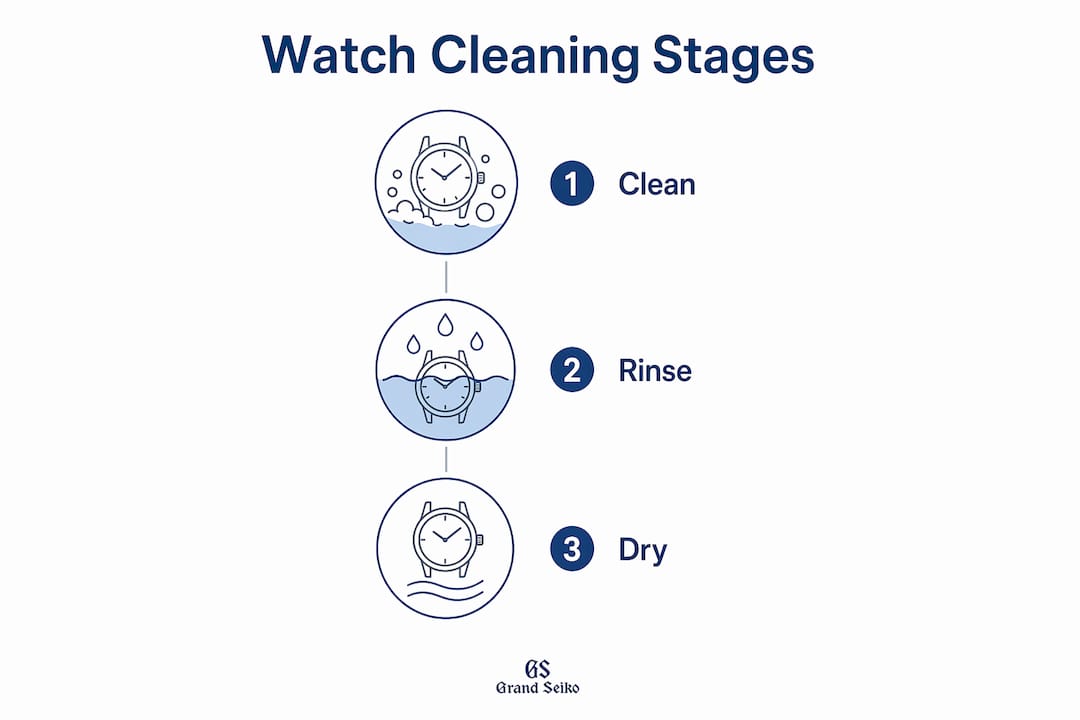
Professional watchmakers follow a three-stage cleaning system: clean, rinse, and dry. Each stage has a specific chemical role. Skipping any one of them causes problems that show up weeks or months after the service.
Stage 1: Cleaning. The disassembled movement parts go into an alkaline or ammonia-based solution. This stage breaks down oxidized lubricants, grease, and particulate contamination. Standard professional cycles run 5–10 minutes at temperatures under 50°C. The cleaner lifts contaminants but leaves a surfactant film on the parts.
Stage 2: Rinsing. This is the stage most often skipped in amateur servicing, and it is the most consequential omission. Skipping the rinse leaves residual surfactant films on pivot surfaces and jewels. New lubricants cannot adhere properly to contaminated surfaces. The result is sluggish performance, gummy buildup, and accelerated wear. The rinse agent must be a volatile solvent that evaporates fully, leaving no trace.
Stage 3: Drying. A dedicated drying agent displaces any remaining moisture from the parts. Moisture left inside a movement causes corrosion on steel pivots and mainsprings. Drying agents like Suprol Pro are formulated to evaporate without residue.
| Stage | Solution type | Purpose | Risk if skipped |
|---|---|---|---|
| Clean | Alkaline or ammonia-based | Removes oxidized lubricants and grease | Contamination remains on parts |
| Rinse | Volatile solvent, pH-neutral | Removes surfactant residue from cleaner | Lubricant adhesion failure, gummy buildup |
| Dry | Moisture-displacing drying agent | Eliminates water to prevent corrosion | Rust on pivots and mainsprings |
The cleaner and rinse agents are not interchangeable. This is the largest misconception in DIY watch cleaning. A cleaner is designed to emulsify grease. A rinse agent is designed to remove the cleaner. Using one product for both tasks leaves the movement worse off than before the service.
Why does degreaser quality directly affect watch longevity?
Watch maintenance is a mechanical necessity, not a cosmetic one. The lubricants inside a movement oxidize and change viscosity over time, and lubricants degrade significantly after 5–7 years, increasing friction and wear on pivots and jewels. Proper degreasing before relubrication is what makes the new lubricant effective. If old grease residue remains on the surfaces, the fresh oil mixes with contamination and degrades far faster than it should.
Major manufacturers including Rolex, Omega, and Breitling recommend a 6–7 year service interval for mechanical movements. That interval assumes proper cleaning at each service. A poorly degreased movement that receives fresh lubricant on top of old residue will not last another 6–7 years before needing attention again.
“Amplitude drop below 200° or beat error above 0.8 ms signals immediate overhaul need. These are the measurable consequences of degraded lubrication and inadequate cleaning. A movement running at 240° amplitude after a proper service will drop to 180° within two years if the degreasing stage was compromised.”
The watch servicing interval you follow is only as effective as the cleaning protocol behind it. Jewels and pivots that run in contaminated oil develop microscopic wear patterns that no amount of relubrication can reverse. The only fix at that point is replacement of worn components, which is expensive and often avoidable.
- Degraded lubricants increase friction on pivots and jewels, reducing amplitude and accuracy
- Residual surfactant films from incomplete rinsing cause new lubricants to fail prematurely
- Contaminated cleaning cycles accelerate wear rather than preventing it
- Correct degreasing is the foundation that makes every other service step effective
Checking the signs your watch needs professional cleaning before the movement reaches a critical wear state saves both the watch and the cost of component replacement.
Key Takeaways
Professional watch degreasers differ because watch movements contain chemically sensitive materials that require pH-specific, stage-separated cleaning to preserve function and extend service life.
| Point | Details |
|---|---|
| pH range is critical | Alkaline degreasers at pH 9.0–10.0 clean effectively; above pH 10.5 destroys rubber seals within a few cycles. |
| Three stages are non-negotiable | Clean, rinse, and dry are distinct chemical steps; skipping the rinse causes lubricant failure and gummy buildup. |
| Material dictates the degreaser | Brass and steel tolerate alkaline solutions; rubber, EPDM, and anodized aluminum require pH-neutral or low-pH products. |
| Service intervals depend on clean chemistry | The 6–7 year manufacturer-recommended interval only holds when degreasing is done correctly at each service. |
| Ultrasonic cleaning requires disassembly | Never ultrasonically clean an assembled watch; cavitation and heat damage seals and shock settings. |
The detail most enthusiasts overlook
The watch community talks a lot about which lubricants to use and how often to service a movement. Almost nobody talks about the degreasing step with the same rigor, and that is a mistake I have seen cost collectors real money.
The assumption I encounter most often is that any cleaner strong enough to cut grease is good enough for a watch movement. That logic works on a car engine. It does not work on a Swiss lever escapement with tolerances measured in microns. I have seen movements come in for service where a previous owner used an aggressive household degreaser. The rubber crown seal was visibly swollen and cracked. The pivot surfaces had a faint haze from surfactant residue that the rinse stage never removed. The new lubricant applied on top of that residue lasted less than a year.
The three-stage protocol exists because each chemical step has a job the others cannot do. The alkaline cleaner lifts the grease. The rinse agent removes the cleaner. The drying agent removes the rinse. Compress that into two steps or one, and you are not saving time. You are creating a problem that shows up at the next service.
My practical advice for enthusiasts who want to maintain their watches at home: focus on the exterior and the strap. Use products designed for watch surfaces, follow a luxury watch maintenance checklist, and leave movement degreasing to a trained watchmaker with the right chemistry. The cost of a professional service is always less than the cost of replacing worn pivots.
— Raymond Jenkins
ChronoCare’s approach to professional-grade watch cleaning
Watch collectors who want professional-standard results at home need products built around the same chemical principles that trained watchmakers use.
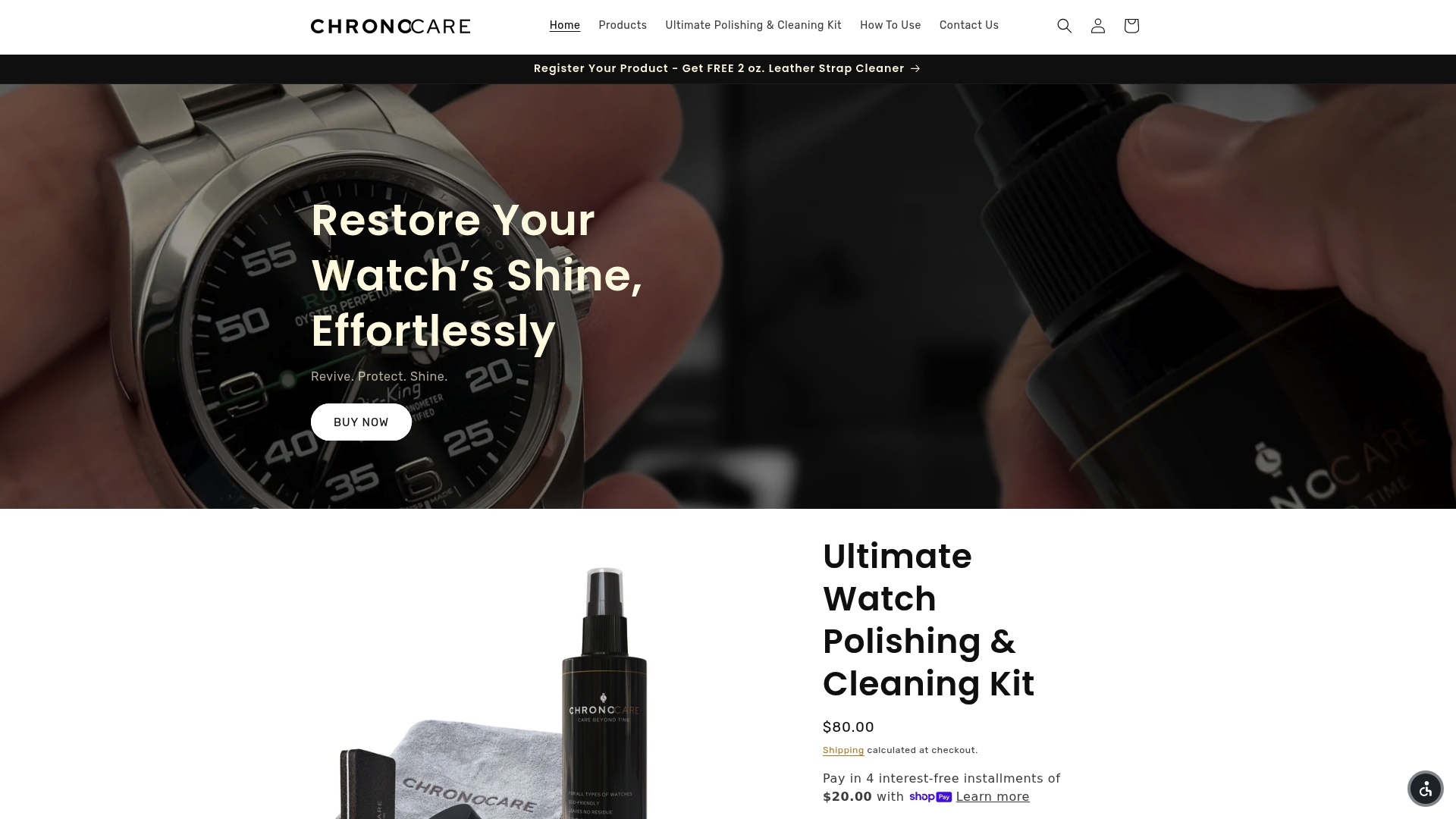
ChronoCare’s Ultimate Watch Cleaning Kit is formulated in the US to address the correct chemical stages of watch care: alkaline cleaning, rinsing, and surface protection. The kit is designed for material compatibility across metal cases, crystal surfaces, and straps, so you are not guessing whether a product is safe for your specific watch. For collectors who also want to restore the appearance of metal surfaces after cleaning, the Ultimate Watch Polishing & Cleaning Kit extends the routine to include light scratch removal and shine restoration. Both kits reflect the principle that effective watch care starts with the right chemistry, not just the right intention.
FAQ
What pH level should a professional watch degreaser have?
Professional watch degreasers should operate at pH 9.0–10.0 to effectively dissolve oxidized lubricants on brass and steel parts. Solutions above pH 10.5 degrade nitrile and EPDM seals within a few cleaning cycles.
Can I use a single cleaner for both degreasing and rinsing?
No. Cleaning and rinsing agents serve distinct chemical functions and cannot be combined into one step. Using a cleaner without a separate rinse leaves surfactant residue that prevents new lubricants from adhering correctly.
Is ultrasonic cleaning safe for all watch components?
Ultrasonic cleaning is safe only for fully disassembled metal parts at temperatures under 50°C. Cleaning an assembled watch ultrasonically risks damaging seals, crystals, and shock settings through cavitation and heat.
How often should a mechanical watch be professionally serviced?
Major manufacturers including Rolex, Omega, and Breitling recommend a service interval of 6–7 years. That interval assumes correct degreasing and relubrication at each service.
What happens if the rinse stage is skipped during watch cleaning?
Skipping the rinse leaves residual surfactant films on pivot surfaces and jewels. New lubricants cannot bond to contaminated surfaces, leading to sluggish performance, gummy buildup, and accelerated wear inside the movement.