

7 Signs Your Watch Needs Professional Cleaning
Most watch owners assume their timepiece is fine as long as it’s running. That logic is exactly how a $3,000 movement ends up needing a $1,200 repair. Knowing the signs your watch needs professional cleaning, what watchmakers call the indicators for a full service overhaul, can be the difference between a $300 cleaning and replacing an entirely corroded balance staff. The damage is almost always invisible until it isn’t. Here’s how to read the warning signals before your watch tells you the hard way.
Table of Contents
- Key takeaways
- 1. Signs your watch needs professional cleaning start with timekeeping drift
- 2. Your power reserve is shrinking without explanation
- 3. Strange sounds during winding or operation
- 4. Visible moisture or fog beneath the crystal
- 5. Debris, grime, or discoloration on the dial or inside the case
- 6. Stiffness or roughness in the crown, pushers, or bracelet
- 7. You can’t remember the last time it was professionally serviced
- What happens when you ignore the warning signs
- How to decide when it’s time to act
- My honest take on watch care after years in this space
- Keep your watch performing at its best with ChronoCare
- FAQ
Key takeaways
| Point | Details |
|---|---|
| Performance drops are red flags | Gaining or losing more than a few seconds daily signals dirt-affected movement efficiency. |
| Moisture inside is an emergency | Condensation under the crystal can cause rust within 48 hours and must be treated immediately. |
| Service every 3 to 5 years | Even a watch that runs fine needs professional cleaning on a fixed schedule to prevent hidden wear. |
| Sensory checks matter | Unusual sounds, gritty winding, or a stiff crown are early warnings you can detect at home. |
| DIY has hard limits | Ultrasonic cleaning on a movement-in case risks dislodging components; professional disassembly is required. |
1. Signs your watch needs professional cleaning start with timekeeping drift
Your watch is a precision instrument. If it starts gaining or losing time at a rate that exceeds the manufacturer’s stated tolerance, that is not normal aging. It’s a symptom. Common service indicators include time drift beyond spec, reduced power reserve, and gritty winding resistance. All of these point to a movement that has accumulated debris or whose lubricants have dried out.
For reference, a quality automatic movement should stay within plus or minus a few seconds per day. If your Rolex or Omega is suddenly running five minutes fast each week, dried oils and micro-debris are likely creating friction that throws off the balance wheel’s oscillation rate. That’s not a minor inconvenience. It’s mechanical wear happening in real time.
Pro Tip: Keep a simple log on your phone: check your watch against an atomic clock reference every morning for one week. A consistent pattern of gaining or losing time is more diagnostically useful than a single observation.
2. Your power reserve is shrinking without explanation
A fully wound automatic or manual-wind watch should hold its charge for the duration its movement was designed to achieve. If your watch is stopping well before that window, or if you’re winding it significantly more often than before, pay attention.
Dirt and degraded lubricants increase friction throughout the gear train. That friction consumes energy that should be driving the watch. The result is a movement that runs out of power faster than it should. Professional service involves full disassembly, ultrasonic cleaning, and re-lubrication with manufacturer-standard oils to restore that efficiency. There’s no home remedy for a starved gear train.
3. Strange sounds during winding or operation
A healthy mechanical watch has a satisfying, consistent feel when you wind it. The clicks are crisp. The resistance is smooth and even. When that experience changes, your ears and fingers are detecting a problem.
Watch for these specific auditory and tactile changes:
- Metallic rattling at rest or when the watch is moved, which may indicate a loose component inside the case
- Grinding sensation while winding, suggesting debris caught between the crown’s winding mechanism and the mainspring
- Irregular ticking or a skipping sound, which can mean the escapement is fouled with dried lubricant
- A soft but unfamiliar clunk when the watch is set down, pointing to something loose within the movement
Early detection of symptoms like metallic rattles or unusual resistance dramatically reduces the cost of restoration and preserves original components.
4. Visible moisture or fog beneath the crystal
This one is not subtle, but many owners misread it. If you see condensation on the inside of the crystal, a blurry fog layer, or actual moisture droplets forming under the glass, stop wearing the watch immediately. This is not a cleaning issue. It’s a seal failure.
Moisture inside the case can cause rust on the balance staff and hairspring within 48 hours. Those are among the most delicate and expensive components in the movement. Once rust sets in, a cleaning won’t fix it. You’re looking at part replacement.
Watch gaskets degrade naturally over a 3 to 5 year cycle, so even a watch with no visible damage has compromised water resistance if it hasn’t been serviced in that window. Treat any unserviced watch as if it cannot tolerate moisture exposure.
5. Debris, grime, or discoloration on the dial or inside the case
This is one of the most overlooked watch cleaning indicators. Open the caseback if you’re able, or examine the dial under magnification. What you’re looking for goes beyond surface dust.
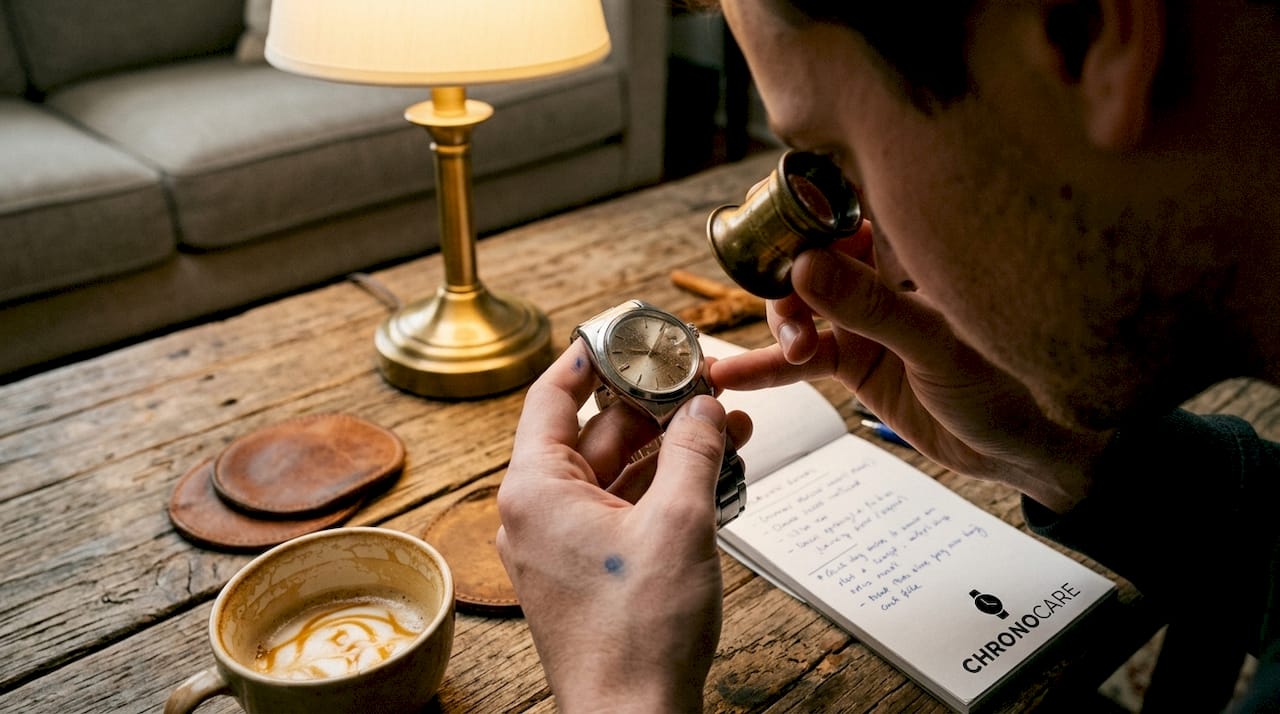
Physical signs requiring service include debris on the dial such as metal shavings or paint flakes, visible dirt trapped in bracelet links, and discoloration that didn’t come from normal patina aging. Metal shavings are particularly alarming because they indicate internal wear between components. That debris then circulates through the movement and accelerates further damage, functioning exactly like sandpaper against microscopic metal surfaces.
A solid watch care routine can address surface grime on the case exterior. But anything visible inside the case or beneath the crystal requires professional disassembly to address safely.
6. Stiffness or roughness in the crown, pushers, or bracelet
The crown is your primary interface with the watch’s movement. Any change in how it feels to pull out, turn, or push back in is a diagnostic signal worth heeding.
Stiffness in the crown often points to dried lubricant in the crown seals or debris in the stem channel. Roughness or a scraping sensation while setting the time suggests grit has entered the crown assembly. For watches with pushers, such as chronographs, any new resistance or sponginess in the pusher action warrants attention.
Bracelet links that have become stiff or that accumulate visible buildup in their hinges are also watch maintenance signs you shouldn’t ignore. Dirt and oxidation in link joints can eventually crack the pin system, which turns a cleaning job into a bracelet repair.
Pro Tip: If you notice crown stiffness or any of the sensory symptoms above, stop winding and setting the watch manually until it’s been examined. Continuing to operate a movement that’s signaling distress accelerates component damage significantly.
7. You can’t remember the last time it was professionally serviced
Here is the most common symptom of all, and the most dangerous one: you have no idea when your watch was last cleaned. Most mechanical watches require professional service every 3 to 5 years to maintain performance and prevent accelerated wear. That interval holds even when the watch appears to be running perfectly.
Many owners delay service precisely because the watch seems fine. But hidden damage from dirt is accumulating the entire time. Lubricants don’t just dry out on a fixed schedule; they attract particulates that grind against pivots and jewels with every tick. By the time a watch starts exhibiting obvious symptoms, the internal wear has usually been building for years.
If your watch hasn’t been serviced in 5 or more years, that absence of service is itself a sign. Schedule a cleaning before the symptoms force your hand.
What happens when you ignore the warning signs
The stakes of delayed cleaning are worth spelling out directly.
| Action taken | Likely outcome |
|---|---|
| Service at first sign of drift | Movement cleaned, re-lubricated, regulated. Cost: $200 to $400. |
| Wait until watch stops running | Pivot wear, possible jewel damage. Cost: $400 to $800 with parts. |
| Ignore moisture ingress | Rust on hairspring or balance staff. Cost: $800 to $1,500 or beyond. |
| No service for 10+ years | Potential total movement failure, original parts unavailable. |
“Catching signs early like metallic rattles or dust inside the case reduces costly restorations and preserves original components.” — Atoz Watch Repair, 2026
DIY ultrasonic cleaning with the movement still in the case risks dislodging components and causing direct damage. Professional watchmakers work in clean-room environments with manufacturer-standard lubricants and full disassembly protocols. There is no shortcut that delivers equivalent results.
How to decide when it’s time to act
When symptoms appear, the decision framework is straightforward. Any single sign from the list above justifies a professional evaluation. Multiple signs together mean you should stop wearing the watch and call a watchmaker today.
For timing professional cleanings on a schedule rather than waiting for symptoms:
- Record your watch’s service history from purchase documentation or ask a jeweler to examine the movement condition
- Set a calendar reminder for every 3 years if you wear the watch daily, every 4 to 5 years for occasional wear
- Document symptoms with photos and short audio recordings before your appointment. This leads to 25% faster assessments by watchmakers who can diagnose issues before disassembly
- Look for watchmakers who provide written condition reports and use manufacturer-approved service standards
- Between professional services, use quality home maintenance products on the case exterior to reduce surface debris and protect the finish
Knowing how premium watch care products extend a luxury watch’s life between professional services is part of proactive ownership.
My honest take on watch care after years in this space
By Raymond Jenkins
I’ve watched collectors lose four-figure movements because they trusted appearances over evidence. A watch that runs is not necessarily a watch that’s healthy. That distinction took me years to fully internalize, and I see new collectors make the same mistake constantly.
In my experience, the watches that end up needing the most expensive repairs are almost never the ones that broke suddenly. They’re the ones whose owners ignored a slightly gritty crown feel for two years, or didn’t think the occasional condensation fog was urgent. Those subtle symptoms are not quirks. They are early communication from a precision system under stress.
My honest recommendation is to stop thinking of professional cleaning as a repair you do when something goes wrong. Think of it the way you think of an oil change. You don’t wait for the engine to seize. You stay ahead of the failure curve because the cost difference between preventive care and reactive repair is enormous.
Combine that scheduled service mindset with consistent at-home maintenance on the case and bracelet, and most quality watches will outlast their owners without losing a step. That’s not optimism. That’s what the data on watch service frequency and component wear actually shows.
— Raymond Jenkins
Keep your watch performing at its best with ChronoCare
Between professional service appointments, your watch still needs care. Skin oils, dust, and environmental residue accumulate on the case, crystal, and bracelet every single day. The right home maintenance routine extends the time between professional cleanings and protects the finish you’ve invested in.

ChronoCare’s Ultimate Watch Cleaning Kit gives you professional-grade products formulated specifically for luxury timepieces, including cleaning spray, polishing cream, and applicators designed for delicate surfaces. For collectors who want a complete solution, the polishing and cleaning kit handles everything from light scratch removal to full case restoration. Both are formulated in the US and built for the kind of collector who takes their watches seriously.
FAQ
How often should a watch be professionally cleaned?
Most mechanical watches should receive a full professional service, including cleaning and re-lubrication, every 3 to 5 years. Daily wear and exposure to moisture or humidity can justify the shorter end of that interval.
What does professional watch cleaning actually involve?
A professional service includes full movement disassembly, ultrasonic cleaning with specialized solutions, replacement of worn gaskets, re-lubrication with manufacturer-grade oils, and precision regulation to restore factory timing accuracy.
Can I clean the inside of my watch at home?
No. DIY ultrasonic cleaning with the movement inside the case risks dislodging components and causing damage. Home cleaning is appropriate for the case exterior and bracelet only.
What should I do if I see moisture inside the crystal?
Stop wearing the watch immediately and take it to a watchmaker as soon as possible. Moisture inside the case can cause rust on the hairspring and balance staff within 48 hours, leading to catastrophic movement damage.
Is timekeeping drift always a sign of dirt?
Not always, but it’s the most common cause in a watch with a service gap of more than three years. Drift can also result from magnetization or physical shock, but any consistent deviation beyond manufacturer spec warrants a professional inspection to rule out movement wear.