

What Does a Watch Care Routine Involve?
Most watch owners know their timepiece deserves attention, yet very few actually know what a proper watch care routine involves beyond a quick wipe now and then. The good news: effective care is not about spending hours each weekend polishing every surface. It comes down to consistent daily habits, smart storage, material-specific cleaning, and knowing when to hand things off to a professional. This guide breaks down each layer so you can protect your watch’s function, appearance, and long-term value without overcomplicating it.
Table of Contents
- Key takeaways
- What a daily watch care routine involves
- Periodic and weekly cleaning best practices
- Material-specific care for cases and straps
- Professional servicing: schedules and what to expect
- Common mistakes that undo your efforts
- My honest take on watch care
- Build your routine with the right tools
- FAQ
Key takeaways
| Point | Details |
|---|---|
| Daily wiping prevents damage | A quick microfiber wipe each day removes oils and sweat that corrode metal and degrade seals over time. |
| Crown security is non-negotiable | Always secure the crown before any water exposure to protect the movement from moisture ingress. |
| Material determines cleaning method | Leather, metal, and rubber straps each require distinct cleaning products and techniques to avoid damage. |
| Professional service has a schedule | Plan for a maintenance check every 2 to 3 years and a full service every 4 to 6 years. |
| Mistakes matter more than effort | Most watch damage comes from common errors like harsh chemicals, improper storage, or ignoring early warning signs. |
What a daily watch care routine involves
The foundation of any effective care routine is what you do every single day. Not cleaning, exactly. More like protecting.
The most impactful daily habit is also the fastest. A 10-second microfiber wipe removes the oils, sweat, and fine dust particles that accumulate on your case and bracelet throughout the day. Left unchecked, these residues accelerate corrosion on metal parts and degrade the rubber seals that keep moisture out of your movement. A soft, lint-free microfiber cloth is all you need. Keep one on your nightstand or next to where you store your watch.
Beyond the wipe, check your crown every time you take the watch off. The crown is the most mechanically vulnerable point on most watches. Unscrewed crowns expose open channels that lead directly into the movement. Even a splash from a sink can cause damage if the crown is not fully secured. Screw it down or push it in to the home position before setting the watch down for the night.
Storage matters more than most people think. You want a cool, dry spot away from direct sunlight and anything that generates a magnetic field. That means avoiding windowsills, bathroom counters, and the top of your speaker. Sunlight and humidity cause UV degradation on dials and crystals and promote internal condensation. A watch box or a soft pouch kept in a drawer is the right call.
Pro Tip: Place a small silica gel packet inside your watch box. It absorbs ambient moisture and significantly slows seal degradation, especially if you live in a humid climate.
Periodic and weekly cleaning best practices
Daily habits cover the basics, but a deeper clean once a week or after specific activities gives you a much more complete care routine. The key word here is “gentle.”
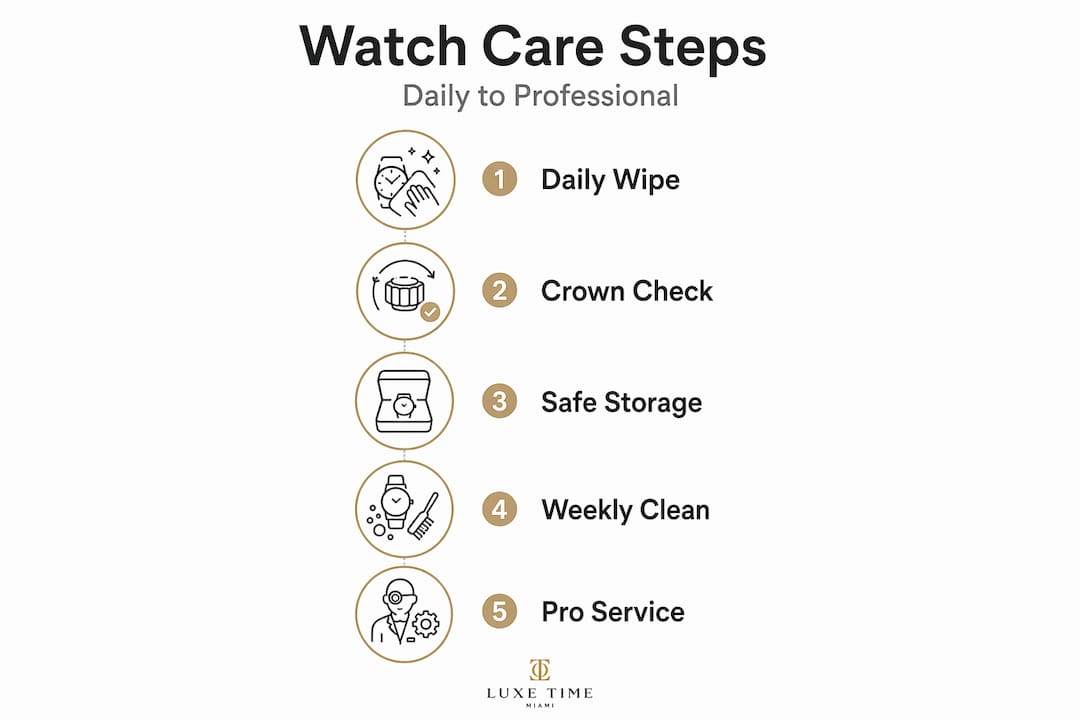
For metal bracelets, weekly cleaning with lukewarm soapy water and a soft-bristle brush keeps grime from packing into the links. Follow up with a thorough rinse and a dry microfiber wipe. Never let water sit in the links or around the clasp. If you swam in the ocean or a pool, rinse your watch under a thin stream of tap water and pat it dry immediately. Salt and chlorine both attack rubber seals with surprising speed.
Here is a simple weekly cleaning process that works for most metal-cased watches:
- Remove the bracelet if possible, or work carefully around the clasp and links.
- Dampen a soft brush (a clean toothbrush works) with a mild soap solution.
- Gently scrub the bracelet, case sides, and lugs.
- Rinse under lukewarm running water. Never hot.
- Dry thoroughly with a microfiber cloth, getting into the link gaps.
- Let the watch air dry in a ventilated area for a few minutes before storing.
Pro Tip: Avoid cleaning the crystal or dial with soap and water directly. A slightly damp microfiber cloth is all you need for the face. Excess moisture near the bezel gasket is unnecessary risk.
The table below shows how to adjust your cleaning approach based on environment and strap type.
| Situation | Cleaning frequency | Approach |
|---|---|---|
| Daily office wear, minimal sweat | Weekly | Microfiber wipe daily, full bracelet clean weekly |
| Active use, gym or outdoor wear | 2 to 3 times per week | More frequent rinses, dry after each use |
| Salt water exposure | Immediately after | Tap water rinse, thorough air dry |
| Leather strap, dry climate | Every 2 weeks | Specialized leather strap care, no water |
Material-specific care for cases and straps
One of the most common watch care mistakes is treating every watch the same way. What works for a stainless steel bracelet can ruin a leather strap in a single cleaning session.

Leather straps are the most delicate. Water and chemicals degrade leather by stripping its natural oils, which leads to cracking and discoloration over time. Clean leather with a dry or barely damp cloth and a product specifically designed for leather. Keep leather straps away from sweat-heavy activities entirely if you want them to last.
For metal bracelets and cases, the main risks are harsh chemicals and scratches. Here is what to keep in mind:
- Use only mild soap (dish soap diluted in water works well) and a soft-bristle brush.
- Avoid bleach, ammonia, and alcohol-based household cleaners. Harsh solvents damage seals and can strip surface coatings.
- Dry completely before putting the watch on or storing it.
- Polish lightly with a microfiber cloth in one direction to minimize micro-scratches.
Rubber and silicone straps are actually the most forgiving. Rinse them with fresh water, pat dry, and let them air out. Still avoid harsh chemicals, which can cause the material to swell or crack.
Sapphire crystals are scratch-resistant but not scratch-proof. Never use abrasive cloths or paper towels on the crystal. For visible smudges and fingerprints, a technique for removing fingerprints safely is always gentler than rubbing hard with whatever is handy.
Professional servicing: schedules and what to expect
No home cleaning routine replaces what a trained watchmaker can do. Professional servicing is where the real long-term protection happens.
Breitling recommends a maintenance service every 2 years and a complete service every 4 to 6 years. The maintenance check covers movement inspection, seal condition, water resistance testing, and surface cleaning. The full service goes deeper: complete disassembly, replacement of worn components, fresh lubrication of all moving parts, and reassembly to factory tolerances. OW Watch recommends servicing every 3 to 4 years by an authorized center to preserve warranty coverage and keep the movement running accurately.
Here is what a complete watch service typically involves:
- Disassembly of the movement, case, and bracelet
- Cleaning of all components in ultrasonic or specialty cleaning solutions
- Replacement of gaskets, seals, and worn mechanical parts
- Lubrication of all gear trains, jewels, and escapement components
- Regulation and timing calibration across multiple positions
- Water resistance pressure testing
- Cosmetic work including case polishing and crystal inspection
The signs that you need service before your scheduled interval include: losing or gaining more than 30 seconds per day, a stiff or gritty crown, condensation appearing under the crystal, or any unusual sounds from the movement.
| Service type | Interval | What it covers |
|---|---|---|
| Maintenance check | Every 2 to 3 years | Seals, water resistance, visual inspection |
| Complete overhaul | Every 4 to 6 years | Full disassembly, lubrication, parts replacement |
| Water resistance test | After any impact or exposure | Pressure testing, gasket inspection |
| Unscheduled visit | When warning signs appear | Diagnosis and targeted repair |
Water resistance is not permanent. Seals degrade with time and wear regardless of how carefully you clean the watch at home. Skipping the service interval is one of the fastest ways to turn a minor seal replacement into a full movement overhaul.
Common mistakes that undo your efforts
Even watch owners who follow a cleaning routine regularly make errors that quietly cause damage. Understanding these pitfalls is half the battle.
Never operate the crown while the watch is wet or submerged. The crown/case-back interface is where grime and moisture accumulate most readily, and it is also where the movement is most exposed to ingress if the crown is not seated correctly.
Other mistakes to cut from your routine immediately:
- Overwinding mechanical watches. Wind until you feel resistance, then stop. Forcing the crown past resistance stresses the mainspring.
- Winding while wearing. The angle puts lateral stress on the crown stem and can cause it to bend over time.
- Ignoring temperature extremes. The operational range for most watches is 0°C to 50°C. Moving quickly from a hot sauna to a cold pool is a thermal shock that can harm precision and crack crystals.
- Using generic cleaning products. Household sprays, kitchen degreasers, or anything with alcohol or bleach can damage coatings and seals. Always use products formulated for watches.
“Watch care is fundamentally risk management. Protecting the watch from shocks, magnets, temperature extremes, and chemical exposure matters more than intensive cleaning ever will.” — Louis Vuitton FAQ
Pro Tip: Avoid placing your watch near speakers, phone charging pads, and magnetic bag closures. Magnetic fields can magnetize the movement’s balance spring, causing dramatic timing errors that don’t look like magnetic interference until a watchmaker checks it.
My honest take on watch care
I’ve seen how most watch owners approach maintenance, and the pattern is consistent: do very little until something goes wrong, then panic about the cost. The irony is that the daily habits that actually preserve a watch take less than a minute total.
What I find most overlooked is environmental risk. People obsess over cleaning but leave their watches on bathroom shelves where humidity cycles daily, or set them next to charging cables generating magnetic fields. The cleaning routine matters less than eliminating those chronic, low-grade threats.
The other thing I’d push back on is the belief that professional servicing is optional unless the watch stops working. Seal renewal and internal lubrication are invisible to you at home, but they are what keep a 10-year-old movement running like it did on day one. Skip those services and you’re not saving money. You’re borrowing against a much bigger repair bill later.
The watch owners I respect most treat care as part of enjoying the watch, not a chore separate from it. A 10-second wipe, a secured crown, a proper storage spot. That’s most of it. The routine doesn’t need to be complicated to be effective. It just needs to be consistent.
— Eduardo
Build your routine with the right tools
Knowing what a watch care routine involves is only half the work. The other half is having products that are actually formulated for the job.
ChronoCare builds its kits specifically for watch enthusiasts who take their timepieces seriously. The Ultimate Watch Cleaning Kit includes professional-grade microfiber cloths and a cleaning solution designed to lift oils and residue without touching your seals or coatings. For owners focused on metal bracelet maintenance and surface restoration, the polishing and cleaning kit pairs a fine polishing cream with the brushes and cloths you need for a complete weekly session. Every ChronoCare product is formulated in the US and designed to match the care standards that luxury manufacturers actually recommend. If you’re building a routine, start with the right foundation.
FAQ
What does a watch care routine involve day to day?
A daily watch care routine involves wiping the watch with a soft microfiber cloth to remove oils and sweat, securing the crown, and storing the watch away from sunlight, humidity, and magnetic fields.
How often should you professionally service a watch?
Most manufacturers recommend a maintenance check every 2 to 3 years and a full service every 4 to 6 years, which includes seal replacement, lubrication, and movement calibration.
What cleaning products are safe for luxury watches?
Use only mild soap diluted in water or cleaning sprays formulated specifically for watches. Avoid household chemicals, alcohol, bleach, and solvents, which can damage seals, coatings, and straps.
How do you care for a leather watch strap?
Keep leather straps dry and away from chemicals and direct sunlight. Clean with a product designed for leather and avoid wearing leather-strap watches during activities that produce heavy sweat or water exposure.
What are the warning signs that a watch needs early servicing?
Losing or gaining more than 30 seconds per day, a stiff or gritty crown, condensation inside the crystal, and unusual sounds from the movement all indicate the watch needs professional attention before the standard service interval.