

The Role of Watch Boutique Cleaning Standards Explained
Most collectors assume that cleaning a luxury watch is straightforward. Rinse it, wipe it down, maybe use a soft cloth. The role of watch boutique cleaning standards challenges that assumption completely. What happens inside a professional boutique service is a different category of care entirely, one where disassembly, component-specific protocols, pressure testing, and material analysis determine whether a timepiece emerges better or worse than it arrived. For anyone serious about preserving the value and function of a high-end watch, understanding these standards is not optional.
Table of Contents
- Key takeaways
- The role of watch boutique cleaning standards in luxury care
- Why improper cleaning causes more harm than dirt
- Step-by-step workflows in reputable boutique services
- Choosing and working with boutiques for cleaning services
- My take on why boutique standards matter more than most realize
- Boutique-grade care you can use at home
- FAQ
Key takeaways
| Point | Details |
|---|---|
| Boutique cleaning is systematic | Professional boutiques follow structured, component-specific protocols that go far beyond surface wiping. |
| Seal replacement is non-negotiable | Gaskets are replaced during every service because ultrasonic vibrations degrade existing seals over time. |
| Material type dictates method | DLC finishes, precious metals, and special rotors each require different cleaning approaches to avoid irreversible damage. |
| Service guarantees signal quality | Boutiques offering multi-year service guarantees, like two-year coverage, reflect documented process control and accountability. |
| Home care complements but cannot replace professional service | Proper at-home maintenance extends intervals between boutique visits but cannot replicate pressure testing or movement-level cleaning. |
The role of watch boutique cleaning standards in luxury care
When a watch enters a reputable boutique for service, the cleaning process begins long before any solution touches the case. The watchmaker starts with a full assessment of the piece. Condition, material, water resistance rating, and known service history all factor into decisions made before a single component is removed.
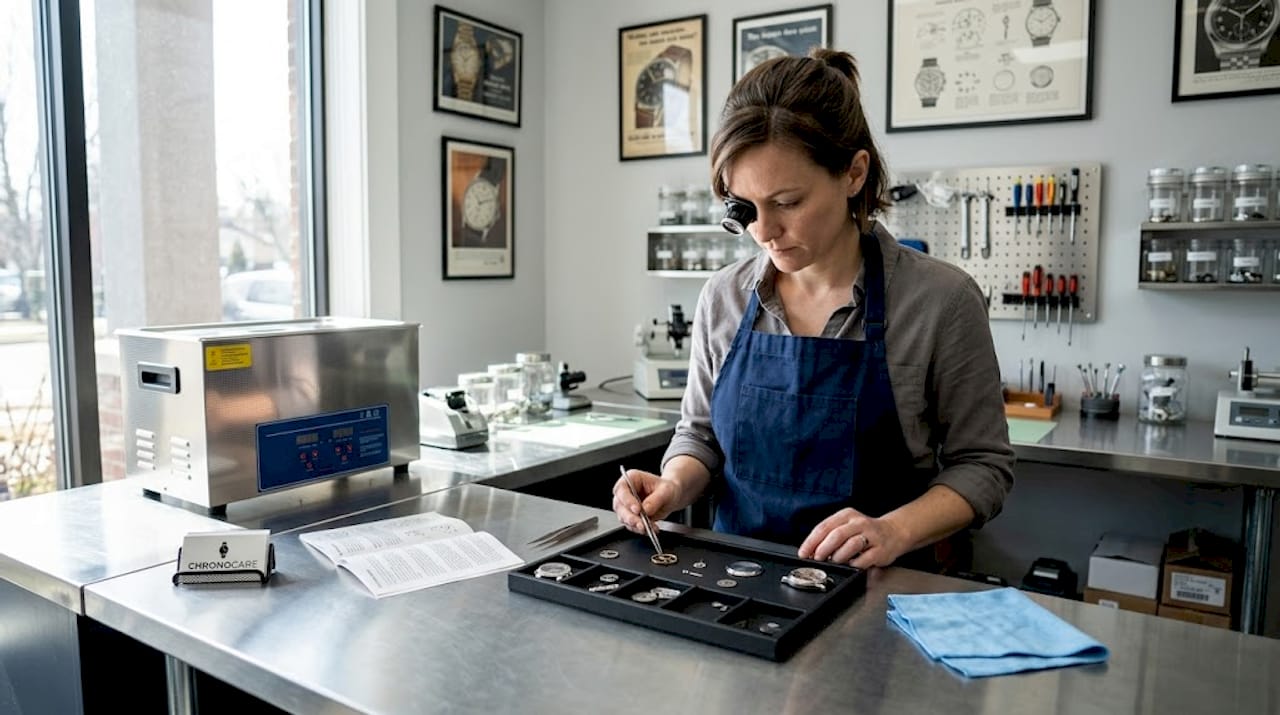
Boutique cleaning involves deliberate partial disassembly to expose dirty components while protecting delicate movement parts from ultrasonic damage. Components are cleaned in baskets separately, not as an assembled unit. This distinction matters enormously.
Here is what standardized boutique cleaning typically includes:
- Full disassembly of exterior components including the crown, pushers, bracelet, and in many cases the crystal, to allow thorough access to dirt-trapping areas.
- Component-specific ultrasonic cleaning where bracelets and case parts are placed in ultrasonic baths separately from the movement, which is never submerged while assembled.
- Gasket and seal replacement as a standard step, not an optional add-on. Gaskets are replaced during service because professional cleaning pairs cleaning with seal renewal rather than assuming original seals remain intact.
- Steam cleaning of bracelets at controlled pressure. Bremont boutiques, for example, steam clean bracelets at 8 bars of pressure, which removes debris from between links without damaging surface treatments.
- Hand cleaning of sensitive components. Limited edition rotors or parts with specialty coatings are never placed in an ultrasonic bath. Technicians clean these by hand with appropriate solutions.
- Pressure testing after reassembly to confirm water resistance is fully restored before the watch leaves the workshop.
Pro Tip: Ask your boutique whether they replace gaskets as a standard part of every cleaning service, not just full servicing. If they do not, water resistance is not guaranteed after cleaning, regardless of the original rating.
Bremont’s in-house service documentation also notes that cleaning and drying movement components takes approximately 45 minutes. That time investment alone separates professional boutique work from any quick commercial cleaning. It also explains why you should be skeptical of any boutique promising a thorough cleaning in under an hour.
Why improper cleaning causes more harm than dirt
The assumption that “any cleaning is better than none” is one of the more damaging beliefs in watch ownership. Poor cleaning technique can compromise a watch’s integrity in ways that are invisible immediately but catastrophic over time.
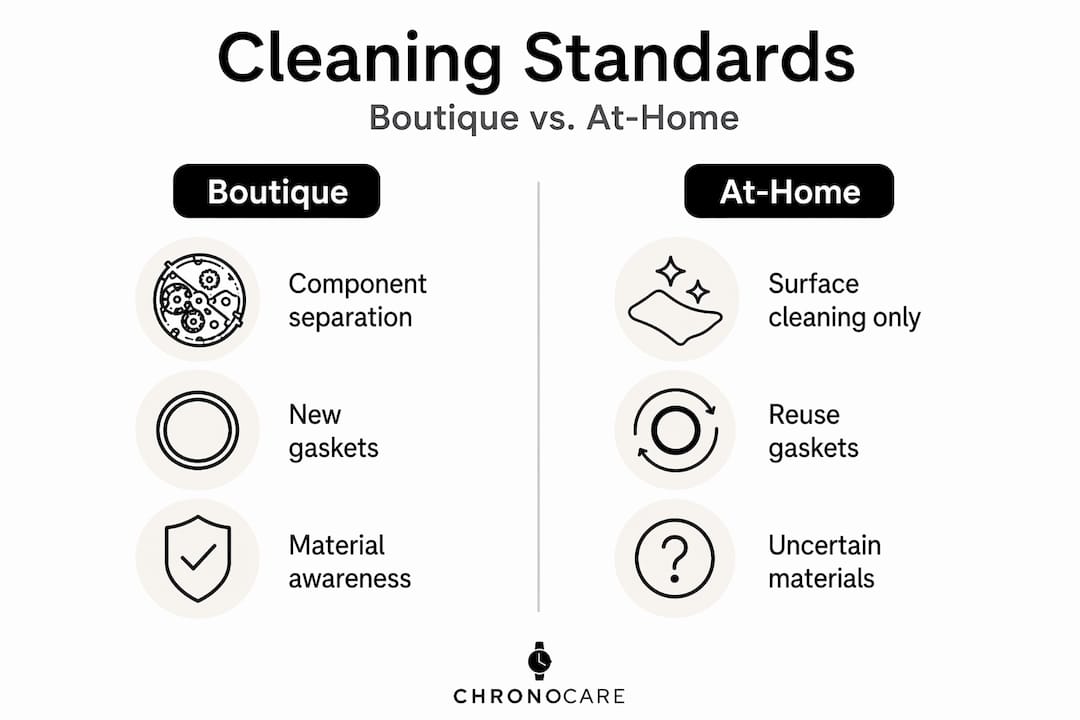
Here is a direct comparison between professional and at-home or improper cleaning approaches:
| Factor | Boutique standard | Improper or at-home cleaning |
|---|---|---|
| Ultrasonic cleaning | Applied only to separated components | Often applied to the whole assembled watch |
| Seal condition after cleaning | Gaskets replaced and pressure tested | Original seals may be weakened or untested |
| Crown handling | Crown removed or fully secured to prevent moisture entry | Often overlooked, creating moisture ingress risk |
| DLC and specialty finishes | Hand cleaned or replaced if necessary | Risk of abrasion or chemical damage |
| Documentation | Service logged with warranty implications | No record, no accountability |
Ultrasonic cleaning applied to an assembled watch can degrade seals and cause micro-leaks that are not immediately noticeable. The vibration frequency that makes ultrasonic cleaning so effective on metal and glass is the same force that weakens rubber and polymer gaskets when applied at the wrong stage of cleaning.
Crown management is another area where professional protocols make a real difference. Longines recommends rinsing with the crown pointing down and securing the crown before and after any water exposure. Small details like rinsing orientation critically reduce the risk of moisture ingress. Most at-home cleaning skips this entirely. For collectors who want to understand how to safely maintain their watches between boutique visits, removing fingerprints correctly is a good place to start.
Material sensitivity is the third area where boutique knowledge is irreplaceable. Bremont replaces top bezels with hardened steel or DLC finish rather than attempting to polish them, because polishing a DLC surface damages its integrity. That is not a precaution most collectors know to take.
Pro Tip: Never use compressed air to dry a watch after cleaning. It can force moisture into crown and pusher seals from the outside in, bypassing the crown entirely.
Step-by-step workflows in reputable boutique services
Understanding the full workflow of a boutique cleaning service helps collectors know what they are actually paying for and what questions to ask. The sequence below reflects documented practices from established boutiques.
-
Initial inspection and documentation. The watch is logged, its condition noted, and any existing damage photographed. This protects both the client and the boutique. Service history is also reviewed if available.
-
Disassembly of exterior components. The bracelet or strap, crown, and pushers are removed. Straps, particularly leather, are set aside for material-appropriate cleaning rather than immersion.
-
Component sorting and basket preparation. Case components, bracelet links, and small hardware are sorted into ultrasonic cleaning baskets. Movement components cleaned separately are placed in their own solutions.
-
Ultrasonic and steam cleaning. Bracelet links and case components go through the ultrasonic cycle. Bracelets receive steam cleaning at controlled pressure for final decontamination. Hand-cleaned components are processed separately at this stage.
-
Inspection under magnification. Every component is reviewed under magnification before reassembly. Scratches, worn finishes, and damaged components are flagged. This is where boutiques make decisions about replacing bezels or other parts rather than attempting restoration on unsuitable surfaces.
-
Gasket replacement and case reassembly. New gaskets are fitted before the case is sealed. For premium watch care products to work well at home, the watch first needs this professional foundation.
-
Pressure testing. Before the watch is returned, it undergoes pressure testing to confirm water resistance matches the manufacturer’s specification. This step is non-negotiable in any boutique following proper standards for watch cleaning.
-
Final quality control and documentation. The service record is updated. The customer receives documentation of work performed. Boutellier Montres backs its service with a two-year guarantee, which reflects what documented process control looks like in practice. Turnaround for this level of service runs four to six weeks.
Choosing and working with boutiques for cleaning services
Not every business calling itself a watch boutique follows the same standards. Knowing how to evaluate a boutique before handing over a significant timepiece is a skill that protects your investment.
When approaching a boutique for cleaning or servicing, ask these specific questions:
- Do you replace gaskets as a standard part of the cleaning process, or only during full service?
- Is pressure testing performed after every cleaning? What pressure specifications do you test to?
- Are all ultrasonic cleaning steps performed on disassembled components only?
- Do you have documented protocols for material-specific finishes like DLC, PVD, or precious metal plating?
- What is your service guarantee period and what does it cover?
Indicators that a boutique meets professional standards go beyond certifications. Look for detailed intake documentation, clear turnaround timelines, and willingness to explain procedures without hesitation. A boutique that cannot articulate its cleaning guidelines for watches by material type is not operating at the level your watch deserves.
Between boutique visits, you can extend intervals significantly with proper at-home care. Wiping case and bracelet surfaces after wear, cleaning leather straps with appropriate products, and avoiding abrasive materials all reduce the burden on your next professional service. The goal is not to replace boutique work but to arrive at each service with a watch in better condition than you would otherwise.
My take on why boutique standards matter more than most realize
I have seen what happens when collectors cut corners on cleaning, and the pattern is always the same. The watch looks fine for a year or two. Then a repair surfaces that traces back to a compromised seal or a finish that was polished when it should not have been. The cost of fixing that damage consistently exceeds what a proper boutique service would have cost in the first place.
What surprises me most is how many experienced enthusiasts still underestimate the role of watch boutique cleaning standards in preserving mechanical health rather than just appearance. Cleaning is not cosmetic maintenance. It is preventive maintenance for the movement, the seals, and the case integrity. Treating it as the former leads to exactly the kind of deferred damage I described.
The detail that changed how I think about this was learning that service guarantees and documented timelines are not just customer service gestures. They are accountability mechanisms that only exist when a boutique has standardized its process well enough to stand behind the outcome. A boutique offering a two-year service guarantee is telling you they are confident in their cleaning and reassembly work. That confidence does not come from ad-hoc procedures.
My advice: treat boutique cleaning as you would a medical checkup for your timepiece. Establish a relationship with one boutique that meets your standards, document everything, and do not shop for price on a watch worth protecting.
— Eduardo
Boutique-grade care you can use at home
Professional boutique service sets the gold standard, but what happens between appointments determines whether your watch arrives in good condition or needing extra work. ChronoCare’s lineup of professionally formulated cleaning and restoration products gives collectors the tools to maintain that standard at home. The Ultimate Watch Cleaning Kit is built specifically for luxury timepiece maintenance, covering case surfaces, bracelet links, and exterior components without risking delicate finishes. For collectors who work across metal and leather, the Ultimate Watch Polishing & Cleaning Kit adds a polishing component formulated to work safely on metal surfaces. Every ChronoCare product is developed with the same material sensitivity principles that professional boutiques apply.
Explore the full ChronoCare product range and keep your timepieces performing at their best between every boutique visit.
FAQ
What does a luxury watch boutique cleaning service include?
A full boutique cleaning service typically includes disassembly of exterior components, ultrasonic cleaning of separated parts, steam cleaning of bracelets, gasket replacement, and pressure testing. Bremont’s documented service process confirms movement component cleaning alone takes around 45 minutes.
Is ultrasonic cleaning safe for luxury watches?
Ultrasonic cleaning is safe only when applied to disassembled components, never the assembled watch. Applied incorrectly to an assembled watch, it can degrade seals and create micro-leaks that compromise water resistance over time.
How long does professional watch cleaning take?
Thorough boutique cleaning and servicing typically takes four to six weeks from drop-off to return. Boutellier Montres’s service timeline confirms this range, noting that parts availability can also affect turnaround time.
Why are gaskets replaced during every professional cleaning?
Gaskets are replaced because the ultrasonic cleaning process itself can weaken existing seals through vibration, even when components are cleaned in baskets. Replacing them restores water resistance to the manufacturer’s specification.
Can I clean a luxury watch at home safely?
Yes, but with strict limitations. Longines recommends using lukewarm water with a single drop of neutral soap, rinsing with the crown pointing down, and using a microfiber cloth to dry. Home cleaning should maintain surface condition between professional services, not replace them.