

Watch Case Metal Types: How to Pick the Right Material
For most buyers, 316L stainless steel is the best all-round watch case metal because it balances scratch resistance, weight, corrosion resistance, and repair cost better than almost anything else on the market. Titanium wins if you want a lighter watch or have sensitive skin. Ceramic wins if scratch-free looks matter more than brittleness under sharp impact. Gold and platinum belong to the dress-watch and heirloom crowd. Bronze suits anyone who likes a case that changes with them.
- Stainless steel (316L, 904L): the default choice, easy to service, moderate cost
- Titanium (Grade 2, Grade 5): lighter, hypoallergenic, harder to spot-polish
- Gold (18k), platinum: soft, heavy, prestige materials that show wear differently
- Ceramic, sapphire: nearly scratch-proof, but brittle under a hard knock
- Bronze, carbon, aluminum, tantalum, resin: niche picks for patina, weight, rarity, or budget
Key Takeaways
316L stainless steel remains the most broadly suitable watch case metal, while titanium, ceramic, gold, and bronze each solve a specific priority steel can’t match.
| Point | Details |
|---|---|
| Steel is the default | 316L balances cost, durability, and easy refinishing better than most alternatives. |
| Titanium wins on weight | It’s roughly 30 to 45% lighter than steel and better for sensitive skin. |
| Ceramic trades toughness for hardness | It resists scratches at roughly 1,200 to 1,400 Vickers but cracks under sharp impact. |
| Patina is a feature, not damage | Bronze cases are meant to darken and develop character over years of wear. |
| Water resistance isn’t about metal | Gaskets, crown design, and caseback sealing decide it, not the case material. |
Where to Read More on Watch Case Materials
- WatchPolice’s material ranking compares steel, titanium, ceramic, and bronze in depth.
- Fratello Watches’ materials primer covers hardness data from aluminum to zirconium dioxide.
- Time+Tide’s watch education guide explains gold alloys and titanium grades.
- Patek Philippe’s manufacturing notes detail case stamping and finishing at the high end.
Table of Contents
- What Is Watch Case Metal Type, and Why Does It Matter?
- How Do the Main Case Materials Compare?
- What Are the Pros and Cons of Each Case Material?
- What Properties Actually Determine How a Case Performs?
- How Should You Choose a Case Metal for Your Needs?
- How Should You Clean and Maintain Different Case Metals?
- Care for Your Watch the Right Way
- Frequently Asked Questions
- Sources
What Is Watch Case Metal Type, and Why Does It Matter?
Watch case metal type refers to the specific alloy or material a watch’s outer shell is machined from, and it decides almost everything about how that watch feels, ages, and holds up. Two watches can look identical in a photo and behave completely differently on your wrist depending on whether the case is 316L steel, Grade 5 titanium, or zirconia ceramic.
The industry sometimes calls this the “case material” or “case alloy,” and you’ll see both terms used interchangeably by watchmakers and retailers. What actually varies from one metal to the next comes down to a handful of measurable properties: hardness, density, corrosion resistance, and how easily a metal accepts a repair polish. Major watch-industry guides consistently point to 316L stainless steel as the backbone of modern watchmaking, precisely because it balances all four of those traits instead of maxing out just one.
How Do the Main Case Materials Compare?
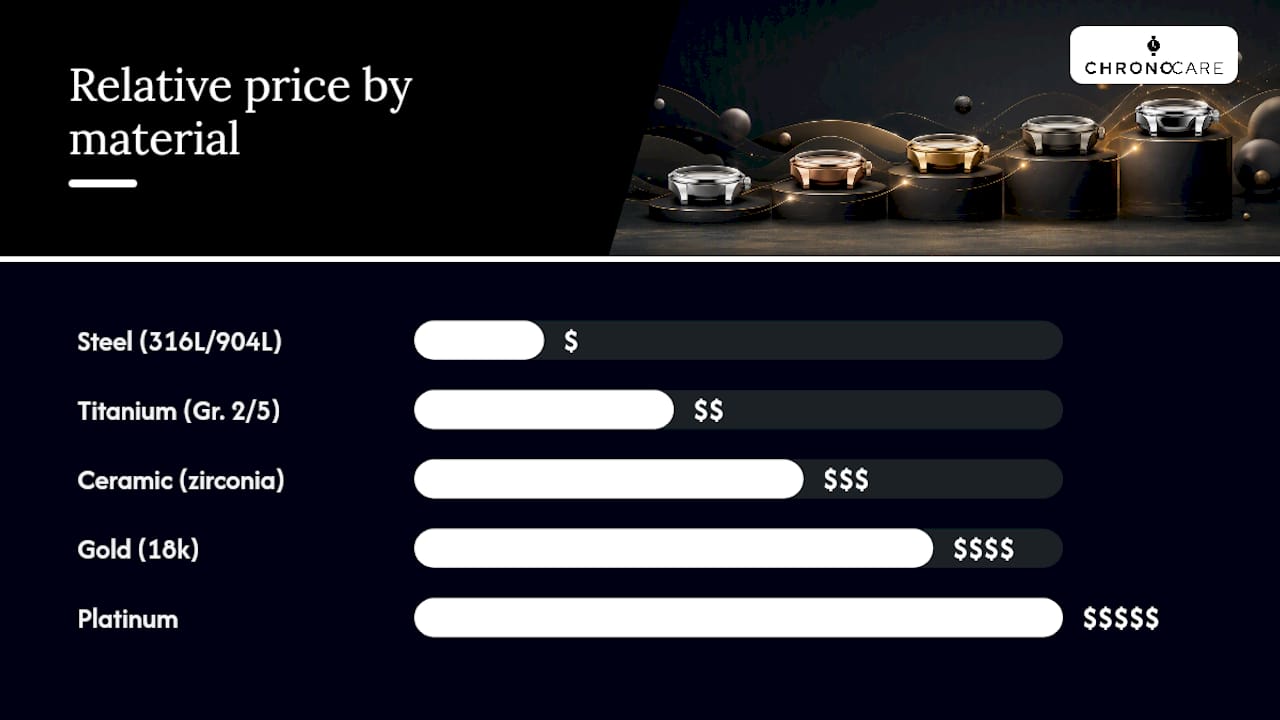
| Material | Best for | Durability/scratch resistance | Weight (density) | Corrosion resistance/hypoallergenic | Relative price | Appearance/finish | Maintenance |
|---|---|---|---|---|---|---|---|
| Steel (316L/904L) | Daily wear, divers | Moderate, dents before cracking | Medium/heavy | Good; nickel-sensitive skin can react | $ | Polished, brushed, PVD options | Easy, refinishable |
| Titanium (Gr. 2/5) | Travel, sensitive skin | Moderate, scratches show on oxide layer | Light (30 to 45% less than steel) | Excellent, biocompatible | $$ | Matte, brushed | Full re-brushing, not spot repair |
| Ceramic (zirconia) | Scratch-free daily look | Very high hardness, brittle on impact | Medium | Excellent, inert | $$$ | Glossy or matte, limited colors | Not polishable, replace only |
| Gold (18k) | Dress, heirloom | Soft, dents and scratches easily | Heavy | Good, alloy-dependent skin reaction | $$$$ | Yellow, rose, white | Sparing polish, loses metal each time |
| Platinum | Statement, investment | Soft but dense, resists tarnish | Very heavy | Excellent | $$$$$ | Satin white, rarely fades | Sparing polish |
| Bronze | Character, patina fans | Moderate, patina protects surface | Medium | Good once patina forms | $$ | Warm tones that darken over years | Patina management, not polishing |
| Carbon/forged carbon | Sport, lightweight | Good, layered structure resists cracking | Very light | Excellent | $$$ | Marbled, matte | Low, mostly cosmetic |
| Aluminum (7075) | Budget sport watches | Low, scratches and dents easily | Very light | Fair, anodized coating helps | $ | Anodized colors | Coating wears, hard to restore |
| Tantalum | Rare, collector pieces | High, dense and tough | Very heavy | Excellent | $$$$$ | Dark gray, hard to machine | Specialist service only |
| Sapphire (synthetic) | Showpiece transparency | Extremely high hardness, shatters on impact | Medium | Excellent | $$$$$ | Crystal clear or tinted | Replace only, no repair |
| Resin/recycled plastic | Sustainability, sport | Low to moderate, flexes rather than shatters | Very light | Excellent | $ | Matte, colored | Easy, low cost |
If you had to pick one line to remember: steel wins on serviceability, titanium wins on comfort, and zirconia ceramic scores roughly 1,200 to 1,400 Vickers on hardness, which is why it shrugs off scratches that would mark up steel in a week.
What Are the Pros and Cons of Each Case Material?
Stainless steel: 316L and 904L
Surgical-grade 316L is an alloy of iron, chromium, nickel, and molybdenum, and it’s what you’ll find in the overwhelming majority of watches sold today. Rolex and a few others use 904L, which adds more chromium and molybdenum for slightly better corrosion resistance, though the practical difference is smaller than marketing copy suggests.
- Pros: affordable to machine, holds a polish well, widely serviceable, moderate weight
- Cons: will scratch with daily wear, contains nickel that can irritate sensitive skin, not the lightest option
Density sits around 8 grams per cubic centimeter, heavy enough to feel substantial without being fatiguing. Stainless steel remains the most serviceable case material because almost any competent watchmaker can buff out scuffs, which keeps long-term ownership costs low compared to materials that can’t be spot-repaired.
Titanium: Grade 2 and Grade 5
Commercially pure Grade 2 titanium is softer and easier to machine; Grade 5 (Ti-6Al-4V) adds aluminum and vanadium for meaningfully more strength. Both trade some hardness for a dramatic weight advantage.
- Pros: roughly 30 to 45% lighter than steel, highly corrosion-resistant, biocompatible for sensitive wrists
- Cons: the oxide layer shows fine scratches more readily than steel, matte finishes are harder to spot-polish, generally costs more to produce
That last point matters more than most buyers realize. Because titanium’s oxide layer makes small scratches more visible, refinishing usually means re-brushing the whole surface rather than touching up one scuff, which changes how you budget for upkeep over the years.
Gold: yellow, rose, and white
Pure 24k gold is far too soft for a case, so watchmakers alloy it down. 18k gold (75% pure) mixed with copper produces rose or red tones, while nickel or palladium additions create white gold.
- Pros: unmatched prestige, ages beautifully with proper care, holds value in the right references
- Cons: soft enough to dent from a light knock, heavy on the wrist, refinishing removes actual gold each time
That last con is the one collectors underestimate. Every polish strips a microscopic layer of metal, so a case polished aggressively over 20 years can visibly soften its edges and lightly reduce its weight.
Platinum
Platinum’s density (around 21 grams per cubic centimeter) makes it noticeably heavier than gold at the same volume, and its scratch pattern differs too: instead of losing metal, platinum tends to displace it, which is why scuffed platinum often looks “brushed” rather than gouged.
- Pros: exceptional tarnish resistance, dense reassuring heft, rarity that holds long-term value
- Cons: among the most expensive case options, heavy enough to bother smaller wrists, soft despite its density
Ceramic: zirconium dioxide
High-tech ceramic cases are sintered from zirconia powder under extreme heat and pressure, and the resulting hardness is dramatically higher than any metal on this list.
- Pros: near-immunity to everyday scratches, stays glossy for decades, hypoallergenic
- Cons: brittle under sharp impact, cannot be polished back to new, replacement (not repair) is usually the only fix
The trade-off here is genuinely binary. Hardness and toughness aren’t the same property, and ceramic’s resistance to surface scratching comes paired with a real risk of cracking if it takes a hard edge-on hit against concrete or tile.
Bronze and aluminum-bronze
Bronze cases oxidize on purpose. The alloy develops a brown-green patina as it reacts with air, moisture, and skin oils, and that patina becomes part of the watch’s identity rather than a flaw to fix.
- Pros: develops a one-of-a-kind look over time, the patina layer helps protect the metal beneath, warm tones many find more interesting than steel
- Cons: patina is uneven and can’t be fully controlled, some owners dislike the darkening they can’t undo, skin oils and sweat accelerate the change
Carbon and carbon composites
Forged carbon and carbon fiber cases are built from layered composite fibers rather than a single alloy, which makes them extremely light and resistant to cracking under flex, though not necessarily under a sharp point impact.
- Pros: among the lightest case options available, distinctive marbled finish, resists corrosion completely
- Cons: limited color and finish options, can be costly to manufacture, repair options are narrow if the structure is compromised
Aluminum, including 7075 aerospace grade
Standard aluminum is too soft for reliable watch cases, but 7075 aluminum alloy (used in aerospace parts) is strong enough for lightweight sport watches, usually paired with an anodized coating for color and surface protection.
- Pros: extremely light, inexpensive to produce, wide color range through anodizing
- Cons: the anodized layer wears through with heavy use, dents more easily than steel, harder to restore once the coating fails
Tantalum and other rare metals
Tantalum is dense, tough, and notoriously difficult to machine, which is exactly why you rarely see it outside limited-run collector pieces.
- Pros: distinctive dark gray tone that resists corrosion almost completely, genuine rarity, dense reassuring feel
- Cons: among the most expensive metals to work with, requires specialist tooling, very limited availability
Sapphire cases
Synthetic sapphire (grown, not mined) offers hardness close to diamond, which is why some brands use it for full transparent cases rather than just crystal covers.
- Pros: essentially scratch-proof, striking transparent aesthetics, chemically inert
- Cons: shatters rather than dents under real impact, extremely costly to produce, no repair option beyond replacement
Resin, plastic, and recycled composites
Modern resin cases have moved well past the cheap-plastic reputation they once had. Some brands now build cases and straps from recycled plastics, including reclaimed fishing nets, as part of a broader sustainability push.
- Pros: shock-absorbent rather than brittle, lowest cost by far, growing sustainability credentials
- Cons: long-term durability varies widely between brands, feels less premium to most collectors, colors can fade with UV exposure
What Properties Actually Determine How a Case Performs?
Five properties do almost all the work in separating one case metal from another.
Hardness measures scratch resistance on the Vickers scale. Sapphire and zirconia ceramic sit far above steel, gold, or platinum. Density determines weight: titanium and aluminum sit at the light end, platinum and tantalum at the heavy end. Corrosion resistance decides how a case handles sweat, saltwater, and daily grime, with titanium and ceramic both excelling. Hypoallergenic potential matters if nickel in steel or certain gold alloys irritates your skin. Machinability decides repair cost and speed. Softer, well-understood alloys like 316L steel are cheap to refinish; harder or rarer materials like tantalum and ceramic are slow or impossible to service the same way.
| Property | Highest | Lowest |
|---|---|---|
| Hardness (scratch resistance) | Sapphire, ceramic | Gold, platinum |
| Density (weight) | Platinum, tantalum | Aluminum, carbon, resin |
| Corrosion resistance | Titanium, ceramic | Untreated aluminum |
| Hypoallergenic potential | Titanium, ceramic | Nickel-alloyed steel and gold |
| Machinability/repairability | 316L steel | Ceramic, sapphire, tantalum |
Hardness helps a finish stay crisp for years, density affects how a watch sits on your wrist over a 10-hour day, and corrosion resistance decides whether sweat or saltwater will leave marks you can’t buff out.
How Should You Choose a Case Metal for Your Needs?
Start by ranking what matters most to you, because no single material wins on every front.
- If scratch-free looks matter most, ceramic or sapphire wins, but accept the brittleness trade-off
- If low weight matters most, titanium or carbon composite is the answer
- If skin sensitivity is a concern, titanium or ceramic avoid the nickel issue found in some steel and gold alloys
- If patina and character appeal to you, bronze rewards patience
- If long-term investment value matters, gold and platinum hold their place, assuming you accept the softness trade-off
- If budget is the deciding factor, steel or resin covers most needs without compromise
Match the material to your actual life, not your Instagram feed. A daily-beater diver in steel or titanium survives gym bags and beach trips; a dress watch in gold or platinum belongs in a drawer between office days.
Watch for vague marketing language like “surgical steel” with no alloy number attached, or a coating description that never names the actual process. Terms like DLC, PVD, or case-hardening treatments such as Tegiment mean very different things for durability and serviceability, and a brand that won’t specify which one it uses is hiding something.
Pro Tip: Always ask for the exact alloy grade (316L vs 904L, Grade 2 vs Grade 5) and check the full on-wrist weight, not just the case spec sheet. Bracelets and crowns add real heft that the case material alone won’t tell you.
How Should You Clean and Maintain Different Case Metals?
Care routines differ sharply by material, and using the wrong method can do real damage.
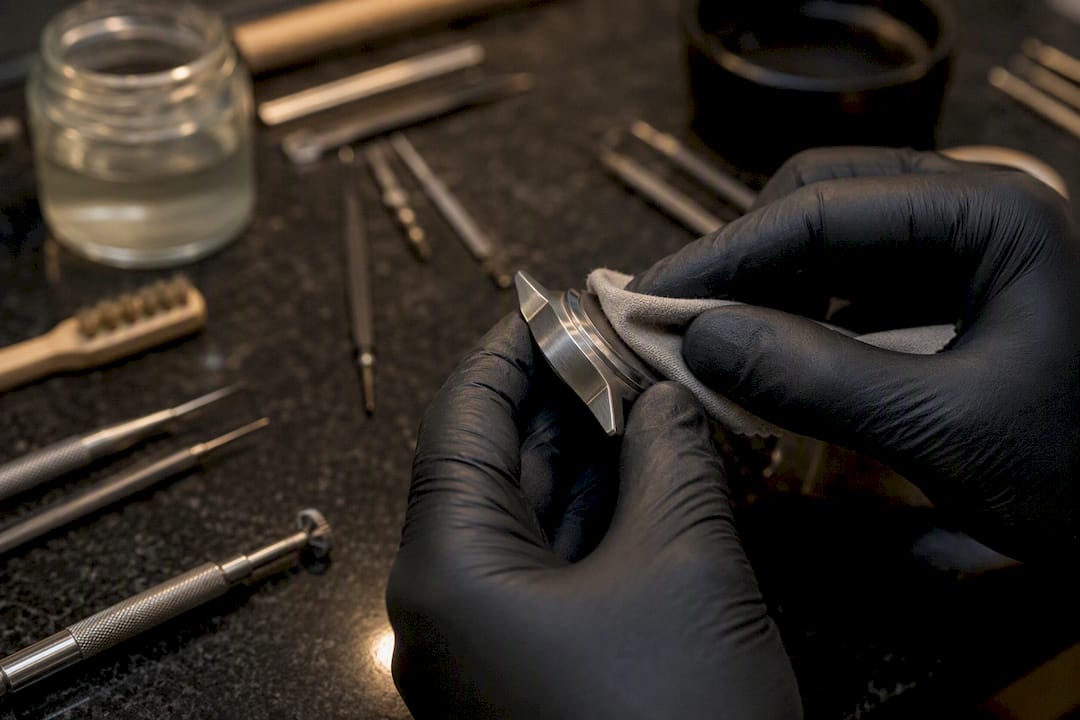
- Steel: clean regularly with a soft brush and mild solution, polish out light scratches at home or with a pro
- Titanium: avoid aggressive spot-polishing; re-brushing the full surface keeps the finish even
- Ceramic and sapphire: clean gently, never attempt to polish out a scratch. Chips or cracks mean full component replacement
- Bronze: rinse off saltwater and sweat promptly, but let the patina develop naturally rather than trying to prevent it
- Gold and platinum: polish sparingly since each pass removes a trace of metal, and skip household abrasives entirely
Know when to hand a watch to a professional. Ceramic and sapphire repairs are replacement-only jobs that require the manufacturer or an authorized service center, while steel and titanium refinishing can often be handled DIY with the right polishing compound or a trusted local watchmaker.
Pro Tip: Avoid hard-edge impacts on ceramic and sapphire cases entirely, rinse saltwater off bronze and steel after every ocean swim, and never use household glass cleaner on gold or platinum finishes.
One thing the case metal alone never guarantees: water resistance. That comes down to gasket quality, crown design, and caseback sealing, not the metal itself. A titanium case with a worn gasket can flood just as easily as a steel one.
Why does material-specific knowledge actually matter here?
I’ve spent enough time around case metals to know that most damage isn’t from bad luck, it’s from treating every material like steel. Ceramic doesn’t forgive a hard drop the way steel does, and gold doesn’t forgive an abrasive cloth. ChronoCare builds its cleaning and polishing kits around exactly that distinction, matching formula and tool to the metal instead of offering one generic solution for every case.
Care for Your Watch the Right Way
Matching your care routine to your case metal is the single biggest factor in whether a watch still looks sharp in ten years or shows every year of wear. ChronoCare’s Ultimate Watch Polishing & Cleaning Kit is formulated with material-specific compounds so you’re not using a steel-grade abrasive on a titanium or gold case. If you just want a reliable everyday cleaning routine across your collection, the Ultimate Watch Cleaning Kit covers the basics without risking the finish on delicate metals.
Frequently Asked Questions
What is the most durable watch case metal? For everyday scratch resistance, ceramic and sapphire are hardest, but steel and titanium handle impact better because they dent instead of cracking.
What watch case metal is best for sensitive skin? Titanium and ceramic are the safest bets since both are essentially hypoallergenic, unlike some steel and gold alloys that contain nickel.
Is titanium better than stainless steel for watches? Titanium is lighter and more hypoallergenic, but steel is easier and cheaper to refinish, so the better choice depends on whether weight or serviceability matters more to you.
Does the case metal affect a watch’s water resistance? No. Water resistance comes from gasket quality, crown design, and caseback sealing, not the metal the case is made from.
Why do some watch cases say “surgical steel” instead of a grade number? That phrase is marketing shorthand with no fixed alloy standard behind it. Ask for the actual grade, such as 316L or 904L, before assuming quality.
Sources
- The Best Watch Case Materials, Ranked: Steel vs Titanium vs Ceramic vs Bronze | WatchPolice
- Back to basics: watch case materials explained — from aluminum to zirconium dioxide | Fratello Watches
- Everything you need to know about watch materials | WATCH EDUCATION | Time+Tide
- Watch Case Materials Guide: Steel, Titanium, Ceramic, Gold & More Compared - We Know Watches
- Cases — Patek Philippe Manufacture and Quality