

How to Restore a Tarnished Watch Case the Right Way
Restoring a tarnished watch case is the process of removing oxidation, surface discoloration, and minor defects to revive a timepiece’s original luster and protect its long-term value. In the watch care industry, this process is formally called case refurbishment. Whether you own a Rolex in stainless steel, a Patek Philippe in gold, or a vintage silver pocket watch, the right restoration technique depends entirely on the material and the severity of the damage. Get the method wrong and you risk stripping factory finishes, erasing valued patina, or triggering corrosion. Get it right and your watch looks and performs like new.
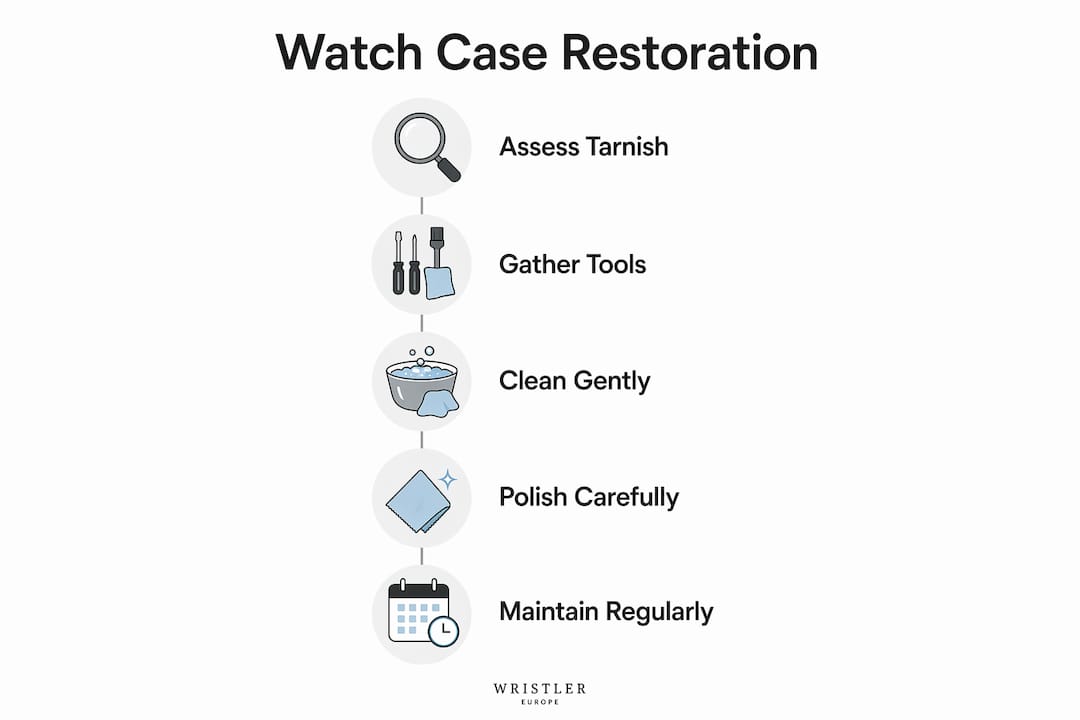
What tools and materials do you need to restore a tarnished watch case?
The right supplies make or break any watch case refurbishment. Using the wrong tools is the fastest way to cause permanent damage before you even start.
Core supplies for most materials:
- Ammonia-free dish soap
- Soft-bristled toothbrush (extra soft, not medium)
- Microfiber cloths, lint-free
- Polishing cloth designed for watch metals
- Small bowl of lukewarm water
- Cotton swabs for tight crevices
Material-specific additions:
- Silver cases: a specialized silver-dip solution for heavy tarnish removal
- Gold cases: a dedicated polishing cream formulated for precious metals
- Stainless steel: a non-abrasive metal polish for light surface scratches
One-size-fits-all cleaning solutions can damage luxury watches. Different steel grades, coatings, and crystal types each require a tailored approach. Identifying your watch’s case material before buying any product is not optional. It is the first step.
Supplies to avoid entirely:
- Bleach, acetone, or ammonia-based cleaners
- Abrasive scrubbing pads or steel wool
- Ultrasonic cleaners for watches with unknown water resistance ratings
- Toothpaste (it is mildly abrasive and scratches polished surfaces)
Pro Tip: Check your watch’s manual or manufacturer website to confirm the case material and water resistance rating before touching it with any liquid or cloth.
| Material | Recommended product | What to avoid |
|---|---|---|
| Stainless steel | Ammonia-free soap, microfiber cloth | Abrasive pads, bleach |
| Sterling silver | Silver-dip solution, polishing cloth | Ammonia, rough brushes |
| Gold (solid or plated) | Polishing cream, soft brush | Ultrasonic cleaners, harsh acids |
| Titanium | Mild soap, microfiber cloth | Metal polishes with abrasives |
How do you restore stainless steel watch cases step-by-step?
Stainless steel is the most common luxury watch case material, and it responds well to careful home restoration. The key is knowing the difference between a daily wipe and a deep clean.
Before you start:
- Confirm your watch’s water resistance rating. Vintage or unknown-rated watches must never be submerged. Use a barely damp cloth only.
- Lay a soft towel on your workspace to prevent accidental drops.
- Remove any leather straps before using any moisture.
Step-by-step deep clean (every 4–8 weeks):
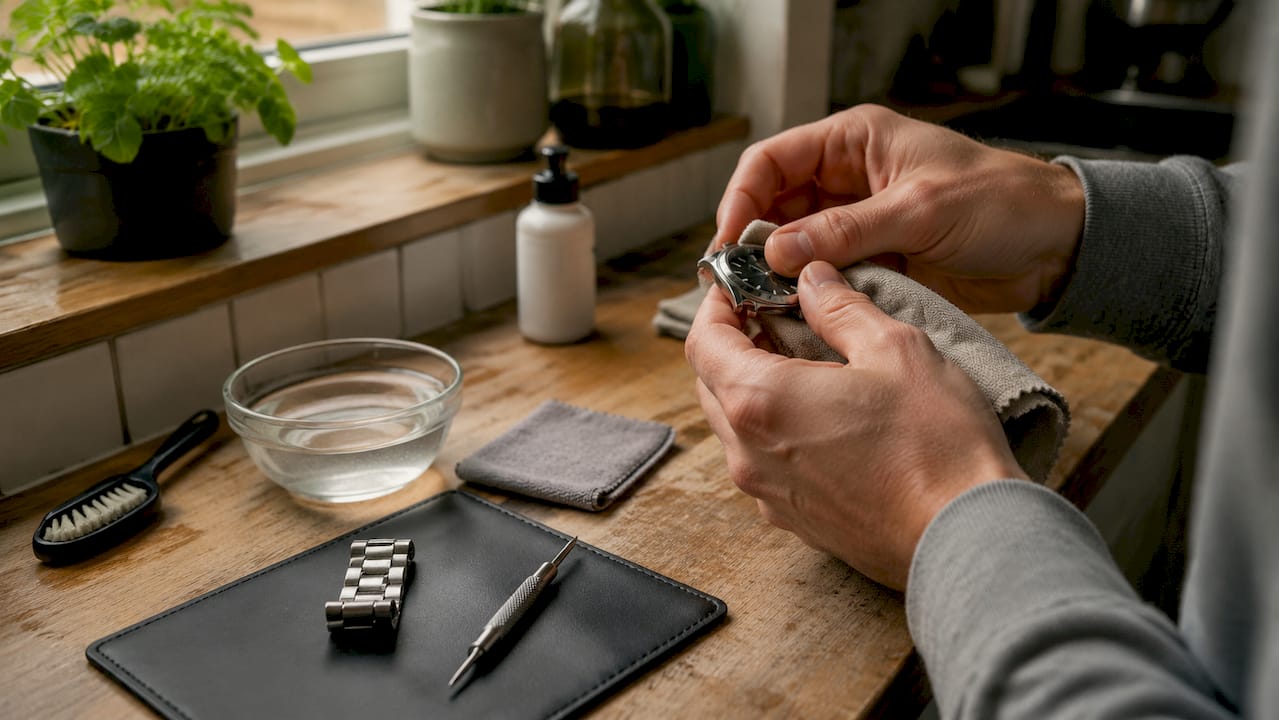
- Mix a few drops of ammonia-free dish soap into a small bowl of lukewarm water.
- Dip a soft-bristled toothbrush into the solution and gently scrub the case, lugs, and bracelet links.
- Pay extra attention to the crown area and between bracelet links where grime accumulates.
- Rinse with a clean damp cloth. Do not run the watch under a faucet unless you have confirmed a high water resistance rating.
- Dry immediately with a lint-free microfiber cloth.
- Dry thoroughly around the crown and bracelet links to prevent water-trapped corrosion.
- Buff the case gently with a dry polishing cloth using straight strokes that follow the grain of the metal.
Routine deep cleaning every 4 to 8 weeks prevents tarnish from building up to the point where polishing becomes necessary. Prevention is always cheaper than restoration.
Understanding buffing vs. polishing:
Buffing with a dry microfiber cloth enhances existing shine gently. Polishing, by contrast, uses an abrasive to physically remove a thin layer of metal to fix scratches. Confusing these two techniques leads to unintended damage. For most tarnish and dullness, buffing is all you need.
Pro Tip: Always buff in straight lines following the brushed grain of the metal. Circular motions create swirl marks that are visible under light and difficult to reverse at home.
Troubleshooting stubborn tarnish:
- For light surface oxidation, apply a small amount of watch polishing cream to a microfiber cloth and work it into the affected area using straight strokes.
- For deep scratches or persistent discoloration that does not respond to polishing cream, stop. Further DIY attempts risk removing the factory finish entirely. That is the point to call a professional.
Harsh chemicals and aggressive scrubbing strip the chromium oxide layer that protects stainless steel from corrosion. Once that layer is compromised, the case becomes vulnerable to rust and pitting.
What are the best methods for restoring gold and silver watch cases?
Gold and silver cases require more caution than stainless steel. Both metals are softer and more reactive to chemicals, and both carry higher financial and collector value.
Restoring sterling silver cases:
Sterling silver cases respond best to submersion in a specialized silver-dip solution for exactly 10 seconds, followed immediately by a warm water rinse. This reverses oxidation faster than any other home method. The timing matters. Leaving a silver case in the dip solution too long risks damaging gaskets or affecting other components.
- Remove the strap or bracelet if possible.
- Submerge only the case in silver-dip solution for 10 seconds.
- Remove and rinse immediately under warm running water.
- Dry with a lint-free microfiber cloth.
- Buff with a silver polishing cloth to restore shine.
Restoring gold cases:
Solid gold cases (18k, 14k) respond well to gentle cleaning with ammonia-free soap and a soft brush. A polishing cream designed for precious metals can address light surface dullness. Gold-plated cases are a different matter entirely. The plating layer is thin, often only a few microns thick, and aggressive polishing removes it permanently.
| Condition | DIY approach | Professional approach |
|---|---|---|
| Light tarnish or dullness | Soap, soft brush, polishing cloth | Not required |
| Surface scratches (solid gold) | Polishing cream, microfiber cloth | Optional for deep scratches |
| Worn or peeling gold plating | Not recommended | Re-plating or electroplating |
| Deep gouges or dents | Not recommended | Laser welding, precision lapping |
Limitations of DIY gold restoration:
Excessive polishing on vintage watches risks removing valued patina and altering original finishes, which directly diminishes collector value. A Rolex Daytona or Audemars Piguet Royal Oak with its original brushed finish is worth more than one that has been over-polished to a mirror shine. When in doubt, do less.
When should you consider professional watch case restoration?
Some damage is beyond what home methods can safely address. Knowing when to stop is as important as knowing how to start.
Signs you need a professional:
- Deep gouges or dents that a polishing cream cannot fill
- Structural damage to lugs or the case back
- Worn gold or rhodium plating that needs re-plating
- A brushed finish that has been accidentally polished to a mirror shine
- Any damage on a high-value vintage piece where patina matters
Professional watchmakers use precision lapping machines and laser welding to restore surfaces without altering the watch’s geometry. This preserves factory finish and market value far better than hand polishing. Laser welding uses 0.2mm wire of a matching alloy to fill deep gouges precisely. The result is a repair that is nearly invisible and does not compromise the case’s structural integrity.
“The goal of professional case refurbishment is to restore the watch to its original specification, not to make it look generically shiny. That distinction separates a skilled watchmaker from a polishing shop.”
Choosing a reputable service:
Look for watchmakers who specialize in the brand you own. Rolex-authorized service centers, for example, use brand-specific tools and alloys. Independent specialists with verifiable credentials and before-and-after portfolios are a strong alternative. Always ask whether they use laser welding or traditional polishing, and whether they can preserve original brushed finishes. Cost varies widely, but a professional case refurbishment on a luxury piece typically runs from a few hundred dollars upward depending on the extent of the damage and the brand.
Loss of factory-applied coatings or brushed finish textures from improper polishing requires costly professional refinishing. Preventing that outcome is always less expensive than fixing it.
How do you maintain a restored watch case to prevent future tarnish?
Restoration is only half the work. A consistent maintenance routine keeps tarnish from returning and protects the investment you made in restoration.
Daily habits that make a real difference:
- Wipe the case with a dry microfiber cloth after wearing to remove sweat, skin oils, and dust.
- Remove your watch before applying perfume, sunscreen, or hand lotion. These chemicals accelerate tarnish on all metal types.
- Avoid wearing your watch in chlorinated pools or saltwater. Both environments aggressively attack metal finishes and gaskets.
- Store the watch in a watch box or pouch when not in use to limit exposure to humidity and airborne pollutants.
Routine care intervals:
A luxury timepiece maintenance checklist should include a light wipe-down daily and a deeper clean every 4–8 weeks. For watches worn daily in active environments, clean closer to the 4-week mark. For watches worn occasionally, 8 weeks is sufficient.
Environmental factors to watch:
Humidity is the primary driver of tarnish on silver and gold cases. Storing watches in a cool, dry environment with silica gel packets in the watch box significantly slows oxidation. Avoid storing watches near windows where UV exposure can degrade rubber gaskets and accelerate surface discoloration on plated cases.
Pro Tip: After any deep clean, apply a thin layer of watch-specific polishing cream to the case and buff it off completely. This leaves a micro-thin protective layer that slows tarnish buildup between cleanings.
Key Takeaways
Restoring a tarnished watch case requires material-specific methods, the right tools, and knowing when home care ends and professional service begins.
| Point | Details |
|---|---|
| Match method to material | Stainless steel, gold, and silver each require different products and techniques. |
| Buffing is not polishing | Buffing enhances shine without removing metal; polishing is abrasive and should be used sparingly. |
| Deep clean every 4–8 weeks | Regular cleaning prevents tarnish buildup that requires more aggressive intervention later. |
| Know when to stop DIY | Deep gouges, worn plating, and vintage patina require professional laser welding or re-plating. |
| Maintenance prevents restoration | Daily wipe-downs and proper storage dramatically slow tarnish and reduce restoration frequency. |
What I’ve learned from years of watching collectors over-polish their watches
The most common mistake I see is treating a watch case like a piece of silverware. Collectors reach for the most aggressive product available, scrub hard, and then wonder why their brushed Rolex Submariner now looks like a mirror. The factory brushed finish on a watch like that is not just cosmetic. It is part of the watch’s identity and its resale value.
My honest advice is to do less than you think you need to. A dry microfiber wipe after every wear handles 80 percent of what most collectors call “tarnish.” What they are actually seeing is a film of skin oils and environmental dust, not true oxidation. True tarnish, the kind that requires a silver-dip or a polishing cream, develops over months of neglect, not days.
For collectors who own pieces worth more than a few thousand dollars, I strongly recommend a professional inspection every two to three years. Not because the case necessarily needs work, but because a trained watchmaker will catch gasket degradation, crown wear, and case back seal issues before they become expensive internal problems. The case is the first line of defense for the movement inside.
The right care routine for collectors is not complicated. It is consistent. Wipe it down, store it properly, and resist the urge to polish unless you genuinely need to. Your watch will thank you for the restraint.
— Raymond Jenkins
ChronoCare has the right kit for every restoration job
Knowing the right technique is only part of the equation. Having the right products makes the difference between a clean that works and one that damages.
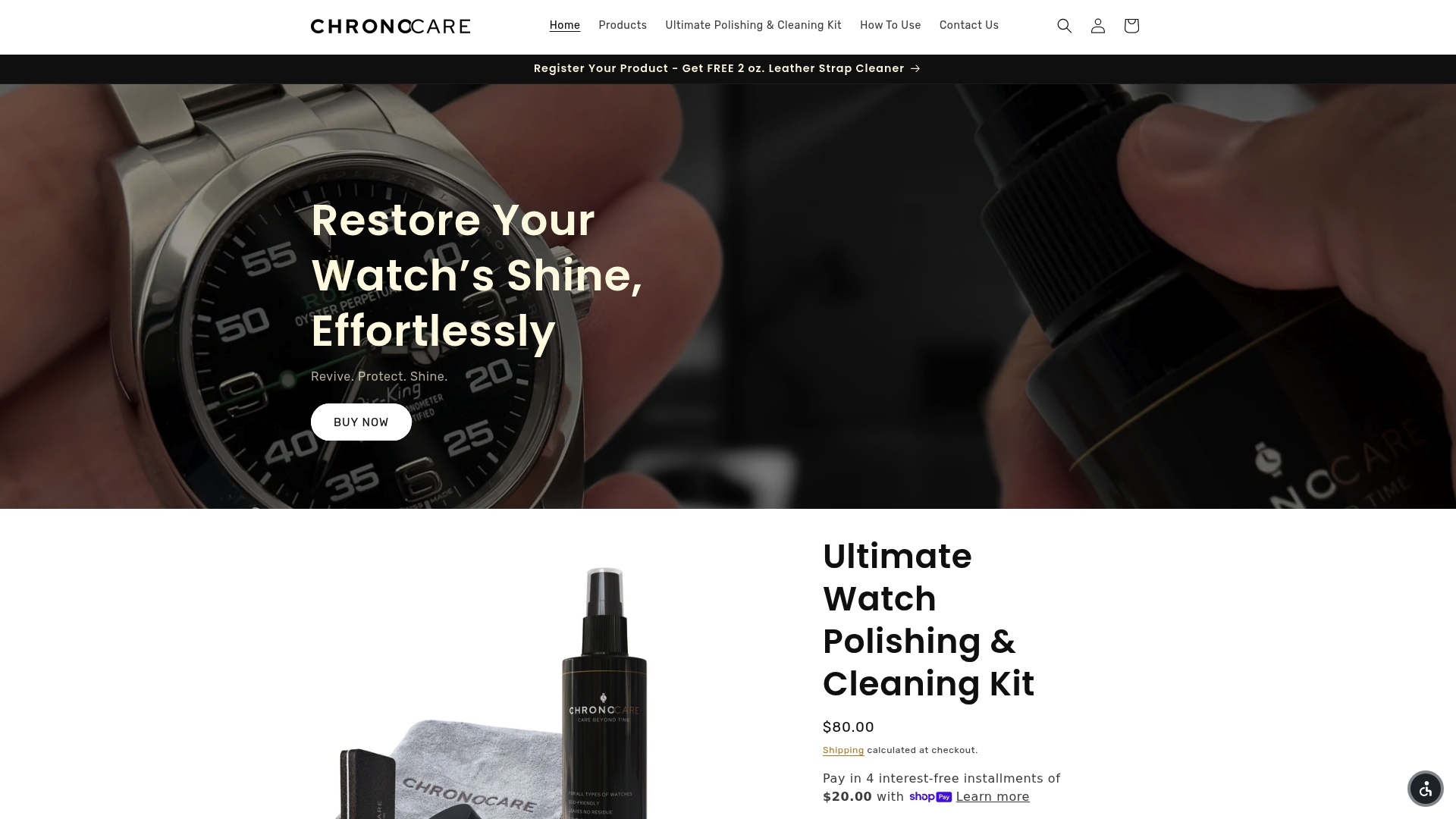
ChronoCare’s Ultimate Watch Cleaning Kit includes ammonia-free soap, a soft-bristled brush, and microfiber cloths specifically selected for luxury watch surfaces. For collectors dealing with surface scratches or dullness after tarnish removal, the Ultimate Watch Polishing and Cleaning Kit combines safe cleaning agents with a polishing compound formulated for precious metals and stainless steel. Every product is formulated in the US and designed to deliver professional-grade results without the risk of stripping factory finishes.
FAQ
What causes a watch case to tarnish?
Tarnish forms when metal reacts with oxygen, moisture, skin oils, and environmental pollutants. Silver cases oxidize fastest, while stainless steel develops a dull film from sweat and chemical exposure over time.
Can I use toothpaste to polish a watch case?
Toothpaste is mildly abrasive and will create micro-scratches on polished metal surfaces. Use a dedicated watch polishing cream instead for safe and effective results.
How often should I deep clean my watch case?
Deep cleaning every 4 to 8 weeks is the standard recommendation for stainless steel cases. Watches worn daily in active or outdoor environments benefit from cleaning closer to the 4-week interval.
Will polishing a vintage watch reduce its value?
Yes. Excessive polishing on vintage watches removes original patina and alters factory finishes, which directly reduces collector and resale value. Stick to gentle buffing and consult a specialist before any abrasive work on vintage pieces.
When should I take my watch to a professional for case restoration?
Take your watch to a professional when you see deep gouges, dents, worn plating, or structural damage to the lugs. These issues require laser welding or precision lapping that cannot be replicated safely at home.