

How Watch Case Finishing Differs: A Collector's Care Guide
Watch case finishing differs primarily in three ways: surface reflectivity (mirror-bright to flat matte), texture (linear hairlines to grainy blast patterns), and protective coatings (bare metal versus PVD or DLC). Those three factors determine how a finish looks on your wrist, how it wears over months of use, and exactly what care it needs.
Here’s the short version before we go deeper:
- Polished (mirror): High gloss, shows every fingerprint and swirl
- Brushed/satin: Directional hairlines, hides light scratches well
- Matte/sandblasted: Flat, non-reflective, very forgiving in daily wear
- Bead-blasted: Uniform grainy texture, slightly softer look than sandblast
- Coated (PVD/DLC): Adds color and hardness over any base finish
Artisan techniques like Zaratsu polishing push mirror surfaces into a different category entirely, and ChronoCare’s care protocols are built around these distinctions. The finish on your case isn’t decoration — it’s a maintenance decision.
Table of Contents
- How watch case finishing differs: identifying each finish type
- Which finishes hold up best to daily wear?
- What makes Zaratsu polishing different from standard finishing?
- How finishing shapes a watch’s personality and legibility
- How to care for your watch case finish at home
- When should you take your watch to a professional refinisher?
- Key Takeaways
- The finish tells you more than you think
- ChronoCare’s polishing and cleaning kits for every finish type
- Useful sources and further reading
How watch case finishing differs: identifying each finish type
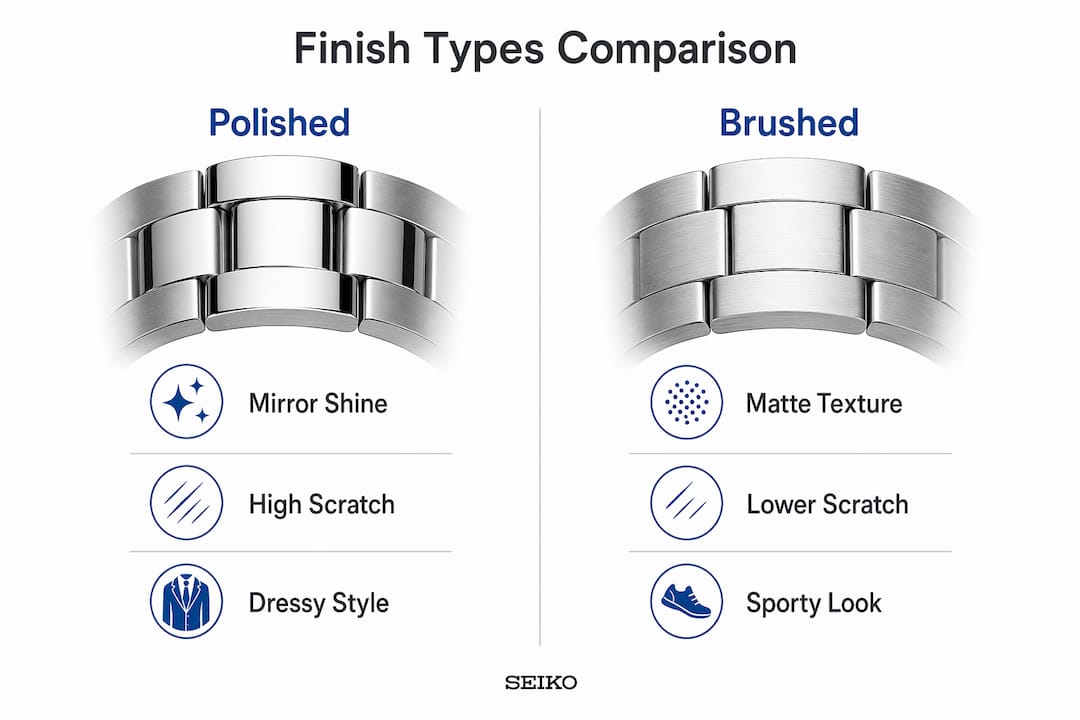
Watch case finishing defines surface texture, reflectivity, and the watch’s aesthetic personality. Knowing which finish you’re looking at is the first step before reaching for any care product.
| Finish | Visual Cue | Scratch Visibility | Best For |
|---|---|---|---|
| Polished (mirror) | Reflects like glass; you see your face | Very high | Dress watches, formal wear |
| Brushed/satin | Parallel hairlines, directional sheen | Low | Daily wear, sports watches |
| Matte/sandblasted | Flat, no reflection, grainy surface | Very low | Tool watches, military style |
| Bead-blasted | Soft uniform grain, slightly smoother than sandblast | Low | Dive watches, casual luxury |
| PVD/DLC coated | Black, gold, or gunmetal color over base finish | Low to moderate | Color-forward, durability-focused |
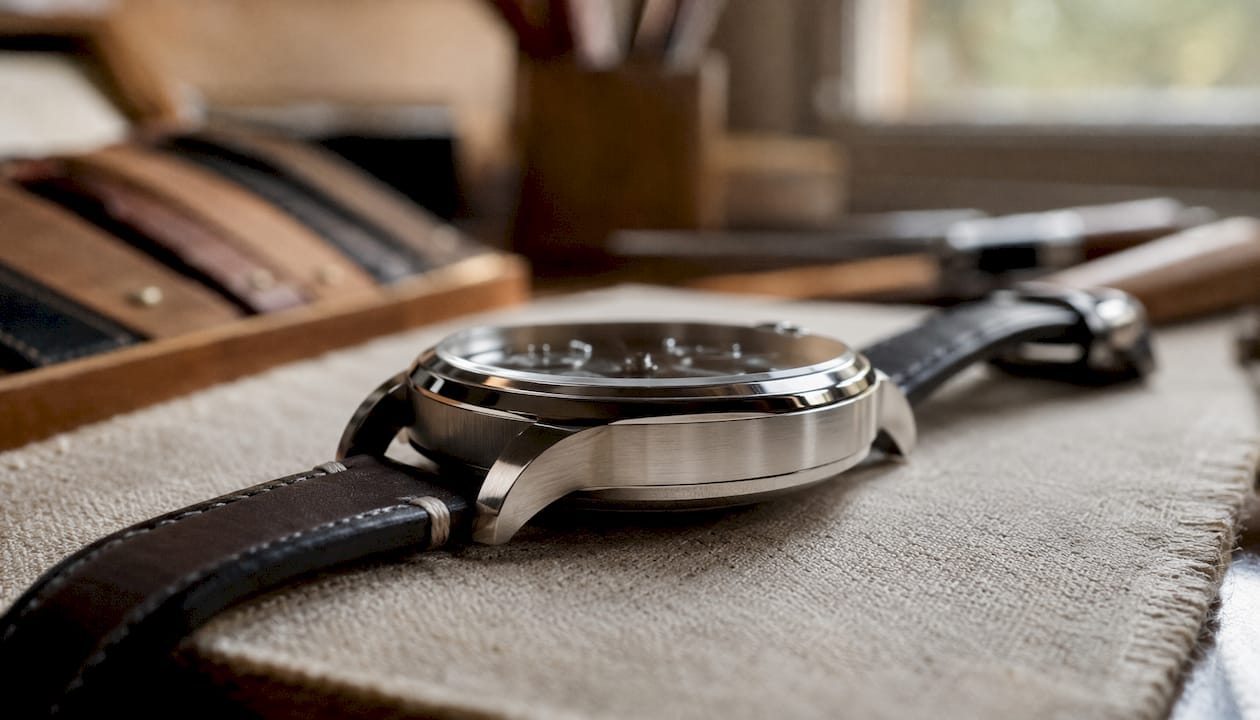
Most luxury watches combine finishes on a single case. Polished bevels run alongside brushed flanks on a Royal Oak or a Submariner-style case. The transition between the two is called a chamfer, and it’s one of the sharpest indicators of finishing quality. A clean chamfer has a razor-defined edge; a sloppy one looks rounded and soft.
Specialty finishes exist beyond these five. Frosted or Florentine finishes use diamond-tipped tools to hammer a crystalline shimmer into the metal surface. They’re laborious, costly, and found almost exclusively at the high end.
Which finishes hold up best to daily wear?
Polished surfaces are the most demanding to maintain. Micro-swirl marks and fingerprints appear almost immediately on mirror-polished steel, especially under direct light. Brushed and bead-blasted finishes scatter light across their textured surface, so minor scratches blend in rather than catch the eye.
Coatings change the equation further. PVD and DLC are functional as well as aesthetic: they increase surface hardness and alter how wear shows up, which means your cleaning and polishing approach must change too. Never use abrasive compounds on a coated case. The coating is thin, and once it’s gone, it’s gone.
Daily maintenance dos and don’ts:
- Do wipe polished surfaces with a clean microfiber cloth after every wear
- Do follow the grain direction when wiping brushed surfaces (always linear, never circular)
- Don’t use paper towels, shirt fabric, or household cleaners on any finish
- Don’t apply polishing cream to PVD or DLC coated cases
- Do schedule a professional service for deep scratches or coating failures rather than attempting DIY fixes
A light polishing cream works well for removing swirl marks from bare polished steel. For brushed surfaces, a specialty restoration kit with directional applicators keeps the grain consistent. Blasted finishes generally need only cleaning, not polishing.
What makes Zaratsu polishing different from standard finishing?
This is where finishing gets genuinely technical. Zaratsu polishing uses the flat face of a Sallaz polishing wheel rather than its rounded running surface. That geometry is everything. The flat face allows a technician to work a single plane without introducing convex distortion, which is why Zaratsu-polished surfaces look optically perfect rather than merely shiny.
Black polishing takes this further. Multiple passes with progressively finer abrasives, all by hand, produce a surface that appears almost black at certain angles because it reflects so little ambient light. It’s the finishing equivalent of optical glass.
Industrial finishing offers repeatability and scale but lacks the selective refinement human eyes provide. A machine can brush a flank consistently across thousands of cases. It cannot judge when a single chamfer edge needs one more pass without touching the adjacent polished surface. That judgment is what hand-refinement delivers and why it costs more.
Pro Tip: When a watchmaker claims a case was hand-finished, look for three things: chamfer edges that are geometrically sharp rather than rounded, polished surfaces that show no distortion when you tilt the case, and no bleed between adjacent finish zones. Those details don’t survive automated finishing.
How finishing shapes a watch’s personality and legibility
Finishing is a structural design decision, not just an aesthetic one. Polished bevels on a case draw the eye along the geometry of the case, making edges appear crisper and the overall form more defined. Matte surfaces absorb light rather than redirect it, which reduces glare under bright conditions and gives a watch a more utilitarian, purposeful character.
Polished cases read as dressy and formal. Brushed or blasted cases read as rugged or sporty. Mixed finishes — polished top surfaces with brushed sides — are the language of luxury sports watches, a deliberate tension between elegance and function.
Finishing also integrates with case production at the final stage, after stamping and machining. That sequence matters for collectors considering restoration: the finish is the outermost layer, and any aggressive polishing removes metal permanently. Restoring a watch to its original finish character requires knowing what that character was.
How to care for your watch case finish at home
Step-by-step care protocol by finish type:
- Identify your finish before touching anything. Polished, brushed, blasted, or coated — each needs a different approach.
- Rinse or wipe off surface debris with a soft, damp microfiber cloth. Never scrub.
- For polished surfaces: apply a small amount of watch polishing cream to a clean cloth and work in small circular motions. Wipe clean and buff dry.
- For brushed surfaces: use a directional applicator or cloth, moving strictly along the grain. Circular motion destroys the hairline pattern.
- For blasted or matte surfaces: clean only. No polishing compounds. A non-abrasive cleaning spray and microfiber cloth is all you need.
- For PVD/DLC coated cases: use only gentle, non-abrasive cleaners. Polishing compounds will strip the coating.
- Inspect edges and chamfers after cleaning. If chamfers look rounded or finish zones are bleeding into each other, stop and consult a professional.
Professional refinishing typically runs from around $100 for a simple brushed steel case to several hundred dollars for a complex multi-finish case requiring hand-polishing. Cases with Zaratsu or black-polished surfaces cost more because the labor is intensive. Material matters too: titanium and precious metals require different abrasives and more care than standard stainless steel.
Pro Tip: Professionals use colored lacquer markers to track material removal during polishing and protect sharp edges. If you’re attempting any light touch-up at home, a similar marker on the chamfer edge shows you immediately when you’re removing too much metal.
Over-polishing is the single most common mistake collectors make. Each pass removes metal. On a high-value watch, repeated amateur polishing rounds off chamfers, blurs finish transitions, and can affect hallmarks or serial engravings. When in doubt, clean rather than polish.
When should you take your watch to a professional refinisher?
Some damage is beyond home care. Take your watch to a professional when you see:
- Deep gouges that catch a fingernail
- Rounded or blurred chamfer edges
- Coating failure (peeling, bubbling, or uneven color on PVD/DLC)
- Finish zone contamination after a DIY attempt (polished areas bleeding into brushed ones)
A professional refinishing service works in stages: stripping the old finish, re-machining edges if needed, applying the base finish, and then hand-refining. That final manual pass is where quality diverges. Ask for photos before and after, and request documentation of the process for provenance.
Questions worth asking any refinisher before you hand over the watch:
- Do you use Sallaz or Zaratsu polishing for mirror surfaces?
- Will you match the original finish character, not just make it shiny?
- Does polishing affect the serial number or hallmarks?
- What’s the turnaround time, and can I see reference photos of comparable work?
A refinisher who can’t answer the Zaratsu question clearly probably isn’t doing hand-finishing. That matters for both the result and the watch’s resale value.
Key Takeaways
Watch case finishing differs across five main types, and matching your care method to the specific finish on your watch is the single most important step in preserving its appearance and value.
| Point | Details |
|---|---|
| Finish type drives care method | Polished needs polishing cream; brushed needs directional wiping; blasted and coated need cleaning only. |
| Brushed and blasted hide wear best | These textures scatter light, concealing minor scratches that would be obvious on a mirror surface. |
| Coatings change the rules | PVD and DLC increase hardness but cannot be polished; abrasive compounds strip them permanently. |
| Hand-finishing is irreplaceable at the top | Zaratsu and black polishing require human judgment that automated systems cannot replicate. |
| ChronoCare for home care | ChronoCare’s polishing cream and cleaning kits are matched to finish type, with guidance on when to stop and call a pro. |
The finish tells you more than you think
Most collectors spend years learning movements and complications before they pay serious attention to case finishing. That’s understandable, but it’s the wrong order of priorities for anyone who cares about long-term appearance.
The finish is the first thing that degrades and the hardest thing to restore correctly. A movement can be serviced without altering the watch’s character. A poorly refinished case cannot be un-polished. Once those chamfer edges are rounded, the geometry that gave the watch its presence is gone.
What I find most overlooked is the relationship between finish type and care frequency. Collectors with polished dress watches often under-clean them, letting micro-swirls accumulate until they feel a full polish is needed. That cycle, repeated a few times, does real damage. A quick wipe after every wear with the right cloth prevents most of it. The brushed-finish crowd tends to make the opposite mistake: using circular motions that gradually erase the hairline pattern they’re trying to preserve.
The practical takeaway is simple. Know your finish, match your method, and treat polishing as a last resort rather than a first response.
ChronoCare’s polishing and cleaning kits for every finish type
Knowing how watch case finishing differs is only useful if you have the right tools to act on it. ChronoCare’s Ultimate Watch Polishing & Cleaning Kit covers the full range: non-abrasive cleaners for blasted and coated surfaces, polishing compounds for light swirl removal on bare polished steel, and finishing cloths sized for case work.
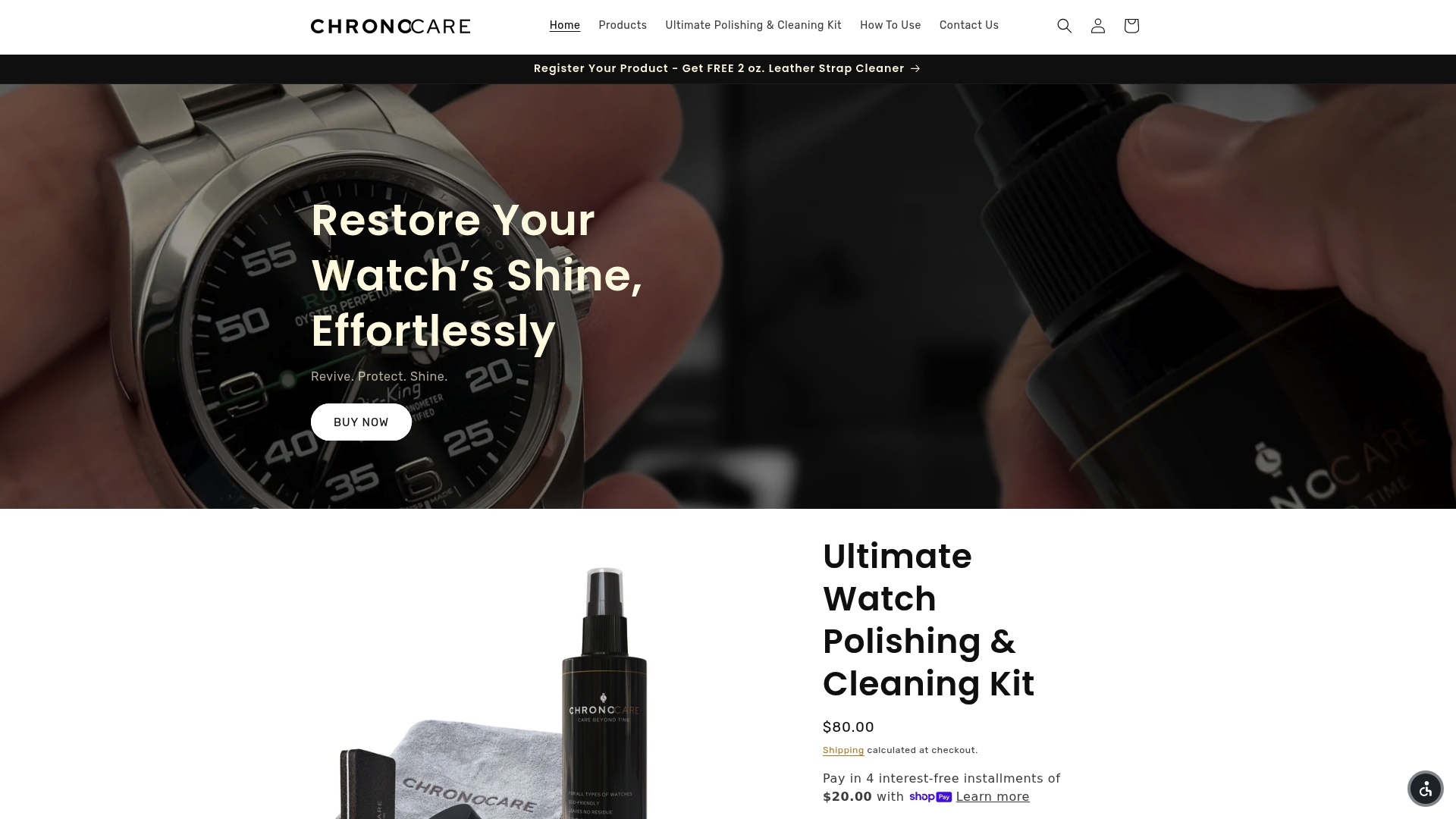
For collectors focused on a single issue, the Watch Polishing Cream handles light scratches and swirl marks on metal surfaces without the risk of aggressive abrasives. One caveat worth stating plainly: polishing is irreversible. Test any compound on a non-critical surface first, and if the damage is deep or the finish is complex, send it to a professional rather than risk the chamfers. ChronoCare’s kits are built for maintenance and light restoration, not for replacing a watchmaker’s bench.
Useful sources and further reading
- Watch Finishing Explained: A Practical Beginner’s Guide — Hewore; covers finish categories, PVD/DLC coatings, and care implications
- Different Types of Watch Case Finishes — RCOEMWatches; practical durability and scratch-visibility comparisons
- The Finishing Styles Unique to High-End Watches Explained — Fratello Watches; Zaratsu, black polishing, and specialty techniques
- Case Finishing: What Separates the Good from the Bad? — Fratello Watches; artisan vs. industrial contrast and hand-refinement standards
- How Watch Cases Are Made — Outlook Luxe; manufacturing sequence and lacquer-marker technique
- What Does Fine Watchmaking Really Mean? — Hodinkee; hand-finishing versus industrial production
- Luxury Timepiece Maintenance Checklist for Collectors — ChronoCare; step-by-step care protocols aligned with this guide
- How to Finish Watch Bracelet Professionally — ChronoCare; matching bracelet finishing to case finish for a consistent result
This article is general information for watch enthusiasts, not professional watchmaking or appraisal advice. For restoration decisions affecting a watch’s value or warranty, consult a qualified watchmaker.