

How to Finish Watch Bracelet Professionally: Expert Guide
To finish a watch bracelet professionally means executing a precise sequence of disassembly, ultrasonic cleaning, surface refinishing, and structural repair to restore both the aesthetic and mechanical integrity of a luxury timepiece. This process goes far beyond buffing with a cloth. It involves specialized equipment, trained technique, and a deep respect for factory specifications. Whether you own a Rolex Oyster, an Omega Speedmaster bracelet, or a Patek Philippe integrated strap, understanding how professional watch strap finishing works protects your investment and keeps your watch looking exactly as it was designed to look.
What tools and preparations are needed to finish a watch bracelet professionally?
Professional bracelet finishing starts before a single abrasive touches the metal. The preparation phase determines whether the result looks factory-grade or amateur.
The first step is ultrasonic cleaning of the disassembled bracelet and case components. Ultrasonic cleaners use high-frequency sound waves to dislodge microscopic dirt and debris from every crevice in the link structure. Skipping this step is the leading cause of micro-scratching during polishing, because residual grit acts as an abrasive against the metal surface. Any technician who skips ultrasonic cleaning before reaching for a polishing wheel is cutting corners that will show in the final result.
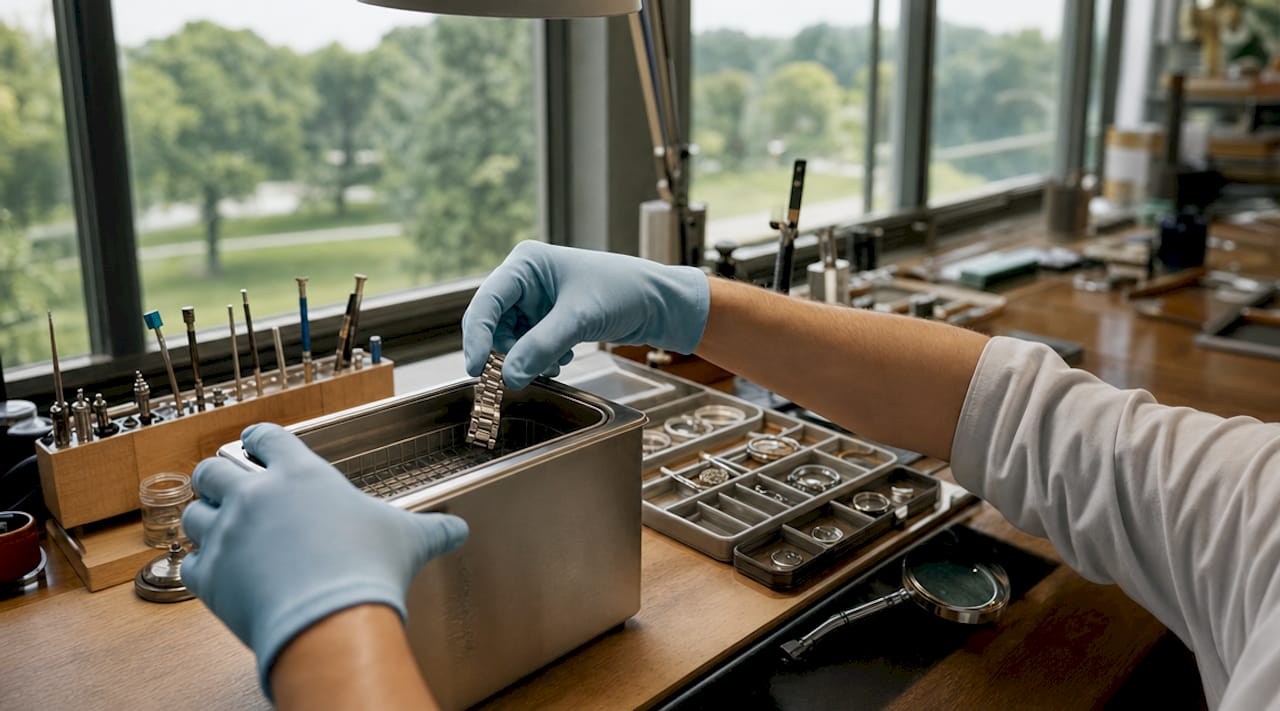
Before cleaning begins, full disassembly is required, including removing the movement, crystal, pushers, and gaskets from the case. This protects the watch’s mechanics from moisture, heat, and compound contamination during refinishing. The bracelet is then separated from the case and handled as its own project.
The core toolkit for professional finishing includes:
- Ultrasonic cleaner for pre-polish debris removal
- Polishing motor with interchangeable spindles and felt bobs
- Graded abrasive compounds ranging from cutting compounds to fine rouge
- Scotchbrite pads in multiple grades for recreating brushed satin finishes
- Lapping films and abrasive belts for flat surface work
- Pin punches and bracelet link tools for disassembly and reassembly
- Magnification loupe or bench microscope for inspecting finish quality
Pro Tip: Before any cosmetic work begins, inspect every link for structural looseness, worn pin holes, and stretch. Polishing a bracelet with compromised pins is wasted effort. Structural issues must be addressed first.
A clean, well-lit workbench with a padded surface prevents accidental scratches during disassembly. Separating components into labeled trays keeps the workflow organized and prevents mixing parts from different finish zones.
How to execute professional polishing and brushing techniques
Achieving a factory-quality result when finishing metal watch bands requires understanding that most luxury bracelets combine two distinct finish types: brushed (satin) surfaces on the outer link faces and mirror-polished surfaces on the beveled edges or center links. Mixing these up, or applying one finish where the other belongs, immediately signals amateur work.
Here is the standard sequence professional technicians follow:
- Map the original finish zones. Study reference photos of the bracelet in new condition. Identify which surfaces are brushed, which are polished, and the exact direction of the grain on brushed sections.
- Polish mirror surfaces first. Using graded polishing compounds on a felt bob, work from coarser to finer grades. A Rolex Oyster center link, for example, requires a high-gloss mirror finish achieved through progressive compound stages ending with a fine jeweler’s rouge.
- Recreate brushed finishes with directional abrasives. Specialized abrasive wheels and belts replicate the original hairline texture. The grain must run perfectly parallel across all links. Any deviation in direction is visible under light and marks the piece as refinished rather than factory-fresh.
- Work link by link, not section by section. Rushing across multiple links simultaneously causes uneven pressure and inconsistent finish depth.
- Clean between stages. Polishing compound residue from mirror stages contaminates brushing stages. Ultrasonic cleaning between steps keeps finishes clean and distinct.
- Inspect under raking light. Hold the finished bracelet at a low angle to a single light source. This reveals any swirl marks, inconsistent grain direction, or missed areas that direct overhead lighting conceals.
Pro Tip: Over-polishing is permanent. Each polishing pass removes a thin layer of metal. On bracelets with sharp decorative edges or fine chamfers, excessive polishing rounds off geometry that cannot be restored without micro-laser work. Less is always more.
| Finish type | Tool used | Key quality indicator |
|---|---|---|
| Mirror polish | Felt bob with rouge compound | Zero visible scratches under 10x magnification |
| Brushed satin | Scotchbrite pad or abrasive belt | Grain runs parallel across all links |
| Sunburst | Radial abrasive disc | Lines radiate from a single center point |
| Bead blast | Micro-bead blasting cabinet | Uniform matte texture with no directional grain |
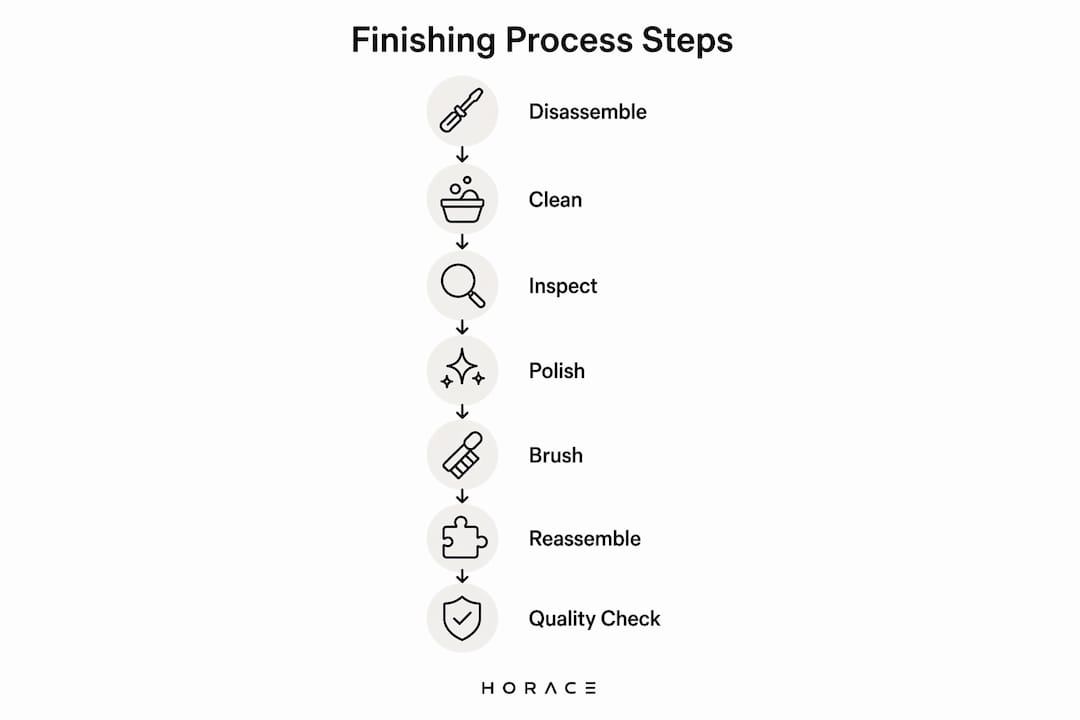
Rolex’s own servicing process detaches the bracelet from the case and routes components separately for refinishing, then reassembles only after sealing and water resistance testing. That workflow is the benchmark every professional service should follow.
What are the methods for addressing structural bracelet issues?
Cosmetic finishing on a structurally compromised bracelet is like painting over rust. The underlying problem will surface again, and the cosmetic work will have been wasted. Structural repair must precede any refinishing.
The most common structural issues in luxury metal bracelets include:
- Link stretch caused by worn or elongated pin holes, making the bracelet feel loose and sloppy on the wrist
- Worn or broken pins that allow individual links to move laterally rather than only in their intended plane
- Cracked or deformed links from impact damage or metal fatigue
- Damaged clasp springs that affect deployment security
Repinning a bracelet involves complete link-by-link disassembly, replacement of worn pins with new ones machined to original tolerances, and full rebuilding of the bracelet. Done correctly, this process can extend bracelet longevity by approximately 20 years. It is painstaking work that takes two to four weeks when performed to a professional standard.
Structural refurbishment of stretched bracelets requires manual, link-level disassembly and rebuilding over weeks. Any service promising rapid turnaround on a full repinning job deserves serious scrutiny.
For dents, gouges, or worn pin holes in precious metal or high-alloy steel bracelets, micro-laser welding adds matching metal directly into the damaged area. Unlike aggressive polishing, which removes material to level a surface, micro-laser work restores geometry by addition. This is particularly valuable for 18k gold bracelets where thinning the metal through polishing would compromise both appearance and structural integrity.
Vintage watch owners face an additional consideration. Replacing original pins with modern equivalents can affect collector value. In these cases, sourcing period-correct hardware or retaining as many original components as possible is the right call. A bracelet maintenance guide can help you identify early signs of wear before they become structural failures.
What are common challenges and mistakes to avoid?
The gap between a professional result and a damaged watch often comes down to a handful of avoidable errors. These are the mistakes that show up most frequently in refinishing work.
- Polishing before cleaning. Residual dirt and grit on the bracelet surface act as abrasives during polishing, creating micro-scratches that require additional material removal to fix. Always ultrasonically clean before any abrasive contact.
- Ignoring finish zone boundaries. Applying a mirror polish to a surface that should be brushed, or vice versa, permanently alters the watch’s appearance. Consulting reference images before starting is not optional.
- Not removing the movement. Polishing compound and moisture entering the case during refinishing can contaminate the movement. Full disassembly before polishing is non-negotiable.
- Over-polishing sharp edges and chamfers. Excessive polishing permanently alters a watch’s profile and erases the sharp edges that define its design character. This reduces both aesthetic quality and resale value.
- Choosing a provider without proper equipment. A technician without an ultrasonic cleaner, polishing motor, and lapping tools cannot deliver professional results regardless of skill level.
Pro Tip: Before starting any refinishing work, discuss finish preservation with the owner. Some collectors actively prefer a patina of honest wear over a fully restored factory look. Knowing this preference before picking up a polishing tool prevents irreversible mistakes.
Checking for signs that a watch needs professional attention before attempting any home maintenance can also prevent compounding existing damage.
How much does professional bracelet finishing typically cost?
Cost varies significantly based on the scope of work, the material of the bracelet, and the reputation of the service provider.
Cosmetic refinishing of a Rolex bracelet typically costs between $200 and $600, with full bracelet replacements exceeding $2,000 on steel models and considerably more on gold variants. These figures reflect the labor intensity of proper professional work, not just material costs.
Key cost drivers include:
- Material. Stainless steel bracelets cost less to refinish than two-tone or solid gold bracelets, which require matching precious metal compounds and greater care.
- Scope of structural repair. A cosmetic polish on an intact bracelet costs far less than a full repinning rebuild.
- Provider credentials. Brand-authorized service centers charge premium rates but follow manufacturer specifications precisely.
| Service type | Typical cost range | Turnaround time |
|---|---|---|
| Cosmetic polish only | $200 to $400 | 1 to 3 days |
| Polish plus structural repinning | $400 to $800 | 2 to 4 weeks |
| Full bracelet rebuild with micro-laser | $800 to $1,500+ | 4 to 6 weeks |
| Bracelet replacement (steel) | $1,500 to $2,500+ | Varies by availability |
The value calculation is straightforward for high-end pieces. A $600 professional refinishing service on a Rolex Jubilee bracelet worth $1,200 as a standalone part is money well spent. Replacing that bracelet costs two to four times more. For watches with sentimental or collector value, preservation through professional refinishing is almost always the better financial decision.
Selecting a qualified specialist matters as much as budget. Look for technicians who can show before-and-after examples of their work, explain their disassembly process, and provide realistic turnaround timelines. Anyone promising a full repinning job in 48 hours is not doing the work properly.
Key takeaways
To finish a watch bracelet professionally, you must combine ultrasonic cleaning, precise finish mapping, graded abrasive technique, and structural repair before any cosmetic work begins.
| Point | Details |
|---|---|
| Preparation is non-negotiable | Ultrasonic cleaning before polishing prevents micro-scratches that compound the damage. |
| Disassemble fully before refinishing | Remove movement, crystal, and gaskets to protect mechanics during any polishing work. |
| Match original finish zones exactly | Brushed and polished surfaces must align with factory specifications or value is lost. |
| Structural repairs come before cosmetics | Repinning and micro-laser work must precede any surface refinishing for lasting results. |
| Professional costs reflect real labor | Expect $200 to $800 for quality refinishing work; shortcuts in pricing mean shortcuts in process. |
Why I’ve stopped recommending DIY polishing for luxury bracelets
I’ve seen hundreds of watches come through for assessment after owners attempted their own finishing work. The pattern is consistent. The owner bought a polishing cloth or a cheap compound kit, spent an afternoon on the bracelet, and ended up with rounded edges, mismatched grain directions, and in several cases, polishing compound embedded in the link joints. The watch looked worse than before, and the damage was permanent.
My position is firm: for any bracelet worth more than a few hundred dollars, professional finishing is not a luxury. It is the only responsible choice. The equipment alone, an ultrasonic cleaner, a proper polishing motor, graded abrasives, and lapping tools, represents a significant investment that casual owners cannot justify. And equipment without trained hands produces inconsistent results anyway.
What I find genuinely exciting about the current state of professional watch bracelet repair is micro-laser welding technology. Ten years ago, a deep gouge in a gold bracelet link meant either living with it or replacing the link entirely. Today, a skilled technician can restore that geometry precisely, without thinning the surrounding metal. That changes the economics of restoration for high-value pieces significantly.
If you are choosing a finishing service, ask one question before anything else: do you fully disassemble the watch before polishing? If the answer is no, or if there is any hesitation, walk away. That single step separates professional services from everyone else.
— Raymond Jenkins
Maintain your bracelet between professional services with ChronoCare
Professional refinishing restores your bracelet to factory condition, but what happens between service appointments determines how long that result lasts. ChronoCare’s Ultimate Watch Polishing and Cleaning Kit gives you the tools to maintain that finish at home without risking damage. The kit includes formulated cleaning solutions and polishing compounds designed specifically for luxury watch metals, so you are not improvising with household products. For day-to-day surface care, the ChronoCare Watch Cleaning Kit handles fingerprints, light surface marks, and link buildup safely. Both products are formulated in the US and designed for the collector who takes their watch’s condition seriously.
FAQ
What does it mean to finish a watch bracelet professionally?
Professional bracelet finishing involves full disassembly, ultrasonic cleaning, precise surface refinishing to match original factory specifications, and structural repairs where needed. It is a multi-stage process, not a single polishing step.
How long does professional watch bracelet finishing take?
Cosmetic polishing takes one to three days, while structural repinning and rebuilding typically requires two to four weeks. Any service promising a full structural rebuild faster than two weeks should be questioned.
Can I finish a watch bracelet at home?
Basic surface maintenance is possible at home with quality products like those from ChronoCare, but full professional refinishing requires ultrasonic cleaners, polishing motors, and graded abrasives that most owners do not have. Attempting mirror polishing or brushed finish recreation without proper tools risks permanent damage.
How much does it cost to refinish a Rolex bracelet?
Cosmetic refinishing typically costs between $200 and $600 depending on material and scope. Full structural repinning with refinishing ranges from $400 to $800, while micro-laser restoration work can exceed $1,500.
Does polishing a watch bracelet reduce its value?
Over-polishing that rounds edges or alters original contours does reduce collector value. Professional refinishing that accurately restores factory finishes without removing excess material preserves or maintains value, particularly when structural repairs extend the bracelet’s functional life.