

How Watch Bracelet Links Wear: A Maintenance Guide
Most watch owners treat their metal bracelet as an afterthought. You spend months researching the movement, the dial, the case finishing, then strap it to your wrist and assume the bracelet will take care of itself. It won’t. Understanding how watch bracelet links wear is the difference between a bracelet that looks sharp at year ten and one that feels like a loose chain by year three. This guide covers link types, wear patterns, maintenance routines, and when to call in a professional before the damage becomes irreversible.
Table of Contents
- Key takeaways
- Link types and how their design shapes wear
- How watch bracelet links wear: patterns, causes, and signs
- Best practices for maintaining and minimizing link wear
- When to replace or resize bracelet links
- My honest take on bracelet wear
- Keep your bracelet in top condition with ChronoCare
- FAQ
Key takeaways
| Point | Details |
|---|---|
| Link design affects durability | Jubilee bracelets have more articulation points and wear faster than Oyster designs. |
| Dirt accelerates wear | Grime acts as an abrasive paste inside pin joints, speeding up bracket stretch. |
| Early signs are detectable | Lateral play, gaps between links, and noise signal wear before functional damage occurs. |
| Fit determines wear rate | A bracelet that fits properly causes significantly less mechanical stress on pins. |
| Professional service beats DIY | Missed collars and damaged pins during DIY resizing can turn a 15-minute job into a costly repair. |
Link types and how their design shapes wear
Not all bracelets wear at the same rate. The construction of each link type creates different stress points, and knowing your bracelet’s architecture is the first step in understanding its vulnerabilities.
The three most common metal bracelet constructions are the Oyster, the Jubilee, and the President. The Oyster uses a three-piece link design with larger individual links. Oyster links measure approximately 8 to 10mm, while a standard factory Oyster bracelet contains around 21 total links. Fewer pivot points mean fewer locations where metal-on-metal friction can remove material over time. That is why Oyster bracelets tend to age well even under daily use.
The Jubilee bracelet uses a five-piece link construction with smaller, tighter links measuring approximately 5 to 7mm each. A standard Jubilee contains 23 to 25 links total due to that smaller sizing. More links means more articulation points, and Jubilee’s 5-link design offers flexibility but more wear points than the Oyster’s 3-link design. That flexibility is what makes the Jubilee so comfortable on the wrist. It is also what makes it more susceptible to stretch over time.
The President bracelet, found on Rolex Day-Date models, uses a semi-circular three-piece design with a concealed clasp. It occupies a middle ground in terms of wear resistance. Mesh and integrated bracelets, by contrast, distribute stress across hundreds of tiny contact points, which often produces a different kind of wear: surface abrasion across the entire bracelet rather than localized pin wear.
Material choice and its impact on longevity
Material matters just as much as construction. Stainless steel shows micro scratches but can be polished back to a near-original finish with the right products. Titanium with a DLC (diamond-like carbon) coating offers excellent scratch resistance and reduced weight, making it a strong choice for active wear. However, titanium can develop a patina over time, and once a DLC coating chips, the exposed metal underneath wears more aggressively.
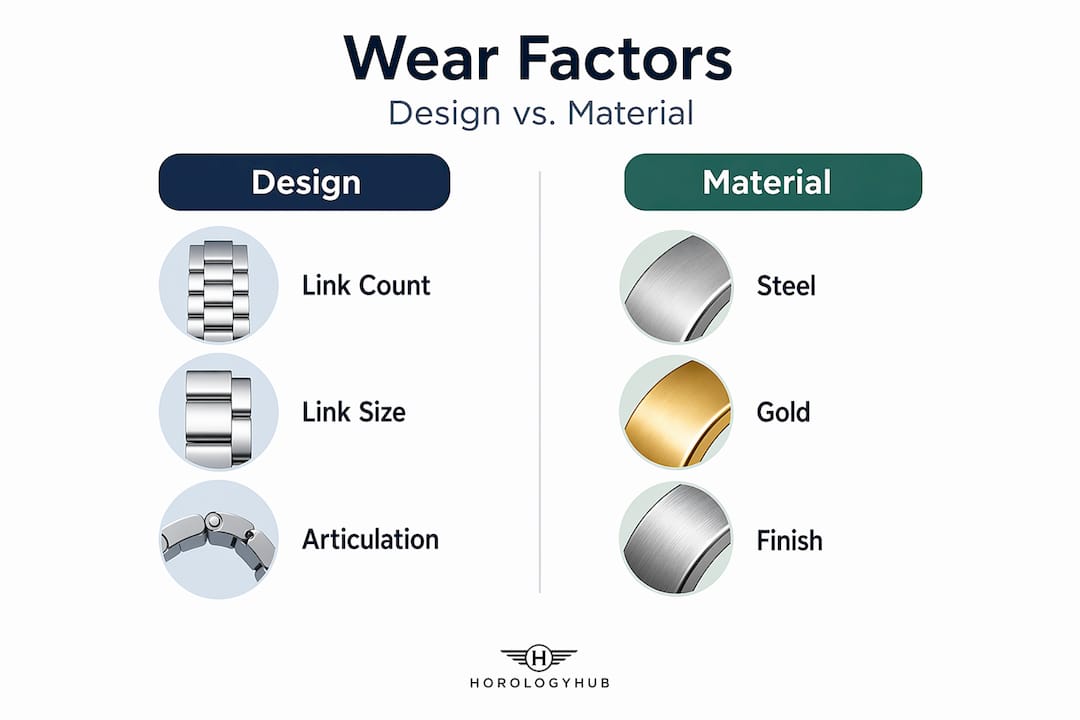
| Bracelet type | Link count | Link size | Primary wear risk |
|---|---|---|---|
| Oyster | ~21 | 8 to 10mm | Pin wear at fewer points |
| Jubilee | 23 to 25 | 5 to 7mm | Stretch from multiple articulation points |
| President | ~21 | Semicircular | Clasp and end-link wear |
| Mesh | 100+ micro | N/A | Surface abrasion and thinning |
Pro Tip: Check your bracelet’s finish type before polishing. Brushed finishes require a directional polishing technique, while polished surfaces need a circular motion. Mixing the two creates visible streaks that are difficult to correct at home.
How watch bracelet links wear: patterns, causes, and signs
The wear process is gradual, which is exactly why most people miss it. Wear manifests as increased lateral play and visible gaps between links as pins thin and the holes they sit in expand. What starts as barely noticeable movement becomes a loose, sloppy feel that no clasp adjustment can fix.
Dirt acts as an abrasive paste accelerating pin and hole enlargement, causing irreversible bracelet stretch. This is the most underappreciated cause of watch bracelet wear. Every time you flex your wrist while there is grit trapped inside a pivot joint, you are grinding metal away. Sweat, soap residue, and fine dust all contribute. They don’t just look bad. They actively destroy the bracelet’s mechanical integrity from the inside.
Bracelet stretch occurs as pins expand and loosen over wear, most noticeably in Jubilee bracelets due to their higher number of articulation points. Modern manufacturing tolerances have reduced this issue, but it has not been eliminated. A well-worn Jubilee on a vintage Rolex can be visibly longer than its factory specification.
Here is how to check your bracelet systematically for early wear:
- Hold the bracelet flat and look along its length. Any noticeable bowing or uneven gaps between links indicate uneven pin wear.
- Pinch a single link and gently push it side to side. More than minimal lateral movement signals pin wear in that joint.
- Listen when you flex the bracelet. Creaking or clicking sounds from a metal bracelet mean dirt has compromised a joint or a pin is loose.
- Inspect the clasp end links under a loupe or magnifier. End links take disproportionate stress and often show corrosion or fatigue cracks first.
- Compare your current bracelet length to when you first got the watch. If the bracelet now fits looser on the same clasp position, stretch has occurred.
Visual signs worth monitoring include discoloration around pin exits, white or gray buildup in link recesses (a sign of trapped moisture), and any darkening of the metal at flex points. Daily maintenance and cleaning is often overlooked but critical to preserving link articulation and appearance over time.
Pro Tip: Stiffness or noise in a metal bracelet signals an urgent cleaning need. Don’t wait for your annual service. Address it within a week or the compounding abrasion will make the damage permanent.
Best practices for maintaining and minimizing link wear
Good maintenance is not complicated. It is just consistent. The watch owners who get a decade of clean wear out of their bracelets are not doing anything exotic. They are doing simple things on a regular schedule.

The foundation is cleaning. Warm water with a small amount of mild dish soap and a soft toothbrush works well for most stainless steel bracelets. Work the bristles into the gap between links to dislodge trapped grit. Pay close attention to the underside of the bracelet, where sweat and skin cells accumulate fastest. For a more targeted approach, understanding watch cleaning spray ingredients helps you choose products that clean effectively without leaving corrosive residue.
What to avoid is just as important as what to use:
- Never use bleach, ammonia, or acetone-based cleaners on metal bracelets. They strip protective coatings and accelerate corrosion at pin points.
- Avoid ultrasonic cleaners unless your watchmaker confirms your specific bracelet can handle the vibration frequency without loosening already-worn pins.
- Skip abrasive polishing cloths on brushed-finish sections. They permanently alter the finish texture and reduce resale value.
- Don’t rinse a bracelet with a leather strap still attached. The strap will absorb moisture and degrade faster than the metal ever would.
For daily wearers, a quick wipe with a microfiber cloth at the end of the day removes surface oils before they migrate into joints. A deeper clean once a week takes five minutes and prevents the grime buildup that turns minor wear into serious damage. For watches worn occasionally, clean the bracelet before storage and store it flat or in a watch roll to prevent stress on clasp pins.
Fit also plays a direct role in how fast links wear. The optimal fit allows a finger to fit snugly between the wrist and clasp. A bracelet worn too loose swings on the wrist, generating impact stress with every arm movement. Too tight, and the bracelet fights against wrist flexion, stressing the inner links with every bend.
Pro Tip: Check your bracelet fit at different times of day. Wrists swell slightly in heat and after exercise. If your bracelet is perfect in the morning but tight by afternoon, use the micro-adjustment holes in the clasp before removing a full link. Those clasp micro-adjustments reduce mechanical stress on pins and extend the time before a full resize is needed.
You can learn more about how specific strap materials affect wear resistance in this watch strap material comparison from ChronoCare.
When to replace or resize bracelet links
Knowing when to act is as valuable as knowing how. There are two distinct decisions here: adjustment (removing links to correct fit) and replacement (swapping damaged links for new ones).
Adjustment is needed when the bracelet has stretched or your wrist size has changed. Replacement is needed when a link shows physical damage such as cracked metal, a corroded pin hole, or a deformed link body that can no longer hold a pin securely. These are not the same problem, and mixing up the solutions causes further damage.
Signs that replacement rather than adjustment is required:
- A pin hole is visibly oval rather than round, meaning the metal has deformed from wear.
- Surface corrosion has penetrated below the finish layer and appears as pitting or flaking.
- A link no longer sits flush with its neighbors when the bracelet lies flat.
- The pin retaining collar is missing or cracked.
Professional resizing generally takes under 15 minutes, but DIY mistakes can lead to damaged pins and costly repairs. The most common DIY error is pushing a pin out in the wrong direction or losing a retaining collar. These tiny collars fall instantly and are nearly impossible to find on a workbench. Precision in removing links, including direction of pushing pins and catching tiny collars, is crucial to avoiding damage and losing parts.
If you choose to resize at home, follow this sequence:
- Identify your pin type. Split pins push out in one direction only. Pin and collar systems require catching the collar as the pin exits. Screw pins unthread counterclockwise.
- Use a proper watch link tool with a correctly sized punch. Using a nail or a generic punch will deform the pin hole.
- Remove links from both sides of the bracelet in equal numbers to keep the clasp centered. Removing equal links from both sides maintains bracelet balance and prevents the clasp from sitting off-center.
- Re-check fit after each pair of links is removed. Do not pre-remove all the links you think you need and reassemble. Small adjustments compound quickly.
- Seat each pin fully. A pin that is only 90% seated will work loose within days of normal wear.
When sourcing replacement links, always use parts from the original manufacturer or a reputable dealer who can confirm compatibility. Off-brand links that “look right” often have slightly different tolerances, and that difference shows up as uneven gaps, mismatched finish, or accelerated wear at the junction.
For a polished final result after resizing, ChronoCare’s dry polishing guide walks through the process of restoring surface consistency after link work.
My honest take on bracelet wear
I’ve seen the same pattern repeat itself across hundreds of watch owners, and it almost always goes the same way. The bracelet is treated like furniture rather than a mechanical component. People will spend money on a watch winder, a humidity-controlled box, and a specialized cleaning kit for the crystal, then neglect the bracelet entirely until it looks embarrassing or starts to rattle.
What I’ve learned is that the bracelet deserves the same respect as the movement. It is the part that physically connects the watch to your body. Every flex, every impact, every drop of sweat runs through those links. The wear is real and cumulative.
My experience with Jubilee bracelets is that they show wear faster than most people expect, especially when worn daily in warm climates. I’ve pulled Jubilee bracelets off watches after three years of daily wear and found measurable stretch. The same watches on Oyster bracelets looked and measured fine at the same interval. That is not a knock on the Jubilee; it is a more comfortable bracelet. But the owner needs to know what they are signing up for.
The most consistent piece of advice I give is this: get your bracelet inspected by a watchmaker at least once every two years if you wear it daily. Not because something will necessarily be wrong. Because the professional will catch what you won’t. Professional servicing identifies early signs of pin wear that DIY users regularly miss, and catching a worn pin before it fails is orders of magnitude cheaper than replacing a cracked link body or sourcing an out-of-production link.
Choose your bracelet type based on how you actually live, not how you imagine you’ll wear the watch. A Jubilee on a daily-wear sports watch in a physically demanding environment is a maintenance commitment. Go in with clear eyes.
— Raymond Jenkins
Keep your bracelet in top condition with ChronoCare
The wear patterns covered in this article are real, but most of them are preventable with the right products and a consistent routine.
ChronoCare’s Ultimate Watch Cleaning Kit includes everything you need to remove the grime and grit that accelerates pin wear, formulated specifically for luxury metal bracelets. For bracelets that have already developed surface scratches or micro-wear, the Watch Polishing Cream restores shine to stainless steel and other metal surfaces without abrasive compounds that worsen the finish. Both products are formulated in the US and designed for watch collectors who treat their timepieces as the investments they are. Protecting a metal bracelet costs a fraction of replacing it.
FAQ
What causes watch bracelet links to wear out?
The primary causes are mechanical friction at pin joints, dirt and grit acting as abrasive material inside those joints, and improper fit that generates constant impact stress. Sweat and moisture also accelerate corrosion at pin holes over time.
How do I know if my watch bracelet has stretched?
If your bracelet fits looser on the same clasp position than it did when new, or if you notice visible gaps between links or increased lateral movement when you flex a single link side to side, stretch has occurred.
Can I resize my watch bracelet at home?
Yes, but the risk of losing retaining collars or damaging pin holes is real. Professional resizing takes under 15 minutes and avoids the costly mistakes that turn a simple adjustment into a bracelet repair job.
How often should I clean my watch bracelet?
For daily wear, a light wipe with a microfiber cloth daily and a deeper clean with mild soap and a soft brush once a week is a solid routine. Clean before storage if the watch will sit unworn for more than a few weeks.
When should I replace bracelet links instead of adjusting them?
Replace links when pin holes show visible deformation, when corrosion has pitted the metal below the surface finish, or when a link body no longer sits flush with adjacent links. Adjustment only addresses fit; replacement addresses structural damage.