

Watch Case Material Care Differences: A Collector's Guide
Ceramic and sapphire cases need almost no routine care beyond a daily wipe. Stainless steel and titanium reward periodic cleaning and occasional refinishing. Bronze is its own category entirely: it ages on purpose, and you either manage that patina or embrace it. The watch case material care differences between these groups are not subtle, and mixing up the rules causes irreversible damage.
- Lowest routine care: ceramic, sapphire, platinum (wipe daily, avoid edge impacts)
- Moderate care: 316L/904L steel, Grade 5 titanium (rinse after salt, soft brush monthly, light polish when needed)
- Patina-first maintenance: bronze (rinse to slow patina, or use lemon juice/baking soda to reset it)
- Coating-specific rules: PVD/DLC finishes (never polish, clean gently only)
ChronoCare cleaning and polishing kits handle routine upkeep for metal and precious metal cases. Deep scratches exposing substrate, coating failure, or water ingress require a watchmaker, not a kit.
Pro Tip: If you own more than one material, start with the most restrictive rule in the house. Never reach for a polishing cloth without confirming the case finish first.
Key Takeaways
Matching your care routine to the specific material is the single most effective way to preserve both the finish and the long-term value of a watch case.
| Point | Details |
|---|---|
| Match care to material | Ceramic and sapphire need only a daily wipe; steel and titanium need monthly cleaning and periodic refinishing. |
| Never polish coated finishes | PVD and DLC cannot be buffed back; coating failure requires professional re-coating at $300 or more. |
| Bronze patina is controllable | Rinse regularly to slow it, or use lemon juice/baking soda to reset it; store dry and separate from other watches. |
| Precious metals lose material when polished | Polish gold and platinum only when genuinely needed; hairline scratches on heirloom pieces are not damage. |
| ChronoCare kits for routine upkeep | Use the Ultimate Watch Cleaning Kit for monthly maintenance; add the Polishing & Cleaning Kit for steel and precious metal refinishing. |
Table of Contents
- How do different watch case materials compare at a glance?
- Care routines for each watch case material
- What mistakes cause permanent damage to watch cases?
- When does a watch case need professional refinishing?
- How often should you clean and service your watch case?
- How should material guide your buying and storage decisions?
- The trade-off most collectors underestimate
- ChronoCare kits for routine watch case maintenance
- Sources
How do different watch case materials compare at a glance?
The table below covers the eight material families collectors encounter most. Use weight and refinishability as your first two filters for daily-wear decisions.
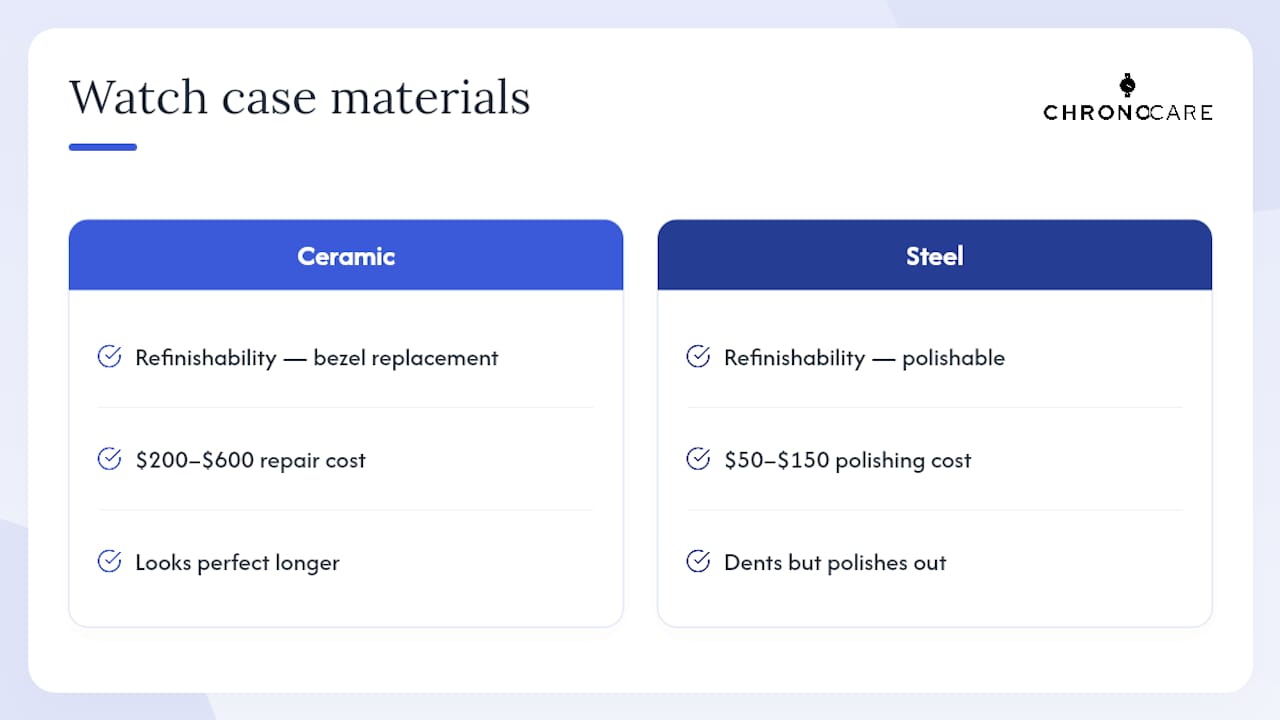
Allergy, weight, and exposure profile should be the first filters you apply when choosing a material, not aesthetics alone.
Pro Tip: If you wear your watch daily in varied conditions, prioritize refinishability. Ceramic looks perfect longer but one bad drop can cost $200–$600 in bezel replacement. Steel absorbs the same drop with a dent you can polish out for $50–$150.
Care routines for each watch case material
316L and 904L stainless steel
316L is the surgical-grade backbone of most watch cases, and it earns that reputation partly because care is straightforward. Daily: wipe sweat and oils with a soft microfiber cloth. Monthly: warm soapy water with a soft-bristle brush through the bracelet links, then rinse and dry thoroughly. After ocean or pool exposure: rinse under fresh running water immediately. For light surface scratches, a Cape Cod cloth or ChronoCare polishing cloth restores shine on polished surfaces. One firm rule: never run a polishing cloth across a brushed-finish panel. You’ll round the grain and create a mismatched sheen that a watchmaker charges real money to correct. See the watch case finishing guide for the difference between brushed and polished panels before you touch anything.
Titanium (Grade 2 vs. Grade 5)
Titanium runs significantly lighter than steel and resists corrosion better, but scratch behavior splits sharply by grade. Grade 2 scratches visibly from everyday contact. Grade 5 (Ti-6Al-4V) and surface-hardened variants hold up considerably better. Daily care mirrors steel: soft cloth wipe, rinse after salt. Skip the polishing compound on titanium unless a watchmaker confirms the surface treatment. Titanium’s oxide layer thickens naturally over years, subtly changing the visual texture. Many collectors leave it alone for exactly that reason.
Bronze
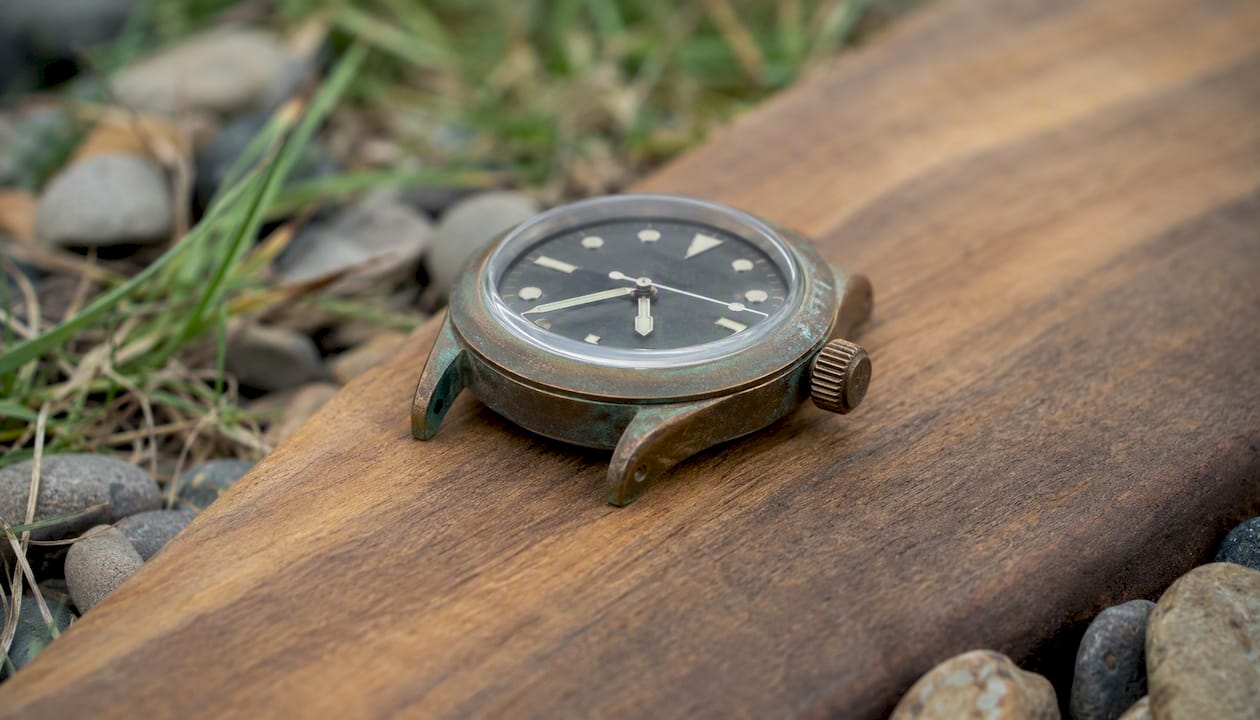
Bronze patinates deliberately when exposed to oxygen, sweat, and salt. That patina is a protective oxide layer, not damage. To slow it: rinse the case after every wear and store in a dry environment. To accelerate it: wear it hard and skip the rinse. To reset it entirely: apply a small amount of lemon juice or a baking soda paste, let it sit briefly, then rinse and dry. Check your caseback material before doing this. A steel caseback on a bronze case can develop green transfer staining if moisture sits in the joint. Store bronze watches separately from other pieces to prevent contact discoloration.
Gold and platinum
Both materials are soft relative to steel. Gold scratches easily; platinum develops a surface sheen called a patina of its own (a compressed rather than removed surface). Clean with mild soap and lukewarm water, dry with a soft cloth. The critical mistake here is overpolishing. Every pass of a polishing wheel removes actual material. On an 18k gold case, that adds up. A watchmaker should handle anything beyond light surface cleaning, and even then, ask them to polish conservatively.
Ceramic and sapphire
High-tech ceramic sits at roughly 1,200+ Vickers hardness, and synthetic sapphire goes well beyond that. Neither scratches from normal daily contact. Daily care is a wipe with a clean, dry cloth. The vulnerability is edge impact: a sharp corner drop can crack ceramic or sapphire cleanly, and neither material can be repaired. Replacement is the only fix. Avoid abrasive cloths entirely; they won’t scratch the surface but can dull any anti-reflective coating on the crystal.
Carbon, forged carbon, and resin/plastic
These materials are light and scratch-resistant but sensitive to UV and solvents. Store away from direct sunlight; prolonged UV exposure yellows resins and can cause delamination in forged carbon. Never use acetone, alcohol, or any solvent-based cleaner. ChronoCare’s cleaning sprays formulated for luxury cases are safe here. Wipe with a soft cloth after each wear.
PVD and DLC coatings
Standard black PVD shows silver wear marks quickly on edges and high-contact points, and those marks cannot be polished away. DLC (diamond-like carbon) is significantly more durable and the better choice for a tool watch you plan to wear hard. For both: clean gently with a damp soft cloth, nothing abrasive. If the coating chips or flakes, the fix is professional re-coating or replacement, not DIY buffing.
Pro Tip: After any ocean swim, rinse the case under fresh running water within an hour. Salt crystals that dry in lug gaps accelerate corrosion on steel and can stain bronze permanently.
What mistakes cause permanent damage to watch cases?
Most irreversible watch case damage comes from three errors: polishing the wrong finish, using the wrong cleaner, and ignoring environmental exposure.
- Polishing brushed steel: rounds the grain permanently; requires professional re-brushing to fix
- Buffing PVD/DLC: removes the coating, exposing raw base metal; no home fix exists
- Abrasive cleaners on ceramic: won’t scratch the case but destroys anti-reflective coatings
- Storing bronze in a damp cloth: accelerates patina unevenly and causes green staining
- Leaving saltwater to dry on lugs: salt crystals concentrate and pit steel or stain bronze over days
- Solvents on plastic/resin cases: causes crazing and surface breakdown
- UV exposure for polymers and composites: yellowing and delamination over months
Manufacturer guidance is clear: only rinse under running water if the watch is rated at least 5 bars (W.R.5BAR). Submerging a watch rated below that for cleaning is a fast route to water ingress.
Pro Tip: Before using any cloth or compound on a case, check whether the surface is brushed or polished. A safe dry polishing approach protects value; guessing wrong costs more than the kit.
When does a watch case need professional refinishing?
Most collectors can handle routine cleaning at home. The line between DIY and professional work is straightforward once you know what each material allows.
Typically reparable by a watchmaker:
- Steel: full re-polish or re-brush to near-factory condition
- Titanium: re-brushing (polishing is possible but often avoided to preserve originality)
- Gold/platinum: re-polish, though with measurable material loss each time
- Bronze: chemical patina removal and surface reset
- PVD/DLC: professional re-coating (not repair of the existing layer)
Not reparable, replacement only:
- Ceramic bezel or case cracks
- Sapphire case fractures
- Delaminated forged carbon
Typical U.S. market cost ranges for common repairs:
Can coatings be re-applied? Yes, but only by a facility with PVD or DLC deposition equipment. Most independent watchmakers outsource this. Expect 3–6 weeks and $300 or more depending on case complexity.
When is damage irreversible? Ceramic or sapphire cracks, deep gouges that expose base metal under a coating, and delaminated composites cannot be restored to original condition.
How often should you clean and service your watch case?
A simple cadence covers most materials:
- Daily: wipe sweat and skin oils with a soft cloth after each wear
- Monthly: warm soapy water and a soft brush for metal cases and bracelets; dry completely
- Annually: thorough cleaning, gasket inspection, and case condition check
- Every 4–6 years: full movement service; case refinishing assessed at the same visit
Red flags that require a watchmaker immediately, regardless of schedule:
- Pitting or corrosion on steel lugs
- Deep scratches exposing a different-colored substrate (coating failure)
- Ceramic or sapphire cracks
- Coating flaking or peeling
- Any sign of water ingress (fogging crystal, moisture under the dial)
- Loose or detached lugs
Pro Tip: Consistent use of ChronoCare cleaning kits for monthly maintenance reduces the frequency of professional shop visits for cosmetic work. Water ingress and detached lugs are the two scenarios where no kit replaces a watchmaker.
How should material guide your buying and storage decisions?
A few honest questions narrow the field faster than any spec sheet.
Before you buy, ask yourself:
- How often will you wear it, and in what conditions?
- Will it see saltwater regularly? (Titanium or ceramic over bronze or steel)
- Do you want the watch to age and develop character? (Bronze yes, ceramic no)
- Do you have a nickel allergy? (Steel is out; titanium, ceramic, gold, or platinum instead)
- Does wrist fatigue matter on long wear days? (Titanium or carbon over gold or steel)
Storage by material:
- Steel and titanium: individual soft pouches or watch rolls; silica gel packs in the storage box to control humidity
- Bronze: dry environment only; separate from other watches to prevent green transfer
- Gold and platinum: soft-lined individual compartments; never stacked or in contact with harder materials
- Ceramic and sapphire: padded storage away from hard surfaces; edge impacts are the only real threat
- Carbon/composites and plastics: away from direct sunlight and heat sources; UV is the long-term enemy
- PVD/DLC: soft pouches; avoid contact with abrasive surfaces even in storage
Short decision framework: choose ceramic or sapphire for a display piece you want to stay pristine with minimal effort. Choose steel or Grade 5 titanium if you want a daily wearer you can refinish affordably when it shows wear. Choose bronze if you want a watch that tells its own story over time.
The trade-off most collectors underestimate
There is a tendency in collector circles to treat low-maintenance materials as the “smart” choice and patina-developing materials as high-effort. That framing misses something.
Bronze and aged gold are not maintenance burdens. They are materials with memory. A bronze case worn through a summer in coastal Maine looks nothing like one worn in Phoenix, and neither looks like it did when it left the factory. That is the point. Collectors who choose bronze are not accepting a compromise; they are choosing a different relationship with the object.
The real trade-off is between control and character. Ceramic gives you control: the case looks the same in five years as it does today. Bronze gives you character: it records where you’ve been. Neither is wrong. But conflating “easy to maintain” with “better” ignores why many collectors own more than one material in the first place.
Where I’d push back on conventional wisdom: the obsession with keeping precious metal cases polished. Every professional polish on an 18k gold case removes material that cannot be replaced. A few hairline scratches on a gold case are not damage. They are evidence of use. Treat heirloom gold and platinum conservatively. Clean gently, store carefully, and let a watchmaker polish only when the surface genuinely needs it, not on a schedule.
Raymond Jenkins’ watch care guides make this point practically: the goal of care is preservation, not perpetual restoration.
ChronoCare kits for routine watch case maintenance
For collectors who want a reliable, material-safe routine without sourcing individual products, ChronoCare offers two kits built specifically for luxury timepieces.
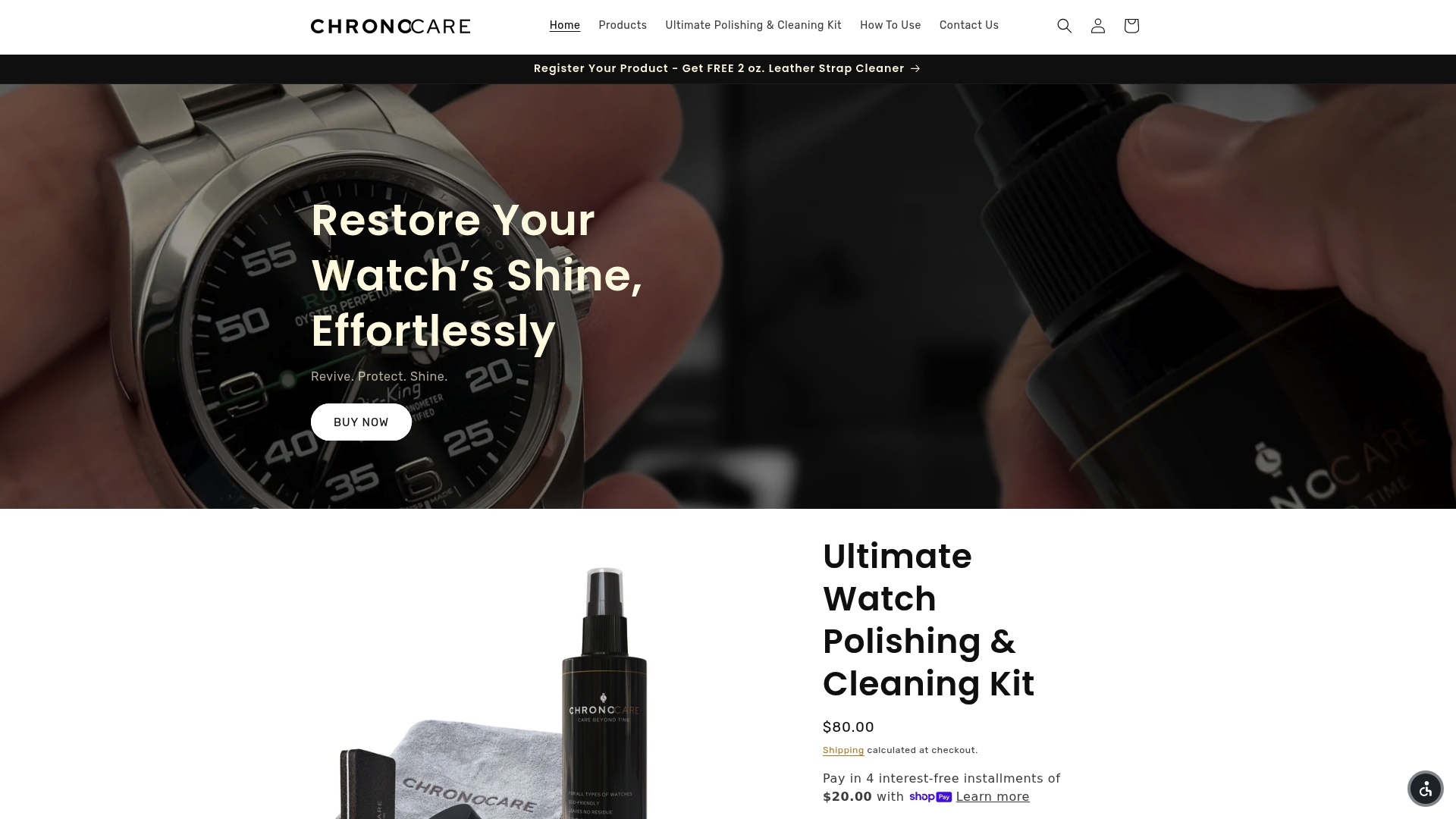
The Ultimate Watch Cleaning Kit covers daily and monthly cleaning across steel, titanium, ceramic, and precious metal cases. It includes a cleaning spray formulated to lift skin oils and salt residue without stripping coatings or damaging gaskets, plus a soft cloth safe for all polished and brushed surfaces.
The Ultimate Watch Polishing & Cleaning Kit adds polishing compounds and cloths for light refinishing on steel and precious metal cases. One firm warning: do not apply the polishing paste to PVD, DLC, anodized, or coated cases. Use the cleaning components only on those finishes.
Safe order of operations: clean first, inspect the surface, then polish only if the material allows it. Both kits are formulated in the U.S. and designed around the care requirements of luxury watch cases.
Sources
- Watch Case Materials Guide: Steel, Titanium, Ceramic, Gold & More Compared - WatchPolice
- Watch case metals reactivity guide | WATCH EDUCATION
- There’s more to watch life than steel | Hodinkee
- Cleaning your wristwatch (with videos) | CITIZEN WATCH Global Network
- Watch Case Materials Guide: Steel, Titanium, Ceramic, Gold & More Compared - We Know Watches