

Watch Display and Rotation: A Collector's 2026 Guide
Watch display and rotation are defined as the combined practice of housing timepieces in a way that maintains their mechanical readiness while protecting their appearance and long-term value. For collectors of automatic watches, the role of watch display and watch rotation goes beyond aesthetics. Rotation exercises the movement, prevents lubricant stagnation, and keeps every piece in your collection ready to wear. A watch left untouched for months risks congealed oils and a dead power reserve. Understanding how these two practices work together is the foundation of serious collection care.
What is the role of watch display and watch rotation?
Watch rotation is the practice of cycling through your collection so each automatic movement stays exercised. The rotor inside an automatic watch converts wrist movement into energy, winding the mainspring and keeping the watch running. When a watch sits still for weeks, the oils that lubricate its gear train and escapement can thicken and pool unevenly. That uneven distribution is the real threat, not the act of stopping itself.
The watch display function serves a parallel purpose. A well-chosen display keeps your collection organized, accessible, and protected from dust, humidity, and UV exposure. Passive displays, such as watch boxes and trays, store watches safely but do nothing to maintain the wound state of an automatic movement. Active displays, meaning watch winders, simulate wrist motion and keep the power reserve topped up between wearings.
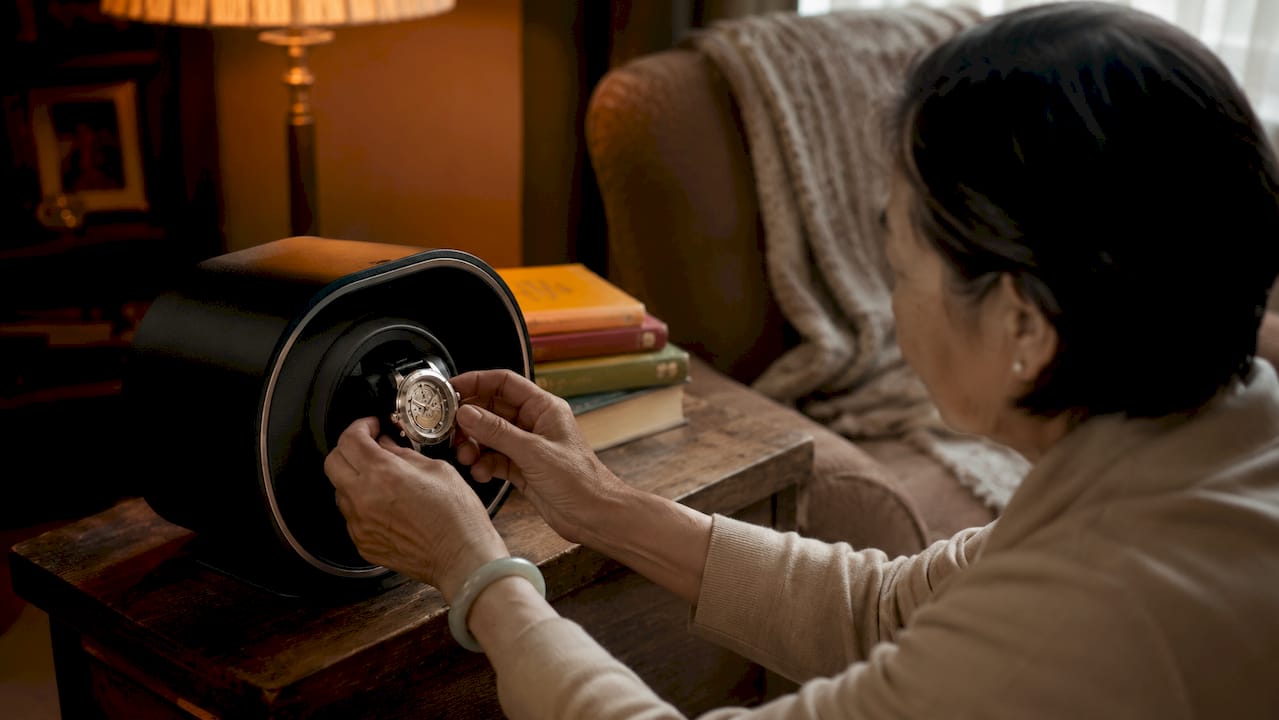
The importance of watch rotation becomes clearest when you consider lubricant stagnation. Mechanical watches generally require servicing every 5–10 years, and rotation supports that interval by keeping oils mobile rather than accelerating wear through motion. The goal is not to run the movement constantly. The goal is to prevent the oils from sitting idle long enough to degrade.
Pro Tip: Treat rotation as a scheduled habit, not a reaction to a stopped watch. A watch that winds down and restarts repeatedly from a cold stop puts more stress on the gear train than one kept gently exercised.
How does mechanical movement lubrication work?
The movement inside an automatic watch contains dozens of friction points: jewel bearings, the escapement lever, the balance wheel staff, and the gear train. Each point receives a specific lubricant applied during servicing. These lubricants are not interchangeable, and their condition determines how smoothly the movement runs.
Modern synthetic watch oils are far more stable than the animal-based and mineral oils used in vintage movements. Modern synthetic oils maintain their viscosity during rest, meaning a watch sitting in a drawer is not necessarily destroying its lubricants. Wear originates primarily from friction during movement, but only minimally during normal use. This fact reframes the entire rotation debate.
The key variable is oil age, not oil motion. A freshly serviced watch can rest for months without damage. A watch running on 15-year-old lubricants is at risk whether it is worn daily or stored. Rotation helps, but it does not substitute for timely servicing.
- Rotor function: The rotor spins with wrist movement and transfers energy to the mainspring via a series of reduction gears.
- Power reserve: Most automatic movements store 38–72 hours of reserve, depending on the caliber.
- Lubrication points: A typical movement has 15–25 lubrication points, each requiring the correct oil grade.
- Synthetic vs. vintage oils: Modern lubricants like Moebius 9010 and D5 are engineered for long-term stability. Older mineral oils degrade faster and benefit more from regular movement.
What rotation schedule works for different collection sizes?
Rotation schedules should match the size of your collection and your actual wearing habits. A weekly rotation schedule works well for collections of seven watches, cycling each piece once before returning to the first. Smaller collections of three to five watches benefit from a 1–2 day rotation to keep movements exercised and wear consistent across straps and cases.
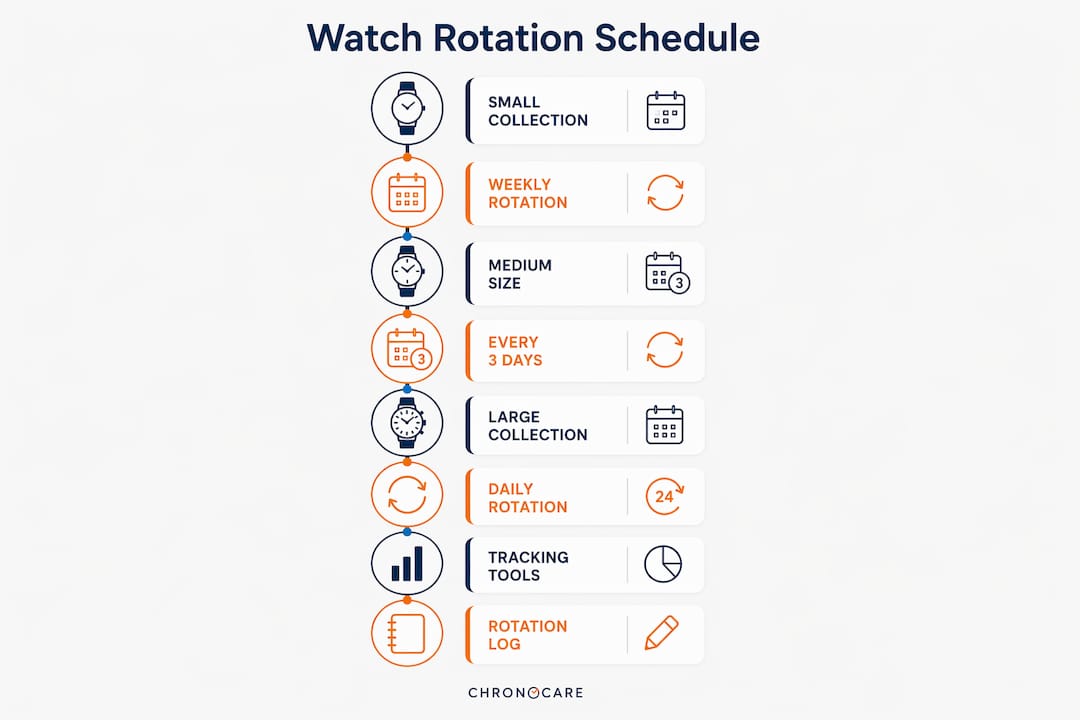
For collectors with more than ten pieces, tracking becomes non-negotiable. Forgotten watches commonly suffer more from lack of regular movement than actively rotated pieces, because lubricant congealing accelerates when a watch sits untouched for months. A simple log, whether a notebook or a collector app like Springboard or WatchVault, prevents neglect and keeps your entire collection in rotation.
Rotation also protects your watches cosmetically. Wearing the same piece every day concentrates bracelet stretch, clasp wear, and case scratches on one watch. Spreading wear across the collection extends the life of every piece.
- Collections of 1–2 watches: Wear alternately on consecutive days. No formal tracking needed.
- Collections of 3–5 watches: Rotate every 1–2 days. Keep a basic log to avoid repeating favorites.
- Collections of 6–10 watches: Use a weekly schedule. Assign each watch a day of the week.
- Collections of 10+ watches: Use a digital tracker. Flag any watch unworn for more than 30 days.
| Collection Size | Recommended Rotation Interval | Tracking Method |
|---|---|---|
| 1–2 watches | Every 1–2 days | None required |
| 3–5 watches | Every 1–2 days | Simple notebook |
| 6–10 watches | Weekly | Spreadsheet or app |
| 10+ watches | Monthly cycle | Digital tracker or app |
How do watch winders and display cases affect rotation?
A watch winder is the most direct tool for maintaining the benefits of watch display in an automatic collection. It mimics natural wrist motion by rotating the watch at programmed intervals, keeping the mainspring wound without requiring daily wear. A watch winder mimics natural wrist motion with intervals of rotation and rest, avoiding continuous forced winding that can cause inefficiency and mechanical stress.
The critical detail most collectors overlook is caliber-specific settings. Matching rotation direction and turns per day to the watch’s specific caliber is essential for proper winder performance. A movement that winds clockwise only will not benefit from a winder set to bidirectional rotation. Getting this wrong wastes energy and can overwind the mainspring on watches without a slipping clutch.
Passive display cases serve a different but equally valid purpose. A quality watch box or display tray protects against dust, humidity, and UV light, all of which degrade dials, gaskets, and straps over time. The choice between passive and active display depends on your collection’s composition.
- Watch winders: Best for automatic watches with complex complications like perpetual calendars, annual calendars, or moon phases, where resetting is time-consuming.
- Passive display trays: Best for manual-wind watches, quartz pieces, and automatic watches worn frequently enough to stay wound.
- Combination cabinets: Offer winder slots for priority pieces and tray storage for the rest. They suit mid-to-large collections well.
- UV-protective cases: Glass-topped display cases with UV filtering protect dials from fading, particularly on vintage pieces with tritium or lacquer dials.
Pro Tip: Expert consensus holds that watch winders should mimic inconsistent motion rather than continuous rotation. Program rest intervals into your winder settings to replicate real-world wear patterns.
Are common beliefs about watch rest and wear actually true?
The most persistent myth in watch collecting is that resting a watch reduces wear. The logic sounds reasonable: less motion means less friction. The reality is more specific. Wear mostly relates to oil age rather than motion, and modern lubricants are stable during rest. A resting watch is not being protected. It is simply not being used.
Vintage movements are a genuine exception. Watches running on original lubricants from the 1960s or 1970s carry oils that have already degraded. Starting and stopping an unserviced vintage movement repeatedly can cause more damage than leaving it at rest, because degraded oil provides almost no protection during the initial startup friction.
Starting and stopping an unserviced watch may cause more damage than resting it. The condition of the lubricant, not the frequency of motion, determines how much protection the movement actually has. A watch due for service needs a watchmaker, not a rotation schedule.
The practical takeaway is this: rotation benefits a well-serviced watch by keeping oils mobile and the power reserve active. It does not fix a watch that needs service. Pairing your rotation schedule with servicing intervals is the only approach that addresses both variables.
How do you build rotation and display into a daily collector habit?
Sustainable rotation habits work because they are simple and consistent, not because they are elaborate. Collectors report that rotation helps avoid frequent resetting and maintains readiness, linking enjoyment directly to mechanical preservation. A watch that is always wound and set is a watch you will actually wear.
- Assign watches to days or weeks. A fixed schedule removes decision fatigue and guarantees every piece gets worn.
- Log each wearing. A note in your phone or a dedicated app creates a record that reveals neglected pieces before damage occurs.
- Service and rotate together. When a watch returns from the watchmaker, reset its position in the rotation cycle. Fresh lubricants deserve regular exercise.
- Use winders for complication watches. A perpetual calendar or tourbillon that stops and needs resetting is a watch you will avoid wearing. A winder removes that friction.
- Clean after each wearing. Sweat, skin oils, and dust accumulate on cases and straps with every wear. Wiping down a watch before returning it to display prevents cosmetic degradation and keeps your watch care routine consistent.
Combining rotation with regular cleaning also protects the display itself. A watch box or winder that holds dirty watches transfers grime to cushions and mechanisms over time. The display and the watch are a system. Caring for one means caring for both.
Key Takeaways
Watch display and rotation together form the single most effective habit for maintaining both the mechanical function and cosmetic condition of an automatic collection.
| Point | Details |
|---|---|
| Rotation prevents oil stagnation | Cycling watches keeps lubricants mobile and power reserves active between wearings. |
| Oil age drives wear, not motion | Modern synthetic oils are stable at rest; servicing intervals matter more than rotation frequency. |
| Winder settings must match caliber | Incorrect turns per day or rotation direction wastes energy and can stress the movement. |
| Tracking prevents neglect | Collections of 10+ watches need a log or app to catch pieces sitting unworn for 30+ days. |
| Display type should match watch type | Use winders for complex complications and passive cases for manual-wind or frequently worn pieces. |
My honest take on rotation after years with a growing collection
I spent the first few years of collecting rotating watches out of guilt rather than strategy. I felt bad about neglecting a piece, so I would grab it, wear it for a day, and put it back. That is not a system. It is just anxiety wearing a watch.
The shift came when I started treating rotation as a maintenance tool rather than a fairness exercise. Once I understood that the real risk is lubricant stagnation and not mechanical wear from motion, the whole practice made more sense. I stopped worrying about wearing a favorite piece three days in a row and started worrying about the pieces I had not touched in two months.
The hardest part of managing a collection over ten watches is not choosing what to wear. It is remembering what you have. A tracking log, even a basic one, changes your relationship with the collection. You stop buying watches to fill gaps and start actually wearing what you own.
My advice for collectors whose collections are growing: build your rotation system before you need it. A five-watch collection is easy to manage by feel. A fifteen-watch collection is not. The habits you form now will determine whether your watches stay in condition or quietly degrade in a drawer.
— Raymond Jenkins
ChronoCare products that support your rotation routine
Rotation keeps your movements healthy, but the case, dial, and bracelet need attention too. Every time a watch comes off your wrist, it carries oils, dust, and micro-abrasions that compound over time.
ChronoCare’s watch cleaning kit gives you a complete solution for wiping down cases, crystals, and metal bracelets after each wearing. For collectors dealing with light surface scratches from daily rotation, the polishing and cleaning kit restores luster to metal surfaces without aggressive abrasion. Pairing a consistent cleaning habit with your rotation schedule is the most direct way to keep every piece in your collection looking and running as it should.
FAQ
What is the main purpose of watch rotation?
Watch rotation exercises the movement of automatic watches, keeping lubricants mobile and the power reserve active. It also distributes wear evenly across your collection, protecting cases, straps, and bracelets from concentrated use.
How often should I rotate my watch collection?
A weekly rotation works for collections of seven watches, while smaller collections of three to five pieces benefit from a 1–2 day cycle. Collections over ten watches need a tracking system to prevent any piece from sitting unworn for more than 30 days.
Does resting a watch actually protect it from wear?
Modern synthetic lubricants are stable during rest, so resting a watch does not meaningfully reduce wear. Oil age is the primary wear factor, which means timely servicing matters more than how often you rotate.
When should I use a watch winder instead of passive storage?
Use a winder for automatic watches with complex complications like perpetual calendars or moon phases, where resetting after a stopped movement is time-consuming. Passive storage suits manual-wind watches and automatics worn frequently enough to stay wound.
How does watch display affect long-term condition?
A quality display case protects against dust, humidity, and UV exposure, all of which degrade dials, gaskets, and leather straps over time. Combining protective display with a regular luxury timepiece maintenance routine preserves both appearance and mechanical integrity.