

The Role of Watch Movement Holder in Luxury Timepieces
A watch movement holder is a precision-engineered component that stabilizes and accurately positions the movement inside the watch case. Collectors and professionals who overlook this part miss one of the most consequential decisions in watch construction. The role of watch movement holder goes far beyond simple containment. It controls radial centering, manages axial positioning, and distributes mechanical loads that would otherwise stress the movement’s most delicate components. Whether you are evaluating a new acquisition or preparing a calibre for service, understanding how this component works changes how you read a watch’s quality from the inside out.
How does a watch movement holder function technically?
A movement holder is the primary radial control when the case itself cannot directly govern movement position. That single fact explains why the holder’s geometry matters as much as the movement’s own tolerances.
Radial centering is the holder’s first job. It prevents the movement from shifting laterally inside the case, which would misalign the crown stem with the setting tube and keyless works. Even a fraction of a millimeter of lateral play causes accelerated wear on those components over years of daily use. The holder fills the gap between movement and case with controlled clearance, keeping the movement locked on its intended axis.
Axial positioning is the second function. The holder sets the movement’s vertical position within the case stack, which governs rotor clearance above the movement and crown stem engagement depth. Get the axial position wrong and the rotor can graze the caseback or the crown can feel loose and imprecise. Tolerance control of 1–10 microns is the engineering standard for this positioning, a range tighter than a human hair.
- Radial centering: Prevents lateral movement and crown stem misalignment
- Axial positioning: Controls rotor clearance and crown engagement depth
- Load distribution: Spreads caseback closure forces across the movement perimeter
- Shock management: Absorbs and redirects impact energy away from pivots and jewels
The holder also distributes forces applied during caseback closure and shock events. When a watchmaker torques a caseback, the compressive load travels through the holder before reaching the movement. A well-designed holder spreads that load evenly. A poorly fitted one concentrates stress at contact points, which can deform plates or crack jewel settings over time.
Pro Tip: When examining a watch movement for purchase or service, check whether the holder seats flush with the case ring with no visible gap or tilt. Any visible asymmetry signals a fitment problem that will compound over time.
What materials are used for watch movement holders?
Material choice defines how well a holder performs its mechanical duties over the life of the watch. The two dominant categories are polymer-based holders and precision-machined metal holders, and they serve very different markets.
| Material | Common Use | Retention Method | Rigidity | Collector Signal |
|---|---|---|---|---|
| POM / Delrin (plastic) | Mass-market watches | Friction only | Lower | Entry-level construction |
| Brass (machined) | Mid-range and microbrands | Friction or screw | High | Manufacturing seriousness |
| Stainless steel (machined) | Tool watches, high-end | Screw fixed | Highest | Premium commitment |
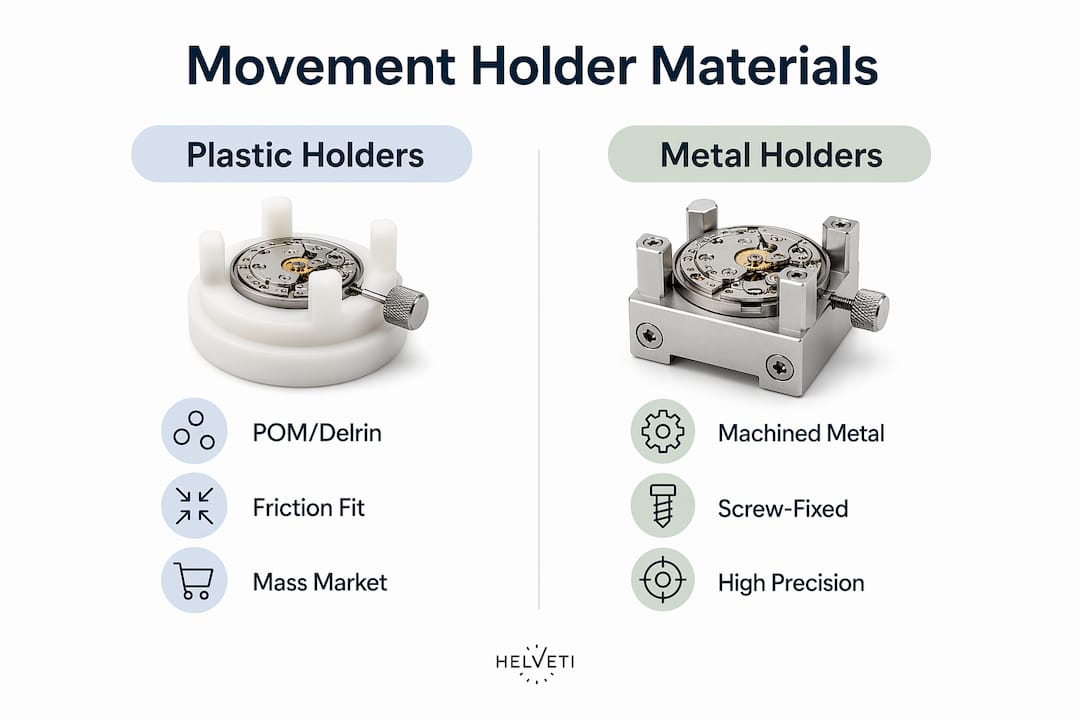
Plastic holders made from POM (polyoxymethylene), sold commercially as Delrin, dominate mass-market production because they are inexpensive to injection-mold and require no secondary machining. They work adequately when tolerances are generous and the watch sees light daily use. The limitation is rigidity. Plastic holders flex under load, which allows micro-movement of the calibre inside the case over time.
Precision-machined metal spacers carry a $1–$4 cost premium per unit but deliver measurably better alignment and durability. That premium is negligible in the context of a $500+ watch, which is why its absence in that price range signals a cost-cutting decision rather than an engineering one. Metal holders also enable screw retention of the movement, a feature plastic holders cannot offer because they lack the thread-holding strength. Screw-fixed movements are standard in serious tool watches and high-end dress watches for exactly this reason.
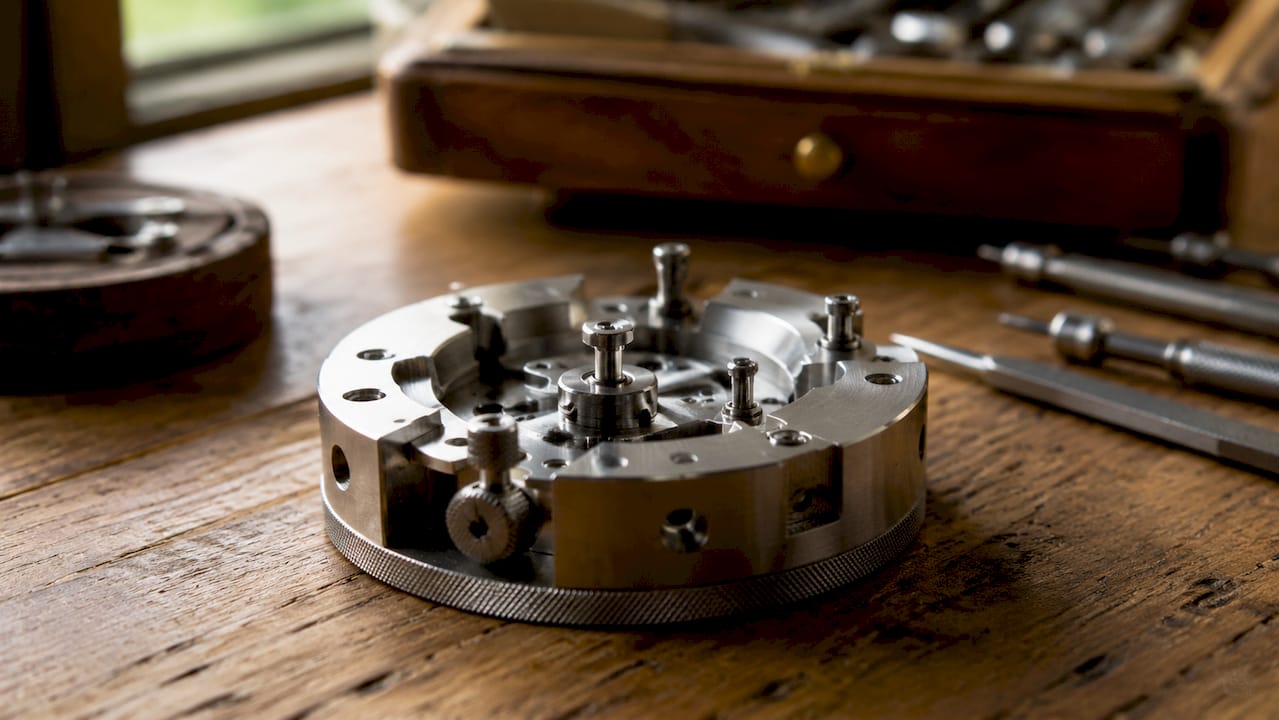
Metal spacers eliminate lateral play that accelerates wear on keyless works and setting tube threads. This is the detail that separates a watch built to last 30 years from one built to last 10.
Pro Tip: When evaluating a microbrand or independent watchmaker, ask specifically whether the movement spacer is machined metal or injection-molded plastic. The answer tells you more about their engineering priorities than any marketing copy.
Why is correct movement holder use vital during servicing?
Servicing a mechanical watch without the right holder is one of the most common sources of avoidable damage in independent repair shops. The movement, removed from its case, is structurally vulnerable. Its plates and bridges are held together by small screws, and any lateral force applied to the movement body can stress those joints or bend the thin pivot arbors that carry the gear train.
-
Use a calibre-specific holder for chronographs. Calibre-matched holders are critical for chronograph servicing because the column wheel, vertical clutch, and additional bridges create an irregular movement profile. Generic holders contact the movement at the wrong points and can deform the plate or damage the column wheel housing.
-
Secure the movement before hand-setting. Pressing cannon pinions and hour wheels onto the dial side requires downward force. Without a holder gripping the movement body, that force travels through the movement unsupported, bending pivots in the gear train below.
-
Use size-specific holders for regulation. Adjusting the regulator lever requires fine lateral pressure on the balance cock. A movement that shifts in the holder during this step produces an inaccurate regulation result, because the reference position changes mid-adjustment.
-
Inspect the holder before each use. A cracked or worn holder loses its dimensional accuracy. Incorrect or generic holders cause movement plate stress and component misalignment, which directly impacts regulation quality and long-term longevity.
-
Match the holder to the movement diameter, not just the calibre family. Many calibre families share a base plate but differ in diameter by 0.5mm between variants. Using the wrong variant within a family creates the same fitment problems as using a completely wrong holder.
Professional watchmakers keep a set of universal adjustable holders for general work and calibre-specific holders for complex movements. The correct holder type protects movement integrity during every stage of service, from disassembly through final regulation. Skipping this step is not a time-saver. It is a liability.
How do movement holders affect accuracy, longevity, and collector value?
The movement holder’s influence extends well past the assembly bench. Its quality shapes how the watch performs and ages across years of ownership.
- Crown stem alignment: A holder that maintains precise radial centering keeps the crown stem on axis with the setting tube. Misalignment creates friction and wear every time the crown is pulled and pushed, eventually loosening the setting mechanism.
- Rotor clearance: Consistent axial positioning prevents the rotor from contacting the caseback. Rotor contact produces audible rattling and generates metal debris that contaminates the oil in the gear train.
- Shock resistance: A holder that manages dynamic forces without inducing plate stress absorbs wrist impacts more effectively, protecting pivots and jewels from repeated micro-shocks.
- Manufacturing quality signal: Metal spacers signal manufacturing seriousness in the watch community, influencing collector perception and brand reputation. Experienced collectors check this detail when evaluating independent brands.
The holder also affects how tolerances express inside the finished watch. Movement holders define the interface controlling how manufacturing tolerances manifest within the watch case. A well-designed holder absorbs variation and keeps the movement centered despite minor dimensional differences between individual cases and movements. A poor holder amplifies that variation, turning a 2-micron tolerance stack into a visible alignment problem.
For collectors focused on watch polishing and value, the movement holder is the internal equivalent of surface finish. Both reflect the manufacturer’s commitment to quality at every level of the watch, visible and hidden.
Key Takeaways
A watch movement holder is not a passive spacer. It is the primary mechanical interface that controls alignment, distributes load, and determines how well the movement performs and ages inside the case.
| Point | Details |
|---|---|
| Radial and axial control | Holders maintain 1–10 micron tolerances to keep crown stem and rotor correctly positioned. |
| Material choice matters | Machined metal holders outperform plastic in rigidity, retention, and long-term wear resistance. |
| Servicing requires the right holder | Calibre-specific holders prevent plate deformation and pivot damage during repair and regulation. |
| Collector value indicator | Metal spacers signal manufacturing quality and influence how experienced collectors evaluate a brand. |
| Tolerance management | Holders control how dimensional variation expresses inside the case, protecting mechanical integrity. |
Why collectors underestimate the movement holder
The movement holder is the component I hear least about in collector forums and the one I think about most when evaluating a watch’s long-term prospects. Most enthusiasts focus on the movement’s finishing, the dial’s texture, or the case’s proportions. Those details matter. But the holder is what keeps all of them working together correctly over a decade of daily wear.
I’ve seen beautifully finished movements develop crown play within three years because the holder allowed 0.3mm of lateral movement inside the case. I’ve also seen modest movements in well-engineered metal holders run accurately for 20 years with minimal service. The holder doesn’t get credit for the second outcome, but it deserves it.
The misconception I encounter most often is treating the holder as a mere accessory rather than a foundational tool. When you’re building a luxury timepiece maintenance checklist, the holder belongs at the top of the servicing equipment list, not as an afterthought. Calibre complexity should drive holder selection. A simple three-hand movement tolerates a universal adjustable holder. A chronograph does not.
My advice to collectors evaluating independent brands: ask about the spacer material before you ask about the movement finishing. The answer reveals more about engineering priorities than any specification sheet.
— Raymond Jenkins
ChronoCare’s watch care kits for serious collectors
Maintaining a luxury watch at the level it deserves requires the right tools at every stage, from the movement holder on the bench to the cleaning kit on your desk.

ChronoCare’s Ultimate Watch Cleaning Kit is formulated specifically for luxury timepieces, covering case surfaces, crystal, and bracelet with professional-grade solutions. For collectors who want complete care, the Ultimate Watch Polishing & Cleaning Kit adds polishing compounds designed to restore case finish without damaging brushed or satin surfaces. Both kits are formulated in the US and built for the collector who treats maintenance as part of ownership, not an afterthought. Precise mechanical care starts inside the case. Precise surface care starts with ChronoCare.
FAQ
What is a movement holder in watchmaking?
A movement holder is a precision-fitted ring or spacer that positions and stabilizes the watch movement inside the case. It controls radial centering and axial positioning to maintain crown stem alignment and rotor clearance.
Why does movement holder material matter?
Machined metal holders offer higher rigidity and can be screw-fixed to the movement, while plastic holders rely on friction alone and flex under load. Metal holders reduce lateral play that accelerates wear on the keyless works over time.
What types of watch movement holders exist?
The three main types are universal adjustable holders, size-specific holders, and calibre-specific holders. Calibre-specific holders are required for complex movements like chronographs to prevent plate deformation during servicing.
How does a movement holder affect watch accuracy?
A holder that maintains precise radial centering keeps the crown stem on axis, reducing friction and wear in the setting mechanism. Consistent axial positioning also prevents rotor contact with the caseback, which would generate debris and contaminate movement oil.
Can I service a watch without a proper movement holder?
Servicing without the correct holder risks plate deformation, pivot damage, and inaccurate regulation results. Professional watchmakers use calibre-matched holders for every service to protect movement integrity throughout the process.