

Gold Watch Owners: Polish Only If Solid Gold and Water Resistant
Yes, you can polish a gold watch at home, but only under one condition: it has to be solid gold with confirmed water resistance and a healthy crystal, not a plated piece with worn edges or a case you can’t verify. Skip that check and you risk pushing moisture past a compromised gasket or stripping a plating layer that’s already thin. If your watch clears that bar, the right supplies and a careful, patient hand will do the job safely.
TL;DR:
- Only polish solid gold watches with confirmed water resistance and intact crystals to avoid pushing moisture inside or damaging plating.
- Use only watch-specific, non-abrasive supplies such as microfiber cloths, soft brushes, and gentle polishing creams designed for precious metals.
- Regular cleaning after wear and cautious monthly polishing help preserve gold’s finish, but avoid polishing plated or PVD watches, which can wear through thin coatings.
- Reserve professional repair, replating, or gasket replacement for deep gouges, plating wear, or internal moisture issues, not routine home care.
- Conservative handling, strict edge avoidance, and proper tools protect a watch’s value and prevent irreversible damage from over-polishing or using improper products.
Table of Contents
- What Supplies Do You Need to Polish a Gold Watch Safely?
- Is Your Watch Solid Gold or Just Plated?
- How Do You Polish a Solid-Gold Case and Bracelet Step by Step?
- Can You Polish a Gold-Plated or PVD Watch at Home?
- How Often Should You Clean and Polish a Gold Watch?
- When Should You Take a Gold Watch to a Professional Instead?
- Why Trust This Guidance on Gold Watch Care?
- Why Conservative Polishing Protects Your Watch’s Value
- Get the Right Tools for Safe At-Home Gold Watch Care
- Where This Guidance Comes From
- Sources
What Supplies Do You Need to Polish a Gold Watch Safely?
The gap between a watch that looks refreshed and one that looks scratched up usually comes down to what touched the metal. Gold is soft, softer than steel or titanium, which means household abrasives that seem harmless on other surfaces can leave permanent marks in minutes.
Here’s what belongs in your kit:
- A microfiber cloth for wiping down surfaces without scratching
- A soft-bristle brush (an old, clean toothbrush works if the bristles are genuinely soft) for reaching into lugs and clasp links
- A watch-grade polishing cloth impregnated with a mild polishing agent, sized for jewelry and watches specifically
- A polishing cream formulated for precious metals, applied in small amounts
- An air puffer (the kind photographers use on lenses) to clear dust and grit before you touch the case
- Protective tape to mask crystal edges or adjoining finishes you don’t want polish drifting onto
- A loupe or magnifier to check your work up close
What you should never reach for: toothpaste, baking soda paste, or any abrasive pad. These are dentist-office and kitchen-counter fixes that feel intuitive because they’re gritty and “clean” things elsewhere in your life, but that grit is exactly what scratches soft gold. Skip household cleaners with bleach or ammonia too. Mild dish soap and a microfiber cloth are the safer standard, and soft-bristle brushes are fine for crevices, but anything abrasive is off the table entirely.
Before you use any new polish on the actual case, test it on a hidden spot first, the underside of a bracelet link or the case back edge, and watch for discoloration or haze after it dries.
Is Your Watch Solid Gold or Just Plated?
This is the question that decides everything else, and getting it wrong is how a $40 mistake turns into a $600 repair bill.
- Check the hallmark. Solid gold cases carry a stamp like 18K, 14K, or 750, usually inside the case back or on the lug. Plated watches are marked GP (gold plated), GF (gold filled), or sometimes carry no karat stamp at all.
- Look at the edges and high-wear points. Plating wears thin first at the crown, the case-back edge, and anywhere the watch rubs against a cuff or bracelet. A silvery or brassy undertone peeking through gold coloring is a dead giveaway you’re dealing with plating, not solid gold.
- Dig up the paperwork. A manufacturer’s spec sheet, warranty card, or original listing will usually state the case material outright, and this is more reliable than guessing from color alone.
- Confirm water resistance before anything touches the case. Look for a “30M,” “50M,” or similar rating on the dial or case back. Anything unmarked or unverifiable should be treated as not water resistant, meaning no rinsing, no submerging, wipe only.
- Check the crown position. It needs to be fully screwed down (on screw-down crowns) or pushed all the way in before any moisture near the case, even a damp cloth.
- Identify the crystal. Sapphire crystal tolerates gentle buffing; acrylic scratches easily and needs a dedicated acrylic polish, never the same cream you’d use on metal.
If you spot deep gouges, a case that’s visibly out of round, or plating that’s flaking rather than just thinning, stop. That’s a job for a professional, not a weekend project.
How Do You Polish a Solid-Gold Case and Bracelet Step by Step?
Once you’ve confirmed solid gold, known water resistance, and an intact crystal, the process itself is straightforward. The discipline is in restraint, not effort.
- Prep the watch. Remove the strap or bracelet if it detaches easily, since working on smaller pieces separately gives you more control. Secure the crown in its pushed-in or screwed-down position.
- Clean surface debris first. Use the microfiber cloth with a little mild soap and water if the case is confirmed water resistant, or a dry wipe plus the air puffer if you’re not sure. Dirt and grit under a polishing cloth is what actually causes scratches, so this step matters more than people assume.
- Spot test again, on the watch itself this time. Pick an inconspicuous spot, like the underside of a lug, and do one light pass before committing to the whole case.
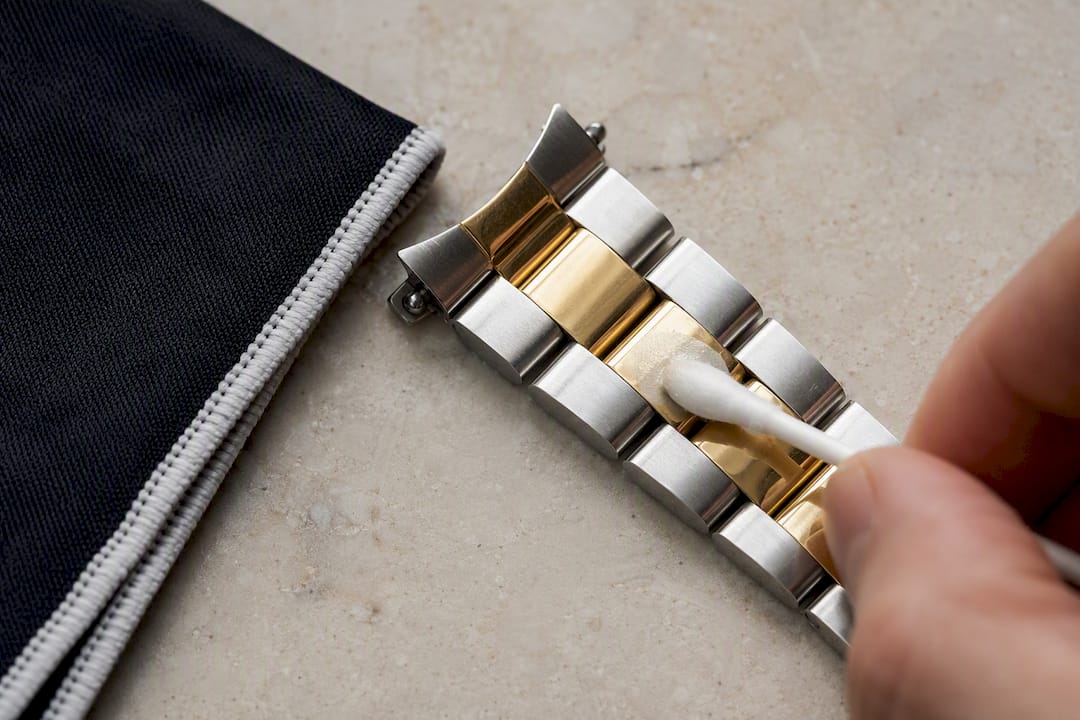
- Apply polishing cream sparingly. A pea-sized amount goes further than you’d think. Use a soft cloth or cotton polishing mop, and match your motion to the finish: short strokes along the grain for brushed surfaces, light circular motions for polished facets. Keep every pass brief.
- Avoid the edges entirely. Professionals working on gold cases deliberately avoid polishing case edges or inner case-back rims because gold removes so quickly that a few extra passes can visibly round a corner that was once sharp. If you take one rule from this guide, take that one.
- Move to the bracelet with the same restraint. Clean links with the soft brush and air puffer to dislodge grime between them, then polish the outer sleeves only, keeping the cloth away from pin holes and clasp edges.
- Verify your work under magnification. Check for any residual polish in crevices, then spin the crown and test the pushers to confirm nothing feels gritty or stiff. A final functional check catches problems before they become bigger ones.
- Finish with a dry microfiber pass to remove any last residue and bring up the shine.
Pro Tip: Time yourself. Professional polishers make short passes with iron-oxide compounds precisely because gold disappears fast under friction. If you’ve been buffing the same spot for more than 10 to 15 seconds, you’re not polishing anymore, you’re grinding.
Can You Polish a Gold-Plated or PVD Watch at Home?
Not the way you’d polish solid gold, and this distinction trips up more owners than any other part of the process. Gold plating is a microscopic layer, often just a few microns thick, bonded over a base metal. PVD (physical vapor deposition) coatings are similarly thin. Any polishing cream or abrasive cloth aggressive enough to bring up shine on solid gold will, over repeated use, wear straight through plating and expose the metal underneath.
The safe home routine for plated and PVD pieces is deliberately minimal:
- Wipe with a dry or barely damp microfiber cloth, nothing more
- Use very light brushing with a soft-bristle brush only for grime in crevices
- Skip polishing creams entirely, even ones labeled “gentle”
- If you’re tempted to try a light polish anyway, test on a fully hidden surface first and stop at the first sign of color change
If you’re already seeing wear-through, a dull patch where the base metal shows, or flaking at the edges, no amount of careful home polishing fixes that. Home polishing on gold plating will strip what’s left of an already-thin layer rather than restore it. That’s a job for professional replating or a PVD recoat, not a cloth and cream. A guide on cleaning two-tone watches covers this masking-and-restraint approach in more detail if your piece mixes plated and solid sections.
How Often Should You Clean and Polish a Gold Watch?
Most of the damage owners worry about, from cloudy crystals to dulled gold, comes from skipping small routine habits rather than from polishing too rarely. Build a rhythm and you’ll rarely need an aggressive polish at all.
- After every wear: a quick microfiber wipe to remove skin oils and sweat before they sit on the metal
- Monthly: a deeper clean if you wear the watch daily or it sees regular sweat or salt exposure, following manufacturer guidance on water-resistant cleaning
- Every 3 to 6 months: a more thorough clean and inspection for anyone wearing the watch less frequently or in milder conditions, a cadence several watch-care guides converge on
- Polish only when needed, not on a fixed schedule; a cloth pass restores shine most weeks without any cream at all
- Store with an anti-tarnish pouch rather than loose in a drawer
- Keep the watch away from perfume, hairspray, and other chemicals, which dull gold’s finish over time and force more frequent polishing
- Avoid humid bathrooms and magnetic closures for long-term storage
Following a habit like this is also the fastest way to cut down on how often you touch polish to metal at all. Notes on keeping a watch dust free go deeper into daily handling that extends the time between polishes.
When Should You Take a Gold Watch to a Professional Instead?
Some problems are outside the scope of a cloth and cream, no matter how careful you are.
- Condensation or fogging inside the crystal after any water exposure, screaming compromised gasket
- A crown or pusher that grinds, sticks, or feels loose when you operate it
- Deep gouges or dents that a polish would only make more visible by highlighting the surrounding shine
- Visible wear-through on plated or PVD watches, where base metal shows through the gold layer
The fixes a watchmaker or jeweler will offer include replating or PVD recoating, professional polishing using controlled tools far more precise than anything sold for home use, and gasket replacement paired with a pressure test. That last step matters: always ask specifically for a pressure test after any reseal, since a new gasket that hasn’t been tested is just a guess at water resistance. A rundown of signs your watch needs professional cleaning walks through these red flags in more detail.
Why Trust This Guidance on Gold Watch Care?
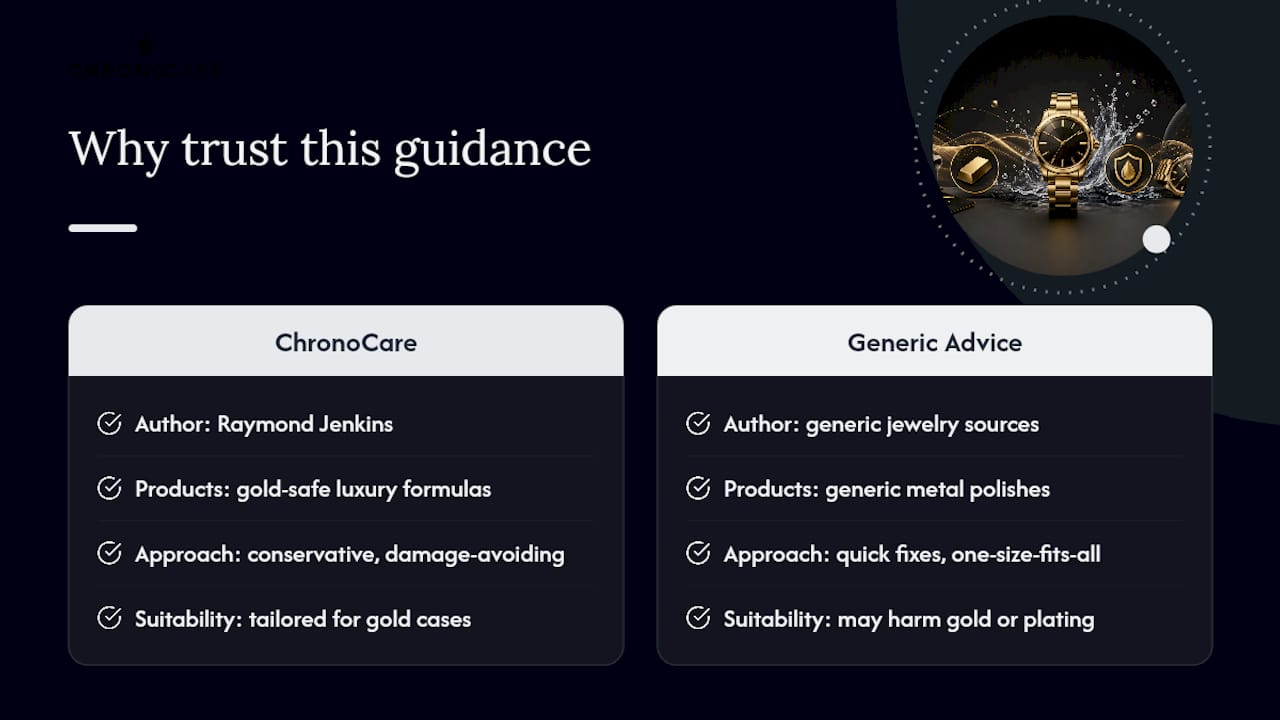
This guide comes from Raymond Jenkins, who writes ChronoCare’s watch-care guides with an emphasis on conservative, damage-avoiding methods over quick fixes. The cleaning and polishing products referenced here are formulated specifically for luxury timepieces, which means the recommendations aren’t generic jewelry advice repurposed for watches.
The company’s focus on gold-safe polishing creams, microfiber tools, and guided kits exists precisely because gold cases and gold-plated cases need different handling, and most generic metal polish doesn’t draw that distinction. Every method described above reflects how those products are meant to be used.
Why Conservative Polishing Protects Your Watch’s Value
Less is more when you’re working with gold. A cosmetic improvement that costs you sharp case edges or a worn-through plating layer isn’t an improvement at all, it’s a trade you can’t undo. Every professional technique referenced in this guide, from short polishing passes to strict edge avoidance, exists to prevent exactly that kind of irreversible loss.
Collectors who hold onto original finishes tend to preserve more value than those chasing a showroom shine every few months. Restraint is the harder skill, but it’s the one that actually protects what you own.
— Raymond Jenkins
Get the Right Tools for Safe At-Home Gold Watch Care
Following the steps above works best when your supplies match the job instead of forcing a general-purpose cloth to do specialized work. Some kits are built around that exact gap: products formulated for precious metals, not repurposed jewelry polish or automotive cream.

For routine upkeep between polishes, the Ultimate Watch Cleaning Kit covers the daily and monthly wipe-downs this guide recommends, without any risk of introducing an abrasive by accident. If you’re following the full solid-gold polishing procedure, the Ultimate Watch Polishing & Cleaning Kit pairs a gold-safe polishing cream with the cloths and mop-style applicators the step-by-step method calls for. And if your watch just needs the cream itself, the Watch Polishing Cream handles light scratches and restores shine across metal surfaces without the guesswork of finding a jewelry-store substitute. Check the product pages for the specific use-case that matches your watch before your next cleaning session.
Where This Guidance Comes From
The polishing and safety steps above draw on manufacturer care documentation and professional watch-service guides. Longines’ official cleaning guidance covers water-resistance and gasket risk directly from a manufacturer’s perspective. The Great British Watch Company’s polishing tutorial explains the professional technique behind gold-safe polishing. Hewore’s home cleaning guide rounds out the safe-supplies and verification steps.
Sources
- How to Polish a Watch Case and Bracelet – Great British Watch Company
- How to clean a watch | LONGINES
- How to clean a watch at home — Avoid costly mistakes - Hewore