

How to Clean a Two-Tone Watch Without Damaging the Gold
Here’s the safe routine: confirm your crown is pushed in and screwed down, mix lukewarm water with one drop of pH-neutral soap, work a soft-bristle brush along the metal grain (never against it), rinse under a gentle stream with the crown pointing down, then pat dry and buff with a clean microfiber cloth. That’s it for a watch with a water resistance rating indicating splash resistance, light water contact, or swimming suitability, provided it is in good working order. Longines’ own care guidance backs this exact sequence for routine maintenance, and it works whether your case is solid steel or a two-tone mix of steel and gold.
The one thing that changes with two-tone pieces: gold is softer than steel, so every step needs a lighter hand where those accents live. A ChronoCare kit can simplify the tool side of this, but the technique matters more than the products.
Two-tone cleaning isn’t a different process. It’s the same process done more gently, because gold scratches at pressures steel shrugs off.
- Secure the crown before any water touches the case
- One drop of soap, lukewarm water, never hot
- Brush with the grain, light pressure only
- Rinse, pat dry, buff with microfiber
When in doubt about water resistance or if you notice fogging under the crystal, skip the soak and head to a watchmaker instead.
Key Takeaways
Cleaning a two-tone watch safely comes down to checking water resistance first, using pH-neutral soap and light pressure, and treating gold surfaces more gently than steel throughout.
| Point | Details |
|---|---|
| Check water resistance first | Confirm the crown is secured and the rating (30m, 50m, 100m) before any water contact. |
| Use minimal soap | One drop of pH-neutral dish soap in lukewarm water is enough for routine cleaning. |
| Brush gently, along the grain | Gold needs roughly half the pressure steel can tolerate without scratching. |
| Detach the bracelet for deep cleaning | Ultrasonic baths are safe only on solid-metal bracelets removed from the case. |
| Know when to call a watchmaker | Condensation, stiff crowns, or loose markers mean it’s time for professional service. |
| Consider a dedicated kit | ChronoCare’s Ultimate Watch Cleaning Kit bundles pH-neutral cleaner and gold-safe tools for two-tone pieces. |
Table of Contents
- Is It Safe to Clean This Two-Tone Watch at Home?
- Safe Tools and Supplies for Cleaning Two-Tone Watches
- Step-by-Step Routine to Clean a Two-Tone Watch Head
- How Do You Deep-Clean a Two-Tone Bracelet?
- How Do You Care for Gold, Gold-Plated, and Steel Parts Differently?
- Caring for Straps That Pair With Two-Tone Watch Heads
- How Often Should You Clean a Two-Tone Watch?
- What Cleaning Mistakes Damage Two-Tone Watches Most?
- When Should You Stop DIY and See a Watchmaker?
- Why a Dedicated Kit Helps for Luxury Two-Tone Watches
- An Editorial Note on Two-Tone Watch Care
- An All-in-One Option for Readers Who’d Rather Skip the Guesswork
- Frequently Asked Questions
- Sources
Is It Safe to Clean This Two-Tone Watch at Home?
Check the water-resistance rating and crown condition before you touch a drop of water to the case. That’s the decision that matters more than any brush or soap you’ll use later.
Most two-tone dress and sport watches carry a rating stamped on the case back: 30m, 50m, or 100m. Here’s how to read those honestly:
- 30m means splash resistant only. Treat wet cleaning as risky and stick to a damp cloth wipe.
- 50m tolerates brief water contact like hand washing or rain. Light rinsing is generally fine if the crown is seated.
- 100m or higher handles swimming and short-term water contact. A full rinse and gentle soak is usually safe.
- No rating listed, or a vintage piece with unknown service history should be treated as not water resistant at all.
Seals compress and harden over years, even on watches that were rated for serious water exposure when new. Longines notes that manufacturers assume a fully secured crown and factory-fresh gaskets when they print that rating, not a gasket that’s five years past its last pressure test.
Pro Tip: If your watch has not been pressure tested recently and you rely on its water resistance for swimming or diving, treat it as compromised until a watchmaker confirms otherwise.
A crown pulled out or unscrewed is an automatic stop. No wet cleaning happens until it is pushed back in and secured.
Safe Tools and Supplies for Cleaning Two-Tone Watches
Your kit needs to be smaller and gentler than most people assume. Here’s what actually belongs on the table:
- A clean microfiber cloth (two, ideally: one for drying, one for buffing)
- A soft, child-size toothbrush with worn-in bristles
- A small bowl of lukewarm water
- One drop of pH-neutral dish soap, nothing more concentrated
- An air-puffer bulb (the kind used for camera lenses) to clear trapped water
- A wooden toothpick with the sharp tip snapped off, wrapped in tissue or microfiber before use
That last one matters more than it sounds. Hodinkee’s guide points out that a bare wooden tip can scratch gold-edged bezels and case flanks if it slips, so wrapping it is a two-second habit that prevents a permanent mark.
Skip anything abrasive, ammonia-based, or alcohol-heavy. Household glass cleaner, rubbing alcohol, and polishing pastes marketed for silverware or jewelry are all wrong here. They strip oils, dull anti-reflective coatings, and on plated gold, they can wear through the plating layer entirely.
Pro Tip: Buy the softest toothbrush you can find, then run it under warm water and press the bristles against your palm a few times before first use. Softening them slightly reduces the risk of hairline scratches on polished gold facets.
Step-by-Step Routine to Clean a Two-Tone Watch Head
Once you’ve confirmed water resistance and gathered your tools, the process runs: soak briefly, brush along the grain, rinse with the crown down, dry, then buff. Here’s the full sequence broken out.
Preparation. Push the crown fully in and screw it down if your watch has a screw-down crown. Lay a towel on your work surface. If your watch has a leather strap, remove it now since leather should never touch water. If the bezel has a delicate ceramic or aluminum insert with painted numerals, keep brushing pressure light around that zone specifically.
- Soak for 3 to 5 minutes in the lukewarm soap water, head and bracelet together if the strap is metal. Longer soaking doesn’t clean better. It just increases the odds of water finding a weak seal.
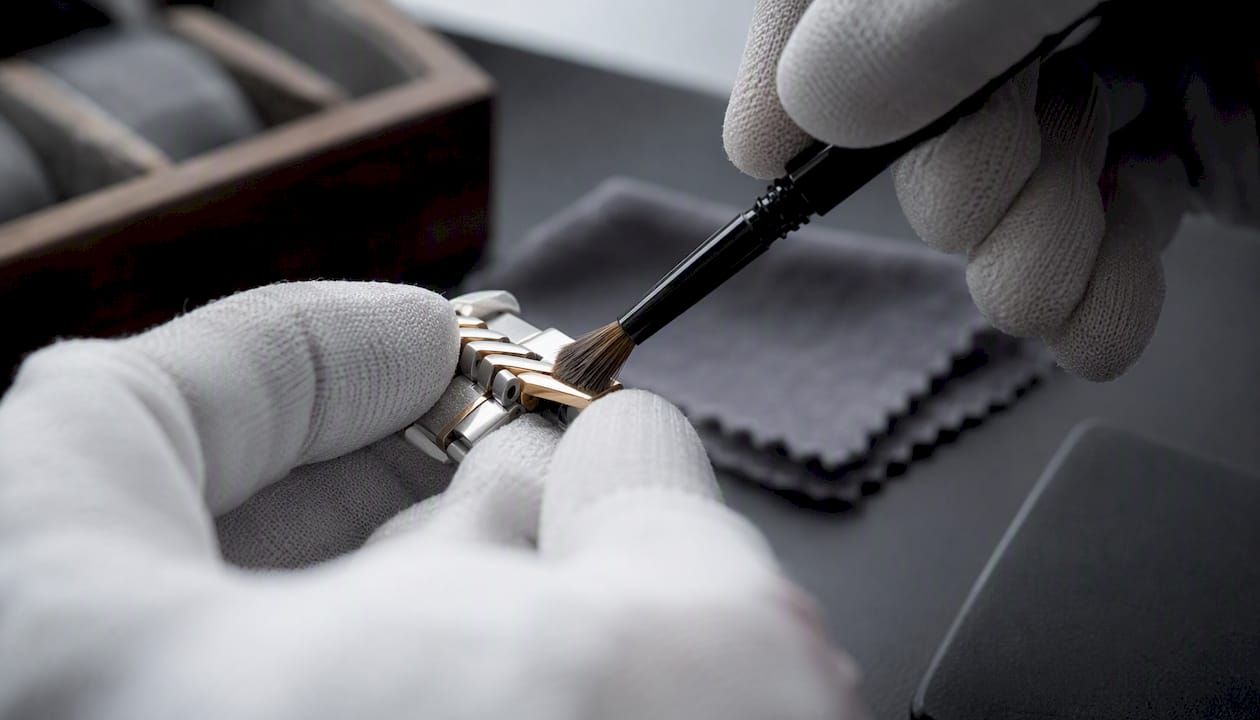
- Brush along the grain, never in circles or against the polish direction. On brushed steel sections, you’ll feel a natural direction where the bristles glide easily. Gold accents, especially polished center links, need roughly half the pressure you’d use on steel. Hodinkee’s advice is blunt on this point: let the brush do the work, not your wrist.
- Focus on the clasp and end-links last, since grime hides in the folding mechanism and the gap where the bracelet meets the case. Open the clasp fully while brushing.
- Rinse under a gentle stream, crown pointing downward and away from the water flow, to keep pressure off the stem seal.
- Dry immediately. Pat with microfiber first, then use the air-puffer bulb to force water out of link gaps and around the clasp hinge. Trapped moisture there is the single biggest cause of green residue and corrosion over time.
- Air-dry for a few minutes, then do a final buff with a dry microfiber cloth, working along the same grain direction you used to brush.
Photograph your crown position before you start (pushed in, screwed down), your brush angle on the gold links, and the clasp fully open. Those three reference shots make it much easier to catch a mistake before it becomes a habit.
Pro Tip: Use short, one-inch brush strokes rather than long sweeping passes. Short strokes give you more control near gold edges and make it obvious the moment you feel resistance or grit, which usually means you should stop and rinse rather than push through.
How Do You Deep-Clean a Two-Tone Bracelet?
Remove the bracelet from the case whenever your tools allow it. A detached bracelet gets a fuller clean, and it opens the door to ultrasonic cleaning, which should never touch an assembled watch head. Our bracelet link cleaning checklist walks through the joint-by-joint process in more detail.
Once detached:
- Soak the bracelet alone in the same lukewarm soap solution for up to 10 minutes.
- Brush every link individually, paying extra attention to the clasp mechanism where sweat and skin oils accumulate.
- Rinse thoroughly under running water, working the links back and forth to flush out soap residue.
- Pat dry, then lay flat to air-dry completely before reattaching to the case.
An ultrasonic bath is genuinely useful here, but only on a solid-metal bracelet with no plating, fully detached from the case. ECI Jewelers warns that gold-plated bracelets are especially vulnerable: the vibration and cavitation that lift dirt out of crevices can also lift plating right off the base metal. If you’re not certain whether your two-tone bracelet is solid gold or plated, assume plated and skip the ultrasonic bath entirely.
Never run an assembled watch through an ultrasonic cleaner. The same vibration that shakes grime loose can shake dial markers loose too.
Avoid aggressive polishing compounds on gold links regardless of the cleaning method. A gentle hand cloth beats a machine every time on plated surfaces.
How Do You Care for Gold, Gold-Plated, and Steel Parts Differently?
Gold areas need less pressure and gentler products than steel, full stop. Solid gold is softer than stainless steel on the Mohs scale, and gold-plated or PVD-coated surfaces add a second problem: the gold layer itself can be worn away entirely, exposing base metal underneath.
Here’s how to tell what you’re dealing with:
- Solid gold (usually 18k on luxury pieces) will show hallmark stamps inside the case back or on clasp links; it tolerates light polishing but still scratches more easily than steel.
- Gold-plated means a thin gold layer, often measured in microns, bonded to a base metal; abrasion of any kind risks wearing through to that base metal.
- PVD coating is a vapor-deposited finish, thinner still in most applications, and generally the least tolerant of polishing compounds or stiff brushes.
For shine restoration, reach for a non-abrasive, gold-safe polishing cloth rather than a cream or paste, and only if the watch’s manufacturer explicitly approves polishing for that finish. Skip polishing compounds on anything plated. The risk of thinning the layer outweighs the cosmetic gain.
Pro Tip: Test any new cloth or cleaner on the case back or an inconspicuous clasp link first. If you see any color transfer onto the cloth, stop immediately. That’s often a sign of plating wear.
Machine polishing has no place on a collectible or vintage two-tone piece. Hand methods only, and less often than you’d think.
Caring for Straps That Pair With Two-Tone Watch Heads
Remove any strap that isn’t rated for water contact before you wet-clean the head. Leather, rubber, and fabric each need a different touch.
- Leather should never be soaked. Wipe it with a barely damp cloth, apply leather balm sparingly, and let it cure overnight before wearing again. Our leather strap maintenance guide covers conditioning intervals in more depth.
- Rubber and silicone straps handle rinsing well after sweat or saltwater exposure; a mild soap wash removes odor, and air-drying away from direct heat prevents the material from stiffening. Our guide to cleaning silicone straps has the specifics.
- Fabric or NATO-style straps tolerate a gentle hand wash but should never go near a dryer or radiator.
Never soak leather, never use a hair dryer or heat vent to speed things up, and keep household solvents away from any strap material.
How Often Should You Clean a Two-Tone Watch?
A quick wipe after every wear, a proper wet clean monthly if the watch is water resistant and worn daily, and professional service on a longer cycle handled by a watchmaker rather than you.
- After every wear: wipe the case and bracelet with a dry microfiber cloth to remove skin oils before they settle into the finish.
- After swimming or heavy sweating: rinse under fresh water as soon as practical, since salt and chlorine accelerate corrosion on clasp hinges.
- Monthly: a full soap-and-water clean for daily-wear, water-resistant models following the routine above.
- Every 1 to 2 years: a professional pressure test if you actually rely on the watch’s water resistance for swimming or diving. Longines frames this as preventive maintenance that protects gasket integrity, not an optional luxury.
Keep the clasp area specifically dry between wears, since that’s where moisture tends to linger longest, and store watches you’re rotating in a dry, dust-free box rather than a humid bathroom cabinet.
What Cleaning Mistakes Damage Two-Tone Watches Most?
No, don’t use Windex or glass cleaner. Ammonia-based sprays can creep past bezel seals and damage anti-reflective coatings or gaskets, a risk GQ’s cleaning guide specifically calls out.
No, don’t use rubbing alcohol on gold or plated surfaces. It strips protective oils and can dull polished finishes faster than plain soap and water ever would.
No, don’t scrub harder if grime doesn’t lift right away. Over-scrubbing is the single most common DIY mistake, and it’s almost always pressure, not soap strength, that’s missing.
No, don’t dry with paper towels or canned air. Paper fibers can leave micro-scratches, and compressed air propellant can force moisture deeper into pushers and seals rather than clearing it out.
No, don’t run an assembled watch through an ultrasonic cleaner, and don’t polish plated links with anything abrasive.
If you see condensation forming under the crystal after cleaning, stop wearing the watch immediately and get it to a service center before more moisture works its way into the movement.
When Should You Stop DIY and See a Watchmaker?
Fogging or visible moisture under the crystal, a gritty or stiff-feeling crown or pushers, and loose hands or hour markers all mean it’s time to stop cleaning and start calling a professional, especially on vintage or high-value pieces where water resistance is uncertain.
If you spot any of these signs:
- Stop wet cleaning immediately and dry the exterior with microfiber.
- Contact an authorized service center rather than attempting further home fixes.
- Ask about a pressure test and gasket replacement if water resistance is in question.
- Condensation or fogging under the crystal
- Grinding, gritty, or stiff crown movement
- Loose dial markers or hands visible through the crystal
- Beads of moisture trapped in bracelet links that won’t dry after 24 hours
Any one of these is reason enough to set the cleaning kit aside for now.
Why a Dedicated Kit Helps for Luxury Two-Tone Watches
A curated cleaning kit reduces guesswork by giving you tools already sized and formulated for gentle work on mixed metals, instead of improvising with whatever’s under the kitchen sink. That matters more on two-tone pieces than single-metal watches, since the margin for error on gold accents is genuinely smaller.
A solid kit typically includes:
- Microfiber cloths dedicated to drying and buffing separately
- Extra-soft brushes sized for link gaps and clasp mechanisms
- A pH-neutral cleaning solution formulated for metal watch surfaces
- A polishing cloth rated safe for gold, not just steel
- An air-puffer bulb for clearing trapped moisture
- Soft drying pads that won’t leave lint behind
Pro Tip: Use polishing products sparingly on gold accents, and skip any polishing compound entirely on parts you know or suspect are plated rather than solid. A light touch preserves both the finish and the resale value of the piece.
An Editorial Note on Two-Tone Watch Care
Years of watching people damage otherwise beautiful two-tone pieces have taught us one lesson repeatedly: the mistake is almost never the soap. It’s pressure, heat, or an ultrasonic bath applied to something that should have been hand-cleaned. The conservative approach outlined here, soft brush, light hand, patient drying, isn’t overly cautious. It’s simply what protects the resale value and finish integrity that make these watches worth owning in the first place.
An All-in-One Option for Readers Who’d Rather Skip the Guesswork
If assembling your own kit from a hardware store and a pharmacy aisle sounds like more hassle than it’s worth, ChronoCare’s Ultimate Watch Cleaning Kit puts everything from this guide into one box: microfiber cloths, extra-soft brushes, a pH-neutral cleaner, and drying pads sized for luxury cases and bracelets.
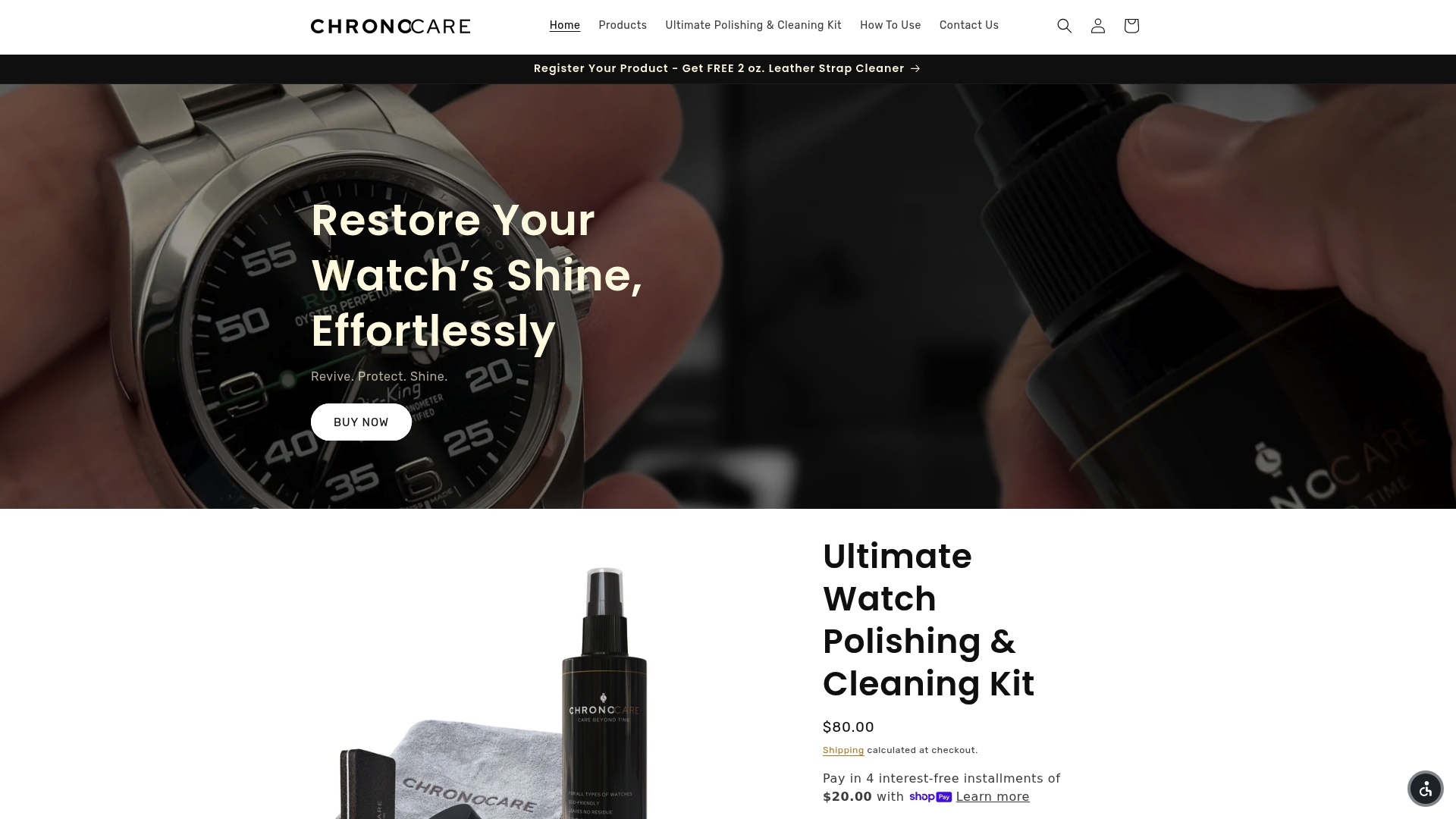
The kit is built with two-tone pieces specifically in mind, so the brush bristles and cloth weave are gentle enough for gold accents while still cutting through grime on steel links. On gold surfaces, use the included cloth sparingly and skip any polishing step entirely if you’re not certain whether your watch is solid gold or plated. Order the kit and you’ll have every tool from this routine on hand the next time your two-tone watch needs a proper clean.
Frequently Asked Questions
Can you clean a two-tone watch the same way as an all-steel watch? Mostly yes, but reduce brushing pressure on gold sections. Steel tolerates more force than gold without scratching, so the soap-and-water method stays the same while your hand gets lighter near gold accents.
Is it safe to use toothpaste to polish gold watch parts? No. Toothpaste contains mild abrasives that can dull polished gold and, on plated surfaces, wear through the plating layer over repeated use. Stick to a gold-safe polishing cloth instead.
How do you know if your watch bracelet is solid gold or plated? Check the case back or clasp for hallmark stamps indicating karat weight. If you see no stamp or the listing describes it as gold-plated or gold-filled, treat it as plated and avoid ultrasonic cleaning or abrasive polishing.
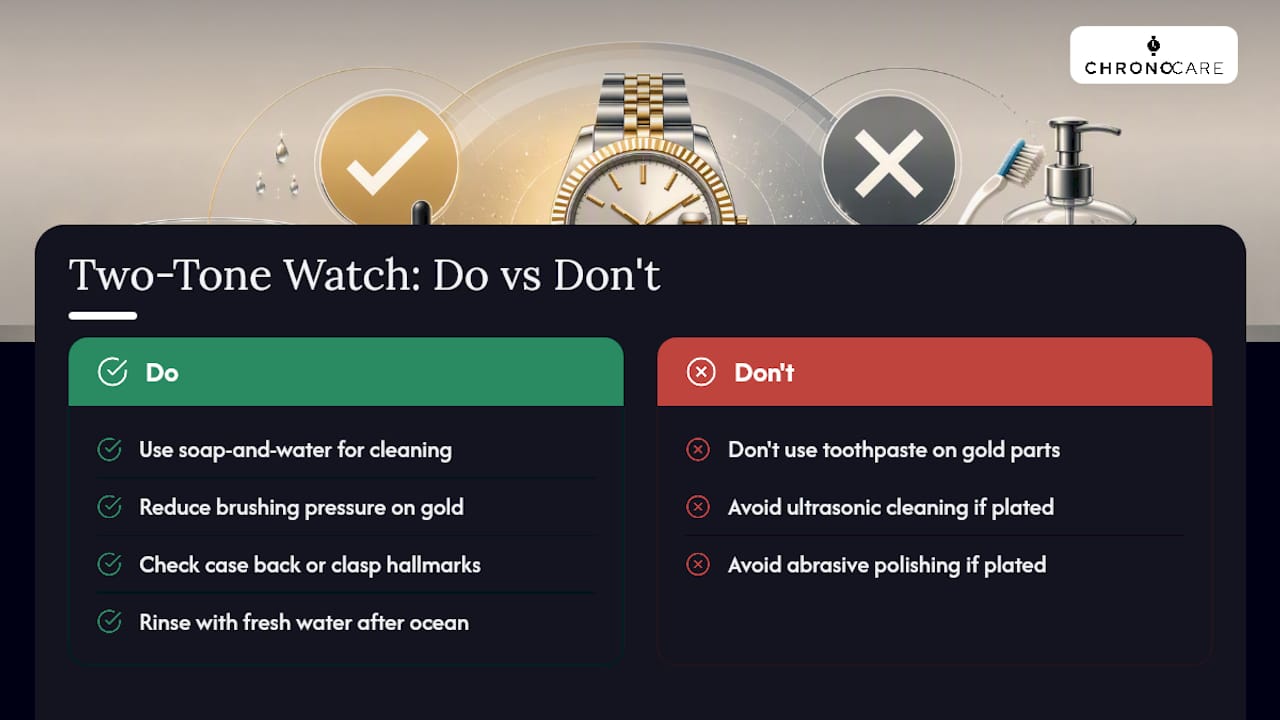
Can saltwater exposure damage a two-tone watch even if it’s water resistant? Yes, over time. Salt accelerates corrosion on clasp hinges and can leave residue in bracelet links, so rinse with fresh water promptly after ocean swimming even on watches rated 100m or higher.
Sources
- How to clean a watch | LONGINES AU
- How to clean your watch — Hodinkee
- How to Clean a Watch Without Damaging It: Case, Bracelet, and Crystal | WatchPolice
- How to Clean a Watch Bracelet The Definitive Guide – ECI Jewelers
- How to Clean a Watch — GQ