

How to safely remove fingerprints from your luxury watch
You spent serious money on that watch. Then you pick it up, hold it to the light, and there they are: smudged fingerprints crawling across the bezel, case, and crystal. Knowing how to remove fingerprints from a luxury watch without causing damage is one of the most practical skills a collector can have. The wrong cloth, the wrong chemical, or the wrong technique can scratch a brushed finish, degrade a gasket seal, or permanently alter the surface you were trying to restore. This guide gives you the exact tools, steps, and judgment calls that protect both the look and the long-term value of your timepiece.
Table of Contents
- Essential tools and materials for removing fingerprints safely
- Step-by-step guide to removing fingerprints without damaging your watch
- Common mistakes and how to avoid damage when cleaning fingerprints
- Verifying your watch’s appearance post-cleaning and routine care tips
- Why less is more: The delicate balance between cleaning and preserving value
- Shop premium watch cleaning kits designed for luxury timepieces
- Frequently asked questions
Key Takeaways
| Point | Details |
|---|---|
| Use gentle tools | Microfiber cloths and extra-soft brushes safely remove fingerprints without scratching delicate surfaces. |
| Avoid harsh chemicals | Only pH-neutral, watch-specific cleaning solutions protect finishes and seals from damage. |
| Detach bracelets for cleaning | Removing the bracelet enables safe soaking and reduces risk to the watch head. |
| No DIY polishing | Polishing at home removes metal and can significantly reduce your watch’s value. |
| Routine care matters | Regular microfiber wipes after wearing prevent fingerprint buildup and more invasive cleaning. |
Essential tools and materials for removing fingerprints safely
Having the right tools is the crucial first step before any cleaning begins. Using whatever is nearby, a paper towel, a cotton t-shirt, a household glass cleaner, is how collectors accidentally introduce micro-scratches or chemical damage to surfaces that took skilled craftsmen hours to finish.
Here is what you actually need before you start:
- Microfiber cloths (at least two, dedicated to watch use only): These lift skin oils without abrasion. A single pass with a quality microfiber is often enough to remove fresh fingerprints from a sapphire crystal or polished case. As a best practice, use microfiber cloths alongside mild pH-neutral cleaning solutions and avoid harsh chemicals entirely.
- pH-neutral cleaning solution or specialized watch cleaner spray: Standard dish soap is mildly alkaline and can dull certain finishes over time. A watch-specific formula is formulated to be safe on precious metals, PVD coatings, and rubber gaskets.
- Extra-soft natural bristle brush: Soft bristle brushes designed for watch cleaning reduce the risk of micro-scratches on link surfaces and case edges far better than a repurposed toothbrush.
- Spring bar tool: If you plan to remove the bracelet for a deeper clean, this is essential. Forcing a bracelet off without the right tool risks scratching lugs and damaging spring bars.
- Two small bowls: One for soapy water, one for rinsing.
What to avoid entirely:
| Avoid | Why it causes damage |
|---|---|
| Paper towels or tissue | Coarse fibers leave micro-scratches on polished surfaces |
| Bleach or ammonia cleaners | Degrade rubber seals and strip PVD coatings |
| Abrasive pads or sponges | Remove metal and alter case geometry permanently |
| Compressed air canisters | Can force moisture past crown seals |
| Acetone or alcohol (undiluted) | Dissolves lacquer and attacks certain crystal coatings |
The ultimate watch cleaning kit from ChronoCare bundles the right microfiber cloths, brushes, and pH-neutral solution in one package, removing the guesswork. A watch cleaner spray formulated for luxury surfaces handles the chemistry so you do not have to improvise.
Step-by-step guide to removing fingerprints without damaging your watch
With proper tools ready, here is the cleaning procedure in full detail.
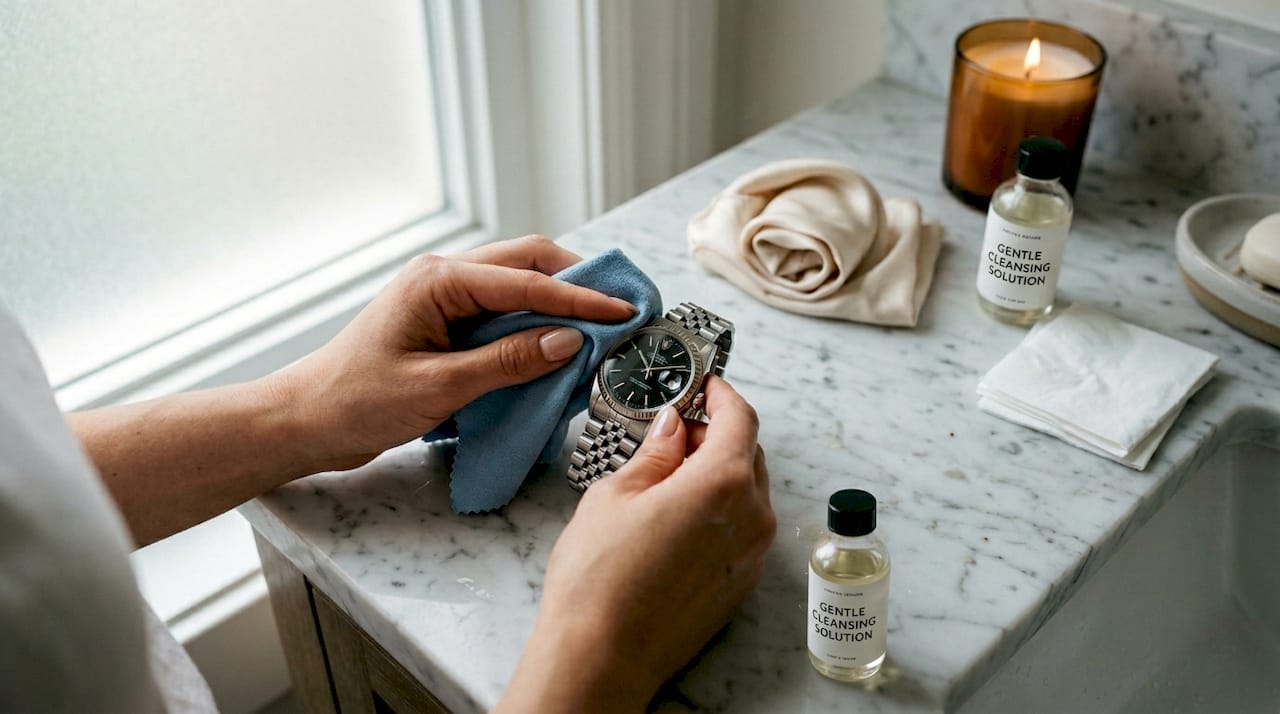
1. Start dry. Before introducing any liquid, wipe the crystal, case, and bracelet with a clean, dry microfiber cloth. Many fingerprints and light smudges come off completely with this step alone. Always start here. Start dry with a microfiber on the crystal and case before reaching for any soapy water.
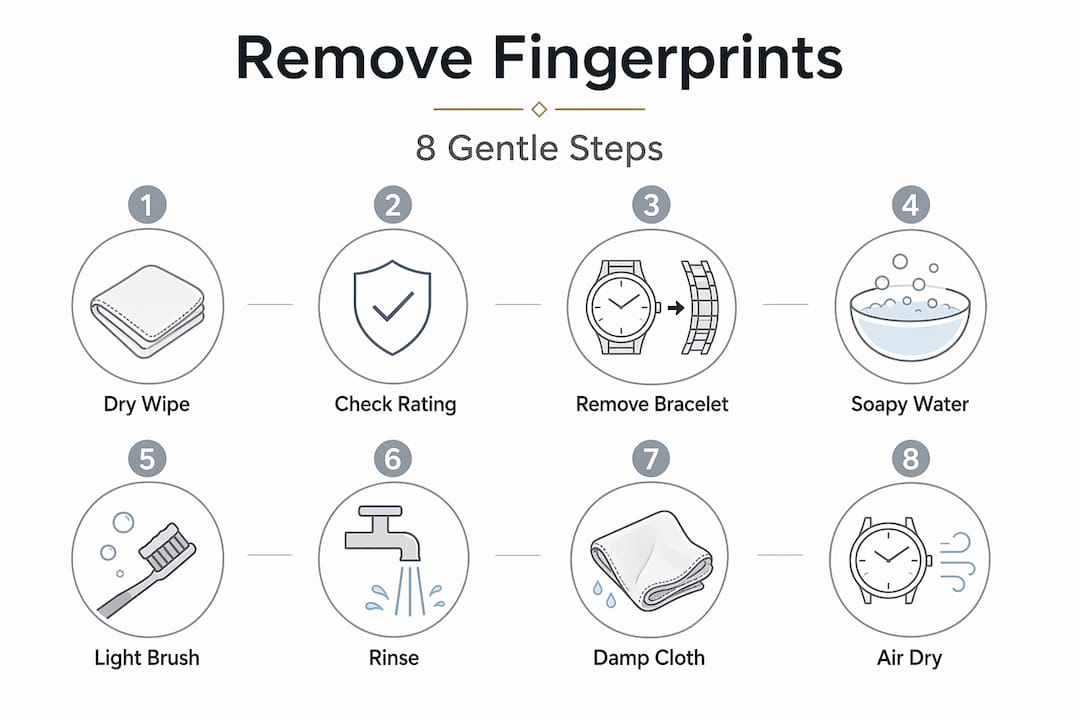
2. Assess water resistance. Check your watch’s water resistance rating before any wet cleaning. A watch rated below 30 meters should not be exposed to running water or submerged. When in doubt, keep the cleaning dry.
3. Remove the bracelet if needed. For a deeper clean on a metal bracelet, use a spring bar tool to detach it from the case. Removing the bracelet allows safer soaking and cleaning separately, reducing any risk to the watch head and crown area.
4. Prepare lukewarm soapy water. Mix a few drops of pH-neutral solution into lukewarm water. Never use hot water. Heat accelerates seal degradation and can cause thermal stress on crystals.
5. Brush the bracelet gently. Submerge only the detached bracelet. Use your extra-soft brush in short, light strokes along the link surfaces. Spend 10 to 15 minutes on stubborn oil buildup in crevices between links. Do not scrub.
6. Rinse the bracelet. Run it under cool, clean water to remove soap residue. Soap left in link gaps will attract more grime over time.
7. Clean the watch case and crystal. Dampen (not soak) a microfiber cloth with your cleaning solution. Wipe the case sides, lugs, and bezel. For the crystal, use gentle circular motions. Keep moisture away from the crown, pushers, and any seals.
8. Dry completely. Pat dry with a second clean microfiber cloth. Allow both the bracelet and case to air dry for at least 15 minutes before reassembly. Trapped moisture between links is a common cause of corrosion.
| Cleaning zone | Method | Avoid |
|---|---|---|
| Sapphire or mineral crystal | Dry microfiber, then damp wipe | Abrasives, undiluted alcohol |
| Polished case surfaces | Damp microfiber, light pressure | Circular scrubbing, rough cloths |
| Metal bracelet | Soft brush in soapy water | Hot water, aggressive scrubbing |
| Crown and pushers | Dry microfiber only | Any moisture contact |
| Leather strap | Dedicated leather cleaner | Water immersion |
Pro Tip: Keep a dedicated microfiber cloth in your watch box. A 10-second wipe immediately after removing the watch prevents oils from bonding to the surface and makes your next full clean far easier. Explore premium watch cleaning kits that include everything you need for this routine.
Common mistakes and how to avoid damage when cleaning fingerprints
Knowing what NOT to do is as important as following the right steps to protect your watch.
Ultrasonic cleaners on the full watch. This is one of the most common and costly mistakes collectors make. Avoid ultrasonic cleaning of a fully assembled watch because the vibrations stress seals and can push moisture inside the movement. Ultrasonic devices are only appropriate for detachable metal bracelets, and even then, only if the bracelet has no decorative coatings or stones.
Hot water and harsh chemicals. Heat softens and shrinks rubber gaskets. Once a gasket is compromised, water resistance is gone until a professional reseals the case. Household cleaners, including glass spray, multi-surface sprays, and kitchen degreasers, contain compounds that attack PVD coatings and anodized finishes.
“The most expensive cleaning mistake is not the one that scratches the crystal. It is the one that lets water reach the movement.”
Confusing fingerprint removal with polishing. This is critical. A fingerprint is a surface oil deposit. A scratch is physical metal displacement. These are completely different problems requiring completely different solutions. Do not polish fingerprints or smudges yourself, because polishing removes original material and can decrease collector value significantly. If your watch has scratches you want addressed, that is a job for a professional watchmaker, not a home polishing kit used aggressively.
Aggressive brushing on bracelets. Even a soft brush used with too much pressure can leave directional scratches on brushed link surfaces. Always brush in the direction of the existing finish, never across it.
Pro Tip: If you are tempted to use a watch polishing cream for fingerprint removal, use it only on specific, appropriate metal surfaces and follow the product directions exactly. Polishing cream is for restoring metal luster, not for routine fingerprint cleaning.
Verifying your watch’s appearance post-cleaning and routine care tips
After cleaning properly, regular maintenance habits keep your watch looking pristine longer.
Once you have finished cleaning, hold the watch under a single directional light source, a desk lamp or natural window light works well. Tilt the case and crystal at different angles. Fingerprints and smudges that survive cleaning show up immediately under raking light. If you see residual marks, a second dry microfiber pass usually handles them.
Routine care habits that make a real difference:
- Wipe after every wear. A quick microfiber wipe after every wear removes fresh oils and sweat before they bond to the surface and become harder to clean.
- Clean in sections. Cleaning in sections, starting with the crystal, then the case, then the bracelet, prevents oils from migrating back onto surfaces you have already cleaned.
- Use separate cloths for different surfaces. The cloth you use on the bracelet picks up oils and metal particles. Using it on the crystal afterward transfers that contamination directly to the glass.
- Store watches properly. A watch sitting on a nightstand collects dust and skin oils every time you handle it. A watch box or display case with a soft interior reduces contact and keeps surfaces cleaner between wears.
- Schedule light cleaning weekly. If you wear a watch daily, a quick cleaning once a week prevents the kind of buildup that eventually requires more aggressive methods.
Pro Tip: For watches with leather straps, keep a leather strap cleaner separate from your metal cleaning supplies. Leather needs conditioning, not just cleaning, and the wrong product will dry it out and cause cracking.
Why less is more: The delicate balance between cleaning and preserving value
Here is a perspective most cleaning guides will not give you: the biggest threat to a luxury watch’s long-term value is not fingerprints. It is the overcorrection.
Watch collectors and auction specialists consistently note that originality commands premium prices. A Rolex Submariner with its original brushed surfaces intact, sharp lug edges, and factory hallmarks unaltered is worth significantly more than one that has been repeatedly polished to a mirror finish. Over-polishing can reduce a luxury watch’s value by 30 to 50% and permanently alters case lines and hallmarks. That number should stop anyone reaching for an abrasive pad.
The impulse to make a watch look “perfect” is understandable. But perfect, in the collector world, means original, not shiny. A light patina on a brushed bezel or subtle wear on lug edges tells the story of the watch. Erasing that story erases value.
What this means practically: your cleaning goal is to remove surface contamination, specifically oils, sweat, dust, and fingerprints, without touching the metal itself. A microfiber cloth and a pH-neutral solution do exactly that. The moment you introduce abrasion, you are no longer cleaning. You are altering.
This is also why we recommend that any deeper restoration work, addressing scratches, restoring case geometry, or refinishing surfaces, goes to a certified watchmaker rather than a home kit. The ultimate polishing and cleaning kit we carry is designed for appropriate, careful use on the right surfaces. It is not a substitute for professional judgment on a watch that matters to you.
The collectors who maintain the highest resale values are not the ones who keep their watches looking brand new. They are the ones who know exactly when to clean and exactly when to stop.
Shop premium watch cleaning kits designed for luxury timepieces
Maintaining a luxury watch at home does not require improvisation. It requires the right tools.
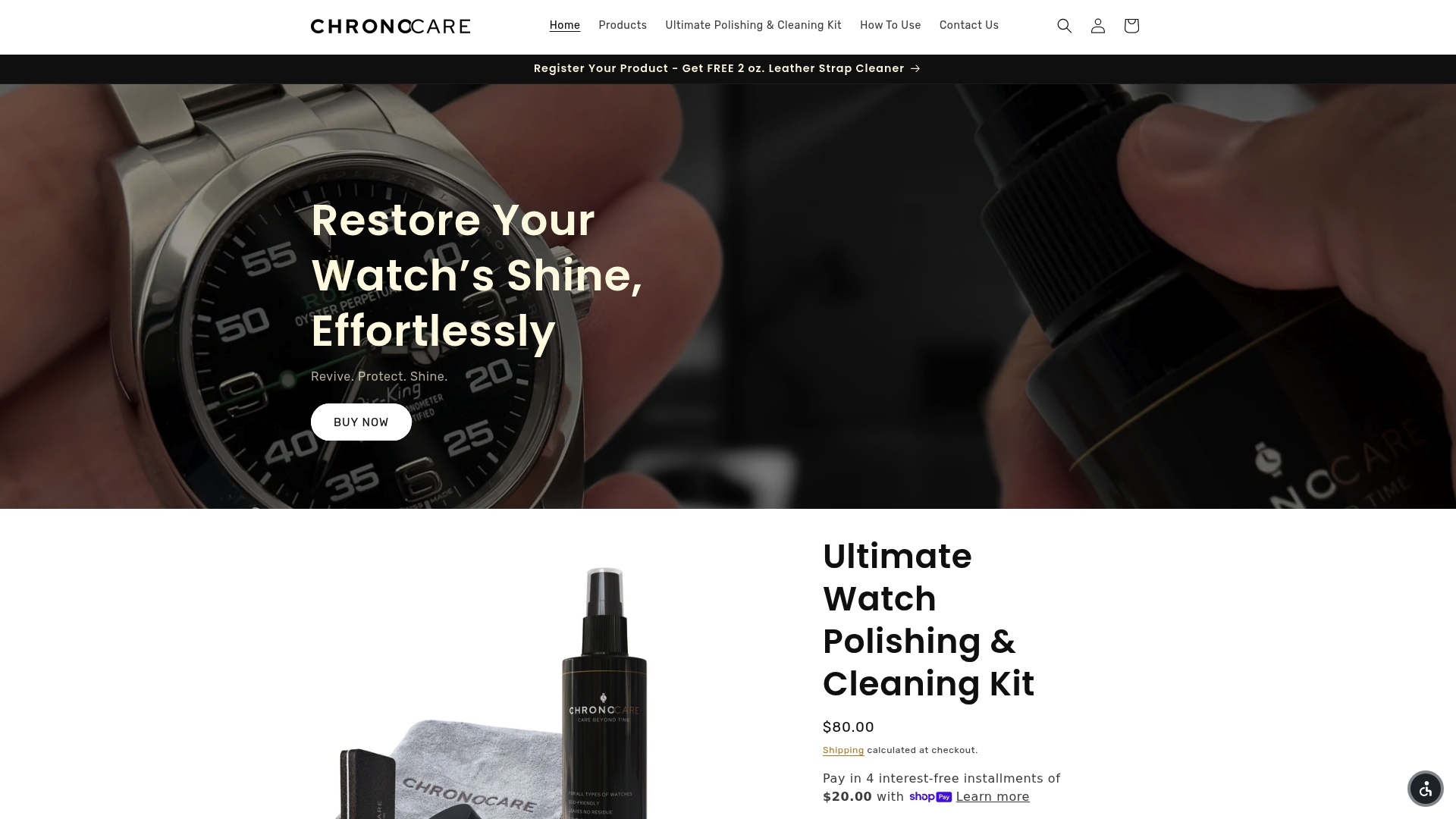
ChronoCare’s ultimate watch cleaning kit is formulated specifically for precious metals, sapphire crystals, and PVD-coated surfaces. Every kit includes pH-neutral cleaning solution, microfiber cloths graded for watch use, and an extra-soft brush, exactly the combination this guide recommends. For collectors who want both cleaning and light surface restoration in one package, the ultimate watch polishing and cleaning kit covers both needs with professional-grade formulations. The ultimate watch cleaner spray is ideal for quick, between-wear maintenance that keeps oils and fingerprints from ever building up in the first place.
Frequently asked questions
Can I use household cleaners like window spray to remove fingerprints from my luxury watch?
No. Household cleaners contain harsh chemicals that damage watch finishes and seals. A proper watch cleaning solution, not dish soap or glass cleaner, is the only safe option for luxury surfaces.
Is it safe to put my entire luxury watch in an ultrasonic cleaner to remove fingerprints?
No. Ultrasonic vibrations stress seals and can push moisture into the movement. Only detachable metal bracelets without coatings or stones should be cleaned this way.
How often should I clean my luxury watch to keep fingerprints and oils from building up?
A quick wipe with a microfiber cloth after every wear is the most effective habit. For watches worn daily, a light cleaning once a week prevents oil buildup from becoming a more difficult problem.
Can I polish my watch case at home to remove fingerprint smudges?
DIY polishing is strongly discouraged for routine fingerprint removal. Polishing removes metal permanently and can blur case lines and erase hallmarks, lowering collector value by 30 to 50%. Leave polish work to a professional watchmaker.