

Why Water Damage Affects Watches: A Complete Guide
Water corrodes metal, breaks down lubricants, and shorts electronic circuits inside a watch case, and the first 24–72 hours after moisture enters determine whether you’re looking at a $50 gasket swap or a $500+ movement overhaul. If you’ve just found fog under your crystal or noticed your watch stopped after getting wet, here’s what to do right now.
Do immediately:
- Remove the watch from your wrist
- Stop winding or setting it
- Dry the exterior gently with a soft cloth
- Keep it upright (crown up) to slow moisture migration
- Contact a watchmaker today, not next week
Do NOT:
- Open the case yourself
- Put it in a bag of rice
- Use a hair dryer or set it in direct sunlight
- Keep wearing it
Urgency callout: Rust can begin forming inside a flooded movement within days. A watch seen by a professional promptly has a dramatically better chance of surviving with minimal parts replacement. Wait a week and you’re likely looking at a full service.
Key Takeaways
Water corrodes metal, emulsifies lubricants, and shorts electronics inside a watch, and acting within 24–72 hours of moisture exposure is the single most important factor in limiting repair cost and scope.
| Point | Details |
|---|---|
| Speed of response matters most | Get a wet watch to a professional within 24–72 hours; rust can form in days. |
| Ratings degrade with age | ATM ratings are static lab tests; aging seals and dynamic pressure reduce real-world protection. |
| Pressure-test regularly | Annual or biennial pressure testing costs $20–$50 and prevents far more expensive repairs. |
| Avoid heat and rice | Hair dryers and rice worsen internal damage; dry the exterior and go straight to a watchmaker. |
| ChronoCare for prevention | ChronoCare cleaning kits remove salt and residue from seals and surfaces, reducing long-term moisture risk. |
Table of Contents
- Why does water damage affect watches so easily?
- What water actually does inside the case
- How to spot water damage in your watch
- Immediate steps to take the moment you find moisture
- Repair options and what to expect on cost and timeline
- What water-resistance ratings actually mean for real-world use
- A practical prevention checklist for watch owners
- What professionals do and what you can safely handle at home
- The case for taking water resistance seriously
- ChronoCare’s preventive care products for external watch maintenance
- Sources
Why does water damage affect watches so easily?
The short answer: a mechanical watch is a sealed environment of microscopic metal parts, precision oils, and in quartz models, sensitive electronics. Water is hostile to all three. Understanding why water damage affects watches starts with knowing how moisture gets past the case in the first place.
Common entry points
Watchmakers consistently report that most water damage cases begin with small, repeated mistakes rather than dramatic submersions: a crown left unscrewed, a gasket that hasn’t been tested in three years, a crystal with a hairline crack nobody noticed. The main entry points are:
- Worn or aged gaskets and seals around the crystal, crown stem, and caseback
- An unscrewed or pulled-out crown, which bypasses the seal entirely
- Cracked or chipped crystal, especially on vintage pieces with acrylic crystals
- A loose caseback, often the result of a DIY battery change
- Pushed-in chronograph pushers while the watch is wet
Situations that cause ingress
A quick handwash seems harmless, but hot water softens gasket rubber and the soap residue degrades seals over time. A shower is worse: steam penetrates gaps that liquid water cannot. Pool water adds chlorine, which accelerates rubber degradation. Saltwater is the most aggressive of all.
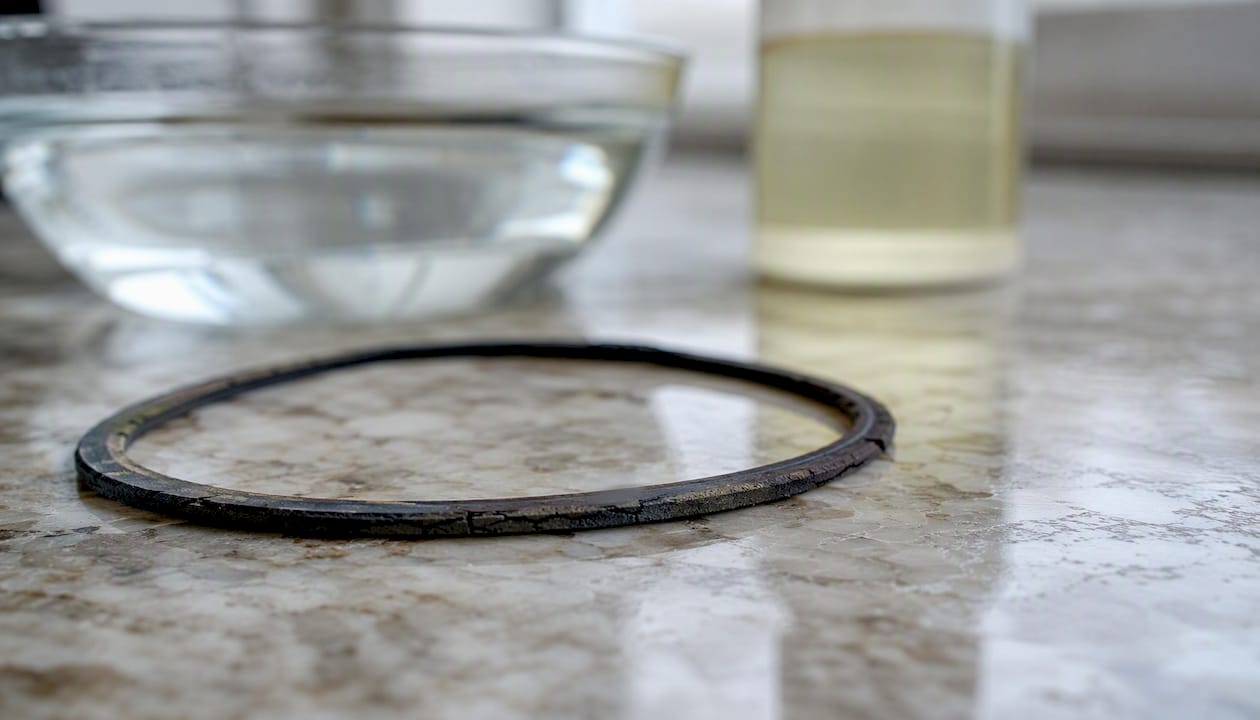
Dynamic pressure is the factor most owners miss. Real-world arm movement and impact can generate pressures far exceeding what a static lab test measures. A watch rated 5 ATM (50 meters) that passes a still-water lab test may not handle the pressure spike of a freestyle swimming stroke.
Pro Tip: Thermal shock is a separate risk. Jumping from a hot tub into a cool pool, or wearing your watch in a sauna and then rinsing it under cold water, causes the case and gasket to expand and contract at different rates. That momentary gap is enough for water to enter, even on a watch with a recent pressure test.
What water actually does inside the case
Once moisture is inside, the damage is chemical and mechanical, and it does not stop on its own.
Corrosion and rust
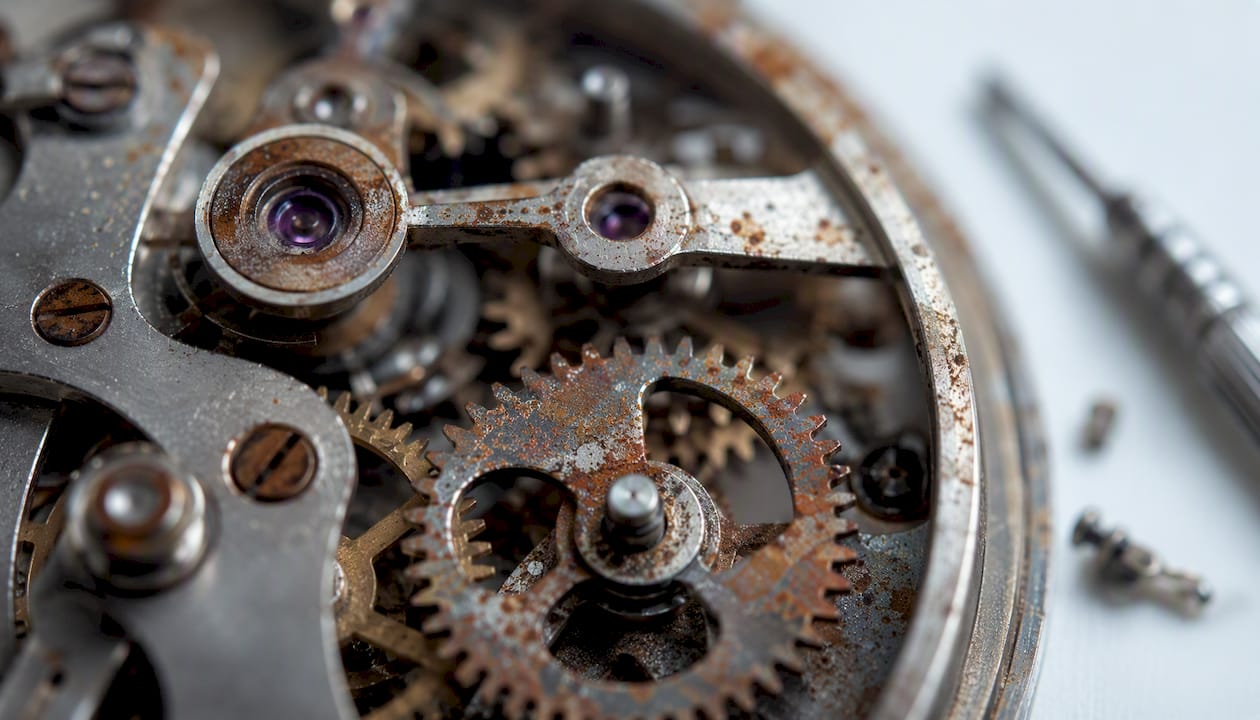
Steel pivots, pinions, screws, and plates begin oxidizing almost immediately on contact with water. A very small amount of water inside a movement can rust a pivot or seize a gear train. Saltwater accelerates this dramatically because dissolved minerals act as electrolytes, speeding the electrochemical reaction. What starts as surface rust on a pivot can lock a wheel train within days.
Lubricant breakdown
Watch oils are precisely formulated to stay in place on tiny surfaces for years. Water emulsifies them, turning a thin, slippery film into a milky, abrasive paste. Once contaminated, lubricants no longer reduce friction; they increase it. Pivots wear faster, jewels crack under load, and the movement either runs erratically or seizes.
Quartz and electronic damage
For quartz watches, water creates an additional failure mode: short circuits. Battery contacts corrode, the printed circuit board (PCB) develops conductive paths between traces it shouldn’t, and the stepping motor can fail. Water causes corrosion, contaminates lubricants, discolors dials and hands, and can stop movements entirely. In quartz models, a corroded battery contact is often the first casualty.
Mineral deposits and biological risk
When water evaporates inside a case, it leaves mineral residue behind. Saltwater deposits are particularly destructive, pitting metal surfaces and clogging the narrow gaps between moving parts. In humid climates, mold can establish itself under the dial, staining the surface and producing acids that attack lacquer and metal alike.
How to spot water damage in your watch
Catching moisture early is the difference between a minor repair and a full overhaul. Run through this checklist if you suspect exposure.
Visual signs:
- Condensation or fog under the crystal, even if it clears after a few hours
- Persistent cloudiness at the crystal edge or dial center
- Rust spots or discoloration on the dial, hands, or indices
- Mineral staining or a white haze on the dial surface
- Corrosion visible around the crown stem or caseback seam
Functional signs:
- Erratic timekeeping or sudden rate changes
- The watch stopping and restarting on its own
- A sticky or unusually stiff crown that requires more force than normal
- Chronograph pushers that feel gummy or resist depression
- Rapid battery drain in a quartz model
Subtle signs:
- A faint damp or musty smell when you bring the watch close
- Increased friction when hand-winding, as if the movement is dragging
- A dial that looks slightly warped or lifted at one edge
Pro Tip: If you see fog that clears within an hour, don’t assume the problem resolved itself. Fog that appears and disappears is a reliable sign that moisture is cycling inside the case with temperature changes. Check the 7 signs your watch needs professional cleaning for a broader symptom list.
Immediate steps to take the moment you find moisture
Speed matters more than almost anything else here. Follow this sequence.
- Remove the watch immediately. Body heat and movement accelerate moisture migration deeper into the case.
- Stop all crown operations. Do not wind, set the time, or change the date. Every crown rotation draws air, and potentially moisture, deeper into the movement.
- Dry the exterior. Use a clean, lint-free cloth. Pay attention to the crown stem, caseback seam, and crystal edge.
- Position it crown-up. Gravity pulls moisture away from the movement toward the caseback, buying a little time.
- Photograph any visible signs. Fog, rust spots, and discoloration help the watchmaker assess severity before opening the case.
- Call a watchmaker today. Explain what happened, describe what you see, and ask about their turnaround. Most reputable shops can triage quickly.
What NOT to do:
- Rice does nothing useful. It absorbs ambient humidity, not the moisture already inside a sealed case. Home remedies like rice, hair dryers, and opening the case often make water damage worse, not better.
- Heat is the enemy. A hair dryer or direct sunlight raises the internal temperature, which expands the case and pushes moisture further into the movement. It also degrades any remaining lubricants.
- Do not open the case. Introducing uncontrolled air and handling the movement without proper tools and a clean environment adds contamination to an already compromised situation.
- Do not keep wearing it. Movement generates heat, and the winding mechanism continues drawing moisture inward.
Pro Tip: The rice myth persists because it feels like doing something. The reality is that a watch case is far more airtight than a wet phone, and the moisture you’re trying to remove is already inside metal and oil, not sitting as free liquid. A watchmaker with an ultrasonic cleaner and controlled drying environment will do in two hours what rice cannot do in two weeks.
Repair options and what to expect on cost and timeline
What a watchmaker actually does
Professional remediation is a multi-step workflow, not a single fix. Full workshop remediation requires complete movement disassembly, chemical cleaning, controlled drying, parts replacement where corroded, re-lubrication, gasket replacement, and a pressure test. Skipping any step reduces the success rate.
The typical sequence:
- Open and document the case condition
- Full disassembly of the movement
- Ultrasonic cleaning in appropriate solvents
- Controlled drying under regulated heat and humidity
- Inspection of every part for corrosion, pitting, or wear
- Replacement of rusted or seized components
- Fresh lubrication with correct oils for each friction point
- New gaskets throughout (crown, crystal, caseback)
- Pressure test to verify the restored seal
When a simple seal change is enough vs. when it isn’t
If moisture was caught within hours and only reached the caseback area without entering the movement, a gasket replacement and pressure test may be all that’s needed. If fog reached the dial, if the watch stopped, or if you can see rust or discoloration, assume the movement needs a full service.
Cost and timeline ranges
Costs vary by movement complexity, brand, and whether parts need to be sourced. Saltwater exposure tends to lead to higher costs because mineral deposits require more aggressive cleaning and corrosion tends to be more widespread. Always ask for a written estimate before authorizing work.
Finding a reputable watchmaker: Look for a watchmaker who offers a written estimate, can describe their pressure-testing process, and has experience with your specific movement type. For high-value pieces, a certified watchmaker or brand-authorized service center is worth the premium.
What water-resistance ratings actually mean for real-world use
The number on your caseback is not a depth guarantee. The ‘meters’ figure is a static lab pressure test and does not guarantee safe real-world underwater use. Thermal shock and dynamic pressure from movement can compromise seals that passed the test perfectly.
ATM ratings mapped to practical use
| Rating | Static Equivalent | Practical Limit |
|---|---|---|
| 3 ATM / 30m | 30 meters static | Splashes and rain only; no swimming |
| 5 ATM / 50m | 50 meters static | Light swimming; no diving or high-impact water sports |
| 10 ATM | 10 ATM | Swimming and snorkeling; recreational diving with caution |
| 20 ATM | 20 ATM | Scuba diving; most water sports |
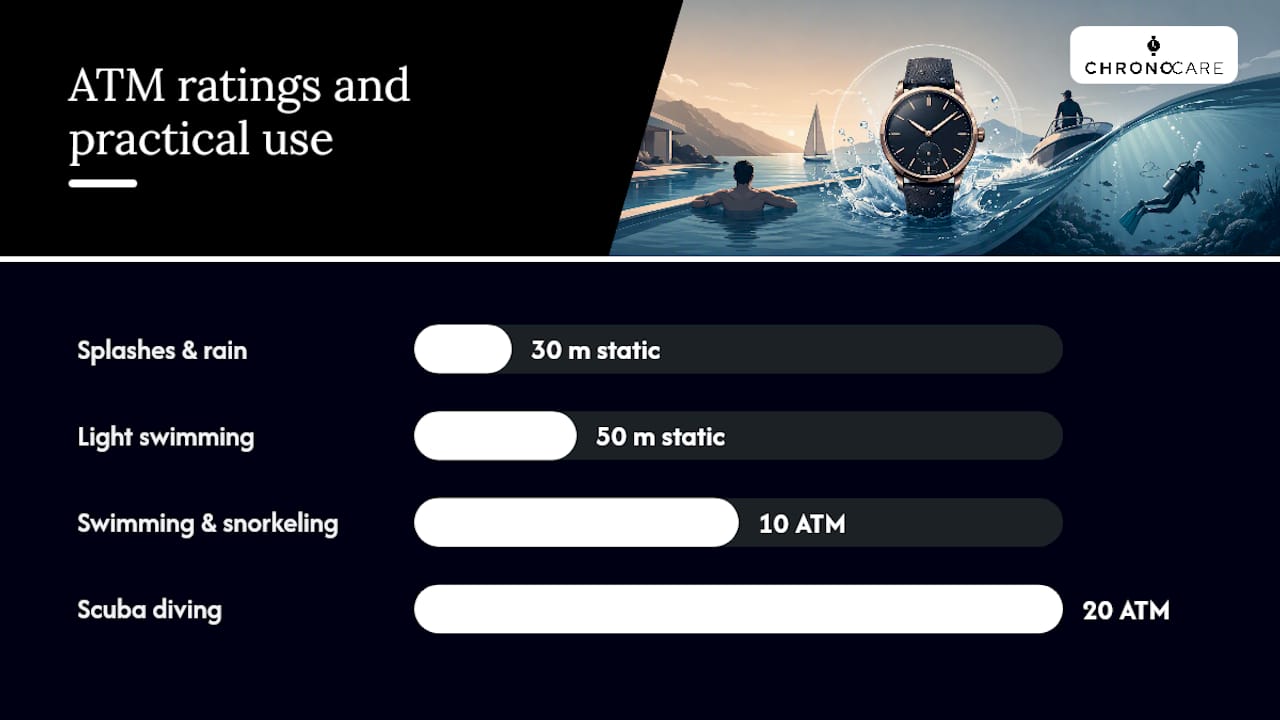
Depth ratings are widely misunderstood; real-world factors like arm movement, aging seals, and temperature changes alter what a rating means on the wrist. A 5 ATM watch worn on a swimming lap generates dynamic pressure that can exceed its static rating, especially if the seals are two or three years old.
Pro Tip: Have your watch pressure-tested every one to two years if you expose it to water regularly. A test costs $20–$50 at most watchmakers and is the single most cost-effective thing you can do to prevent a $500 repair.
A practical prevention checklist for watch owners
Prevention is almost always cheaper than repair. Build these habits and you’ll dramatically reduce moisture risk.
Daily habits:
- Always verify the crown is fully pushed in or screwed down before any water exposure
- Dry the watch with a soft cloth after rain, handwashing, or any splash
- Rinse with fresh water immediately after saltwater or pool exposure, then dry thoroughly
- Never operate pushers or the crown while the watch is wet
Environmental warnings:
- Hot showers and saunas are among the most common causes of seal failure; steam penetrates gaps that liquid water cannot, and the heat degrades rubber gaskets faster than cold water
- Hot tubs combine heat, chemicals, and pressure: a triple threat for seals
- Rapid temperature swings (sauna to cold plunge, for example) cause thermal shock that can temporarily break the seal even on a recently tested watch
Servicing schedule:
- Pressure-test every few years for watches regularly exposed to water
- Replace gaskets at every full service, typically every 3–5 years for mechanical watches
- After any significant water exposure, have the seals inspected before the next swim
Strap guidance:
- Rubber and silicone straps tolerate water well and dry quickly
- Metal bracelets handle moisture but trap water and salt in the links; rinse and dry thoroughly
- Leather straps absorb water, stiffen, crack, and hold moisture against the caseback seam. For swimming or heavy outdoor use, swap to rubber before you get wet. For caring for leather straps between wearings, keep them dry and conditioned.
What professionals do and what you can safely handle at home
The professional workflow
A watchmaker’s response to water ingress follows a documented sequence: rapid disassembly to stop active corrosion, solvent cleaning of each component, controlled drying, inspection under magnification, replacement of any pitted or seized parts, correct lubrication, new gaskets, and a final pressure test. No step is optional. Professional disassembly and cleaning are required to reliably remediate internal moisture; a partial process leaves contaminated oil or residual moisture that continues to corrode.
What you can safely do at home
- Dry the exterior thoroughly with a lint-free cloth
- Rinse the outside with fresh water after saltwater or chlorine exposure (do not submerge a watch not rated for it)
- Avoid heat sources and keep the watch in a stable, room-temperature environment
- Photograph any visible signs before handing it to a watchmaker
What you cannot safely do at home: open the case, run the movement while wet, or attempt ultrasonic cleaning without professional equipment and the correct solvents.
Pro Tip: Before dropping your watch at a shop, log the exposure event: when it happened, how long, what liquid (pool, sea, rain), and what signs you noticed. A good watchmaker uses that information to prioritize which parts to inspect first, which speeds diagnosis and can lower your bill.
For routine external maintenance between professional services, safe step-by-step watch cleaning keeps residue, salt, and chlorine from accumulating around the seals where they do the most long-term damage.
ChronoCare’s cleaning products are formulated for external care: removing residue, salt, and environmental buildup from the case, crystal, and bracelet without introducing moisture to the movement. They are a prevention tool, not a substitute for professional service when moisture has entered the case.
The case for taking water resistance seriously
Most watch owners treat water resistance as a binary: either the watch is waterproof or it isn’t. The reality is more like a sliding scale that degrades with every hot shower, every year without a pressure test, and every crown left unscrewed for a swim.
The watches that survive decades of water exposure aren’t the ones with the highest ATM rating on the dial. They’re the ones whose owners checked the crown before every swim, rinsed them after every beach trip, and had the seals tested on schedule. A $30 annual pressure test on a $3,000 watch is not optional maintenance. It’s the cheapest insurance you can buy.
What surprises most collectors is how often the damage they bring in traces back not to a single dramatic event but to years of small neglect: a gasket that was last tested in 2021, a crown that was “probably screwed down,” a hot shower taken because the watch was rated 10 ATM. The rating was fine. The seal wasn’t.
ChronoCare’s preventive care products for external watch maintenance
Keeping the outside of your watch clean is the first line of defense against long-term moisture damage. Salt, chlorine, and environmental residue accumulate around the crown stem, caseback seam, and crystal edge, exactly where gaskets sit. Left in place, those residues accelerate gasket degradation and create micro-abrasions that trap moisture.
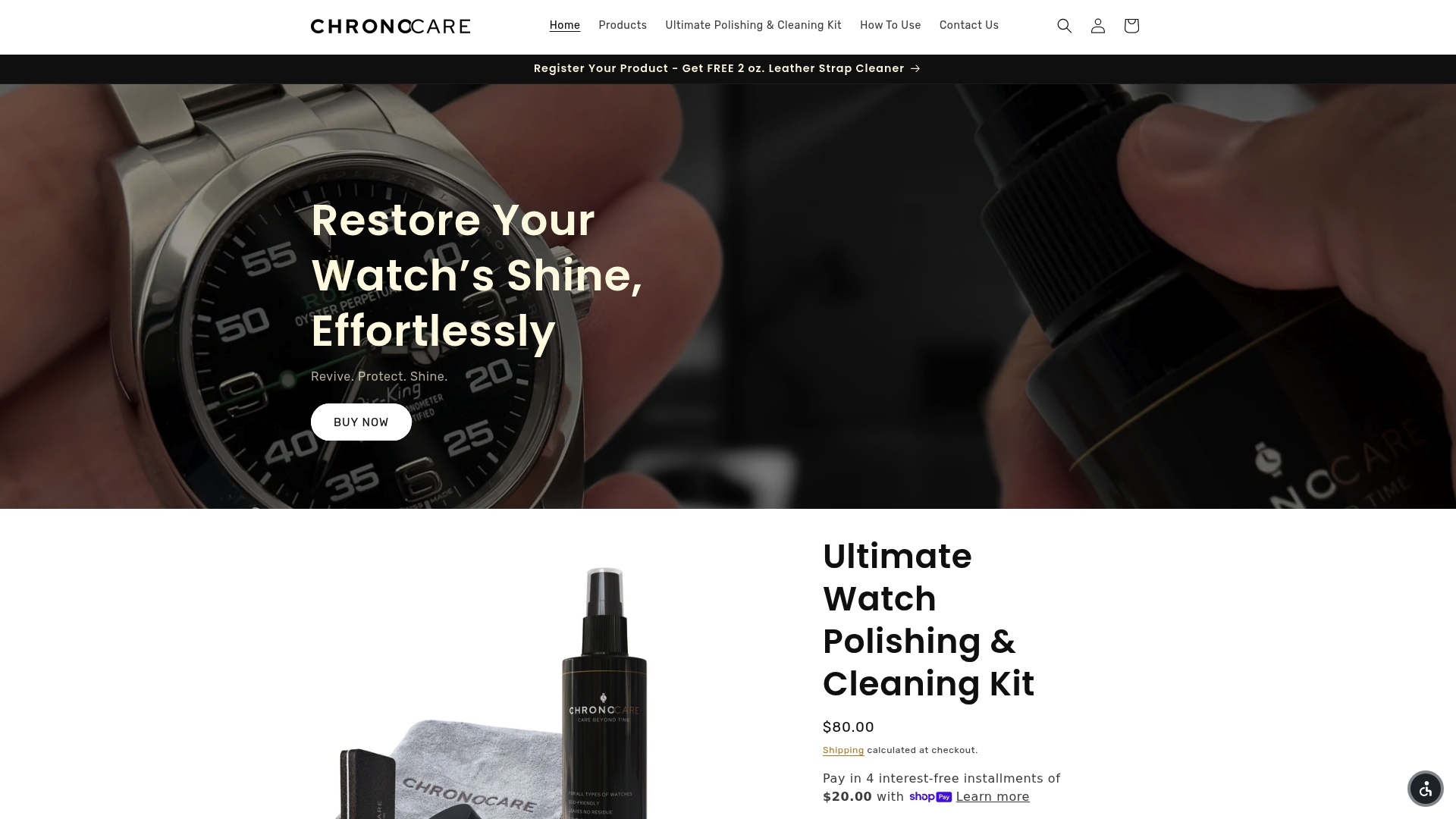
ChronoCare’s Ultimate Watch Cleaning Kit is formulated specifically for luxury timepieces: safe on metal, crystal, and coated surfaces, and designed to lift residue without introducing moisture to the movement. For collectors who want to go further, the Ultimate Watch Polishing & Cleaning Kit adds a polishing step that removes micro-scratches where residue collects and restores the case surface between professional services.
Important: ChronoCare products are for external maintenance only. If moisture has entered the case, stop wearing the watch and contact a watchmaker. No external cleaning product fixes internal water damage.
Browse the full range at Shopchronocare and build a prevention routine that protects your investment between professional services.
Sources
The following sources were used to build this guide. All are publicly available watch-repair and trade resources. For confirmation of your specific watch’s water resistance or seal condition, professional pressure-testing at a certified workshop is always recommended.
- Watch Water Resistance: ATM, BAR & What They Mean | Iglisi Watch
- Fratello Talks: Understanding water resistance | Fratello Watches
- Common Water Damage Mistakes and How to Avoid Them — Reno Watchworks
- Water in Watch - What NOT to Do to Save Your Rolex | WPB Watch Co
- What To Do If Your Watch Movement Gets Wet? - Manhattan Watch Service - Watch Repair
- How water damage affects your watch and how to prevent it | Sangamon Watches