

How to Maintain Floor Model Watch Condition
Keeping a floor-model or display watch in collector-grade condition comes down to one rule: preserve first, intervene only when necessary. Wipe the case after every handling, store in a sealed, low-humidity environment, and schedule professional service when performance drops rather than by the calendar.
Start here — your immediate checklist:
- Wipe the case and crystal with a dry microfiber cloth after every handling session
- Confirm the crown is fully pushed in or screwed down before any cleaning
- Keep display humidity below moderate levels and temperature in a comfortable range for watches
- Never use household cleaners, solvents, or paper towels on any surface
- Rotate display pieces so no single watch absorbs all the handling
Three warning signs that need a watchmaker right now:
- Condensation or fogging inside the crystal (moisture has entered the movement)
- A gritty or stiff crown that resists winding or setting
- Accuracy drift noticeably beyond the watch’s normal daily rate on a watch that previously ran clean
Key Takeaways
| Point | Details |
|---|---|
| Clean after every handling | Use a dry microfiber cloth on the crystal and case after each customer or staff contact. |
| Control humidity and temperature | Keep display environments below 50% humidity and between 50°F–80°F to protect seals and straps. |
| Service on performance, not calendar | Mechanical watches typically need service every 4–7 years, but accuracy drift, gritty crowns, or condensation override any schedule. |
| Preserve finish on collector pieces | Avoid polishing compounds on any watch with collector significance; original patina and factory bevels protect long-term value. |
| ChronoCare for routine maintenance | The Ultimate Watch Cleaning Kit supports daily display care; the Polishing & Cleaning Kit is reserved for selective, low-collectibility restoration only. |
Table of Contents
- How movement type and materials change your maintenance approach
- Step-by-step safe cleaning for case, crystal, and straps
- Best storage and display practices for floor-model watches
- When to use a watch winder and when to leave watches stopped
- How water resistance protects display watches and why pressure testing matters
- Home diagnostics and signs a watch needs professional service now
- When to preserve original finish and when limited restoration is appropriate
- A field-tested daily, weekly, and monthly workflow for floor-model watches
- Handling and wearing precautions specific to floor-model watches
- ChronoCare keeps your floor-model watches display-ready
- Sources
How movement type and materials change your maintenance approach
Not every watch on your display case needs the same care. A quartz floor model and a hand-wound vintage piece have almost nothing in common when it comes to service cadence, humidity sensitivity, or how you should handle the crown.
Movement type matters most for service timing. Quartz watches need battery replacement periodically and are otherwise low-maintenance between services. Automatic and manual-wind mechanicals need periodic winding (or a winder) if they must stay running, and their lubricants degrade over time regardless of use. Vintage pieces made before 1970 often need more frequent service because older lubricants break down faster and tolerances are tighter.
Materials dictate cleaning and storage choices:
- Stainless steel: Tolerates gentle soap and water on the bracelet; brushed surfaces scratch easily and should never be polished without intent
- Gold and gold-plated: Gold-plated cases are thin; aggressive cleaning removes plating; solid gold scratches more visibly than steel
- Titanium: Lightweight and corrosion-resistant, but scratches deeply and is difficult to refinish without altering the finish character
- Ceramic: Scratch-resistant but brittle; avoid impact and never use abrasive cloths
- Leather straps: Absorb moisture and oils; keep away from humidity and never submerge
- Rubber/silicone: Durable but degrade with solvent exposure; wipe clean, avoid alcohol-based products
| Movement/Material | Service Cadence | Humidity Sensitivity | Storage Priority |
|---|---|---|---|
| Quartz | Battery every 1–3 years | Low | Dry, sealed box |
| Automatic/Manual | 4–7 years (performance-triggered) | Medium | Winder or periodic hand-wind |
| Vintage mechanical | 2–3 years | High | Stable temp, desiccant recommended |
| Leather strap | Condition every 3–6 months | Very high | Away from direct light and moisture |
| Rubber/silicone | Clean as needed | Low | Avoid UV and solvents |
Step-by-step safe cleaning for case, crystal, and straps
Start with the crown. Before any cleaning, push it fully in or screw it down. This is the single most important safety step, and skipping it is how moisture finds its way into a movement.
Then follow this sequence:
- Dry wipe first. Use a clean, lint-free microfiber cloth to lift surface oils, fingerprints, and dust from the crystal and case. Do this after every handling, not just during scheduled cleaning.
- Crystal and case (water-resistant models only). Dampen a second microfiber cloth with lukewarm water and a drop of mild, fragrance-free soap. Wipe the case gently, then rinse the cloth and wipe again to remove soap residue. Dry immediately with a third cloth.
- Metal bracelets. For stainless steel bracelets confirmed water-resistant, use a soft-bristle toothbrush with mild soapy water to work between links. Rinse with clean water and dry thoroughly, paying attention to the clasp mechanism where moisture collects.
- Leather straps. Never submerge leather. Wipe the surface with a barely damp cloth to remove surface grime, then apply a leather conditioner formulated for watch straps. Keep moisture away from the stitching and the underside, which contacts skin directly. For dedicated guidance on leather strap display stock, ChronoCare’s strap care guide covers the specifics.
- Rubber and silicone straps. Wipe with a damp cloth. Avoid alcohol, acetone, or any solvent-based cleaner, which accelerates rubber degradation.
- Fabric and NATO straps. Remove from the watch if possible. Hand-wash in cool water with mild soap, rinse thoroughly, and air-dry flat. Never put them back on a watch while damp.
What to never use: household glass cleaner, rubbing alcohol, acetone, bleach, abrasive sponges, paper towels, or compressed air directed at the crown or pushers.
Brushed and matte finishes require extra caution. Wipe only in the direction of the grain. A cloth dragged across the grain creates micro-scratches that catch light and are visible to any collector examining the piece. Gilt dials are especially fragile — never touch the dial surface directly, and avoid any moisture near the dial edge.
Pro Tip: To remove skin oils from display stock without risking the factory bevels, use a dry microfiber cloth in short, light strokes rather than circular buffing. Circular motion is what rounds off sharp case edges over time.
Best storage and display practices for floor-model watches
The storage environment does more long-term damage than handling, and most of it is invisible until it’s too late. Longines recommends keeping watches in a cool, dry place away from direct sunlight, with humidity below 50% and temperature between 50°F and 80°F.
Display case characteristics that matter:
- Sealed or near-sealed construction to limit dust infiltration
- Soft, non-abrasive lining (velvet or microfiber) that won’t scratch case edges
- Individual cushions or slots so watches don’t contact each other
- Positioning watches at 3 o’clock or 9 o’clock (crown at the side) reduces crown stress compared to crown-up or crown-down positions
- UV-filtering glass or acrylic to block light-induced dial fading
Environmental controls:
- Place a small hygrometer inside or near the display case to monitor humidity in real time
- Use silica gel packets inside closed storage boxes; replace or recharge them every 3–6 months
- Keep display cases away from windows, HVAC vents, and exterior walls where temperature swings are largest
- Avoid basements and bathrooms, where humidity is consistently elevated
Handling controls for retail staff and collectors:
- Use cotton gloves or soft finger covers when removing watches from display
- Minimize the number of times a piece is removed from its cushion per day
- Rotate display stock on a schedule so high-traffic pieces get rest periods
- Never place a watch face-down on a glass counter without a microfiber pad underneath
End-of-day display checklist:
- Confirm all crowns are pushed in or screwed down
- Wipe any fingerprints from crystals and cases
- Check that display case is closed and latched
- Log any visible condition changes (new scratch, strap discoloration, fogging)
When to use a watch winder and when to leave watches stopped
The default assumption in retail is that automatics should always be on a winder. That’s not quite right.
When a winder genuinely helps:
- Watches with complex complications (perpetual calendar, annual calendar, moon phase) that are difficult or time-consuming to reset after stopping
- Floor models that need to be running and set correctly for customer demonstrations
- Pieces that will be sold within weeks, where keeping them wound saves setup time
When a winder is unnecessary or counterproductive:
- Long-term display stock that won’t be sold soon; continuous winding adds movement wear with no benefit
- Vintage pieces, where older lubricants can be pushed to failure faster by constant motion
- Any watch where the winder’s rotation direction or TPD (turns per day) setting doesn’t match the movement’s requirements
If you use a winder, match the rotation direction and TPD to the manufacturer’s specification. A winder running the wrong direction on a bidirectional rotor wastes energy; one running too many TPD on a sensitive movement can over-wind the mainspring on watches without a slipping clutch.
Pro Tip: For automatics that don’t need to stay running, hand-wind them once every two to three weeks rather than leaving them on a winder continuously. This keeps lubricants distributed without the cumulative wear of constant rotor motion.
If you choose to let a watch stop, that’s often the right call for preservation. Storage environment matters more than motion; a stopped watch in a stable, dry environment accumulates less wear than one running continuously on a poorly matched winder.
How water resistance protects display watches and why pressure testing matters
Water resistance ratings on a watch are not permanent. The gaskets and O-rings that create the seal age independently from the movement, and a watch that passed a pressure test three years ago may no longer hold that rating today.
Patek Philippe’s care guidance is explicit: always confirm the crown and any pushers are fully closed before any water exposure, and have water resistance verified by an authorized center periodically. For display watches near sinks, in humid retail environments, or in regions with high ambient humidity, annual pressure checks are inexpensive insurance.
Key points on gaskets and seals:
- Gaskets degrade from UV exposure, temperature cycling, and contact with cleaning chemicals even when the movement runs perfectly
- A watch rated 30m (3 ATM) offers minimal real-world protection; it should not be cleaned under running water
- Watches rated 100m or more can tolerate bracelet cleaning under a faucet, but only with the crown confirmed closed
- Plan gasket replacement every 2–4 years as a general rule of thumb, separate from movement service
If you see condensation inside the crystal, stop everything. Don’t wind it, don’t set it, don’t put it back on display. Moisture inside the case causes rust on steel components within hours. Take it to a watchmaker the same day. This is the one scenario where waiting even 24 hours can turn a minor repair into a movement rebuild.
For display watches positioned near a humidifier, a retail sink, or in a storefront with frequent door openings in humid climates, check the crystal for fogging every morning before opening.
Home diagnostics and signs a watch needs professional service now
Service when performance degrades, not strictly by calendar. Most mechanical watches are healthy with a full service every 4–7 years, but a watch showing any of the signs below needs a watchmaker regardless of when it was last serviced.
The five-minute home health check covers five areas that reliably indicate whether a watch needs attention now:
- Accuracy drift. Compare the watch against a reliable time source for 24 hours. A mechanical watch running more than 15–30 seconds fast or slow per day, or one that has changed its rate noticeably, warrants investigation.
- Power reserve test. Fully wind the watch (or let an automatic run on the wrist for a full day), then time how long it runs before stopping. A significant shortfall from the rated power reserve suggests lubricant degradation or a mainspring issue.
- Crown feel. Wind and set the watch. The crown should turn smoothly with consistent resistance. Gritty, scratchy, or suddenly loose feel indicates wear or debris in the winding mechanism.
- Rotor noise. Shake an automatic gently. A faint swoosh is normal. Grinding, clicking, or rattling suggests a rotor bearing problem.
- Condensation check. In good light, tilt the watch and look for any fogging, water droplets, or cloudiness under the crystal.
| Diagnostic Sign | Likely Cause | Action |
|---|---|---|
| Rate drift >30 sec/day | Magnetization, dry lubrication, or worn parts | Watchmaker now |
| Power reserve shortfall | Mainspring wear or lubricant failure | Schedule service |
| Amplitude below 220° | Dry lubricants (request amplitude from watchmaker) | Full service needed |
| Gritty crown | Debris or worn winding mechanism | Watchmaker now |
| Condensation under crystal | Water ingress | Watchmaker same day |
| Rotor grinding | Bearing wear | Watchmaker soon |
If any red-flag sign appears: stop wearing the watch, remove it from the winder, store it crown-up in a dry location, and contact a watchmaker. Don’t attempt to regulate or adjust the watch yourself first.
When to preserve original finish and when limited restoration is appropriate
Preservation stabilizes a watch’s current condition; restoration attempts to return it to factory-new. For collector pieces, preservation wins almost every time.
Preserve when:
- The watch has collector significance (limited edition, discontinued reference, documented provenance)
- Original patina on the dial, hands, or case is visible and intact
- The piece is likely to be resold or appraised
- The case finish, however worn, is original and unaltered
Why over-polishing destroys value: Collectors and retailers should avoid polishing the case unless necessary because polishing removes metal and rounds off the sharp bevels and transitions that define a watch’s factory geometry. The movement can be serviced without touching the case at all.
Selective restoration is acceptable when:
- The piece has low collectibility and a surface scratch is affecting the customer’s perception of value
- Corrosion or a deep gouge poses a functional risk (e.g., compromising a gasket seat)
- The owner explicitly requests it and understands the trade-off
For understanding what restoration means for collector pieces, ChronoCare’s guide covers the decision framework in detail. When you do authorize any case work, document it: note the date, the watchmaker, and exactly what was done. That record protects value and prevents disputes later.
Pro Tip: Before any case work, tell the watchmaker in writing: “Preserve the original finish. Do not polish unless I specifically approve it.” Most watchmakers will polish as a default courtesy — and that default can cost you significant collector value.
A field-tested daily, weekly, and monthly workflow for floor-model watches
This checklist is built for retail staff and private collectors managing multiple display pieces. ChronoCare’s showroom cleaning checklist covers the retail-specific version in full detail.
Daily (sales staff):
- Open display case and visually inspect each watch for new scratches, fogging, or strap damage before the first customer arrives
- Wipe crystals and cases with a clean, dry microfiber cloth
- Confirm all crowns are pushed in or screwed down
- Log any condition changes with date, staff initials, and a one-word tag (“OK,” “scratch-lug,” “fogging”)
- After each customer handling, wipe the piece before returning it to the display
Weekly (manager or owner):
- Remove watches from display and inspect case backs, lugs, and bracelet links for wear or debris
- Clean metal bracelets using the mild soap method described in the cleaning section
- Check leather and rubber straps for cracking, discoloration, or odor
- Review the condition log for any recurring issues or pieces that need rotation
- Photograph each watch (dial and case side) and file by date for the condition record
Monthly (owner or designated staff):
- Test display case humidity with a hygrometer; replace or recharge silica gel if humidity exceeds 50%
- Rotate display stock: pieces that have been handled frequently go to lower-traffic positions or into storage
- Check winder settings against manufacturer specifications if winders are in use
- Review service dates for all pieces; flag any watch approaching its service window or showing diagnostic signs
- Confirm pressure-test dates for water-resistant pieces; schedule annual checks for any watch exposed to humidity or cleaning water
Pro Tip: A single close-up photo of the dial and case, taken monthly with a phone camera, is the simplest condition-tracking system that works. Add the date and staff initials to the filename. After six months, you can spot trends — a lug scratch that’s growing, a strap that’s darkening — that no written log captures as clearly.
Handling and wearing precautions specific to floor-model watches
Floor-model watches accumulate more handling than almost any other watch in a collection, and that handling is the primary source of cosmetic wear. Every removal from the display cushion, every customer try-on, every staff demonstration adds fingerprints, micro-scratches, and crown stress.
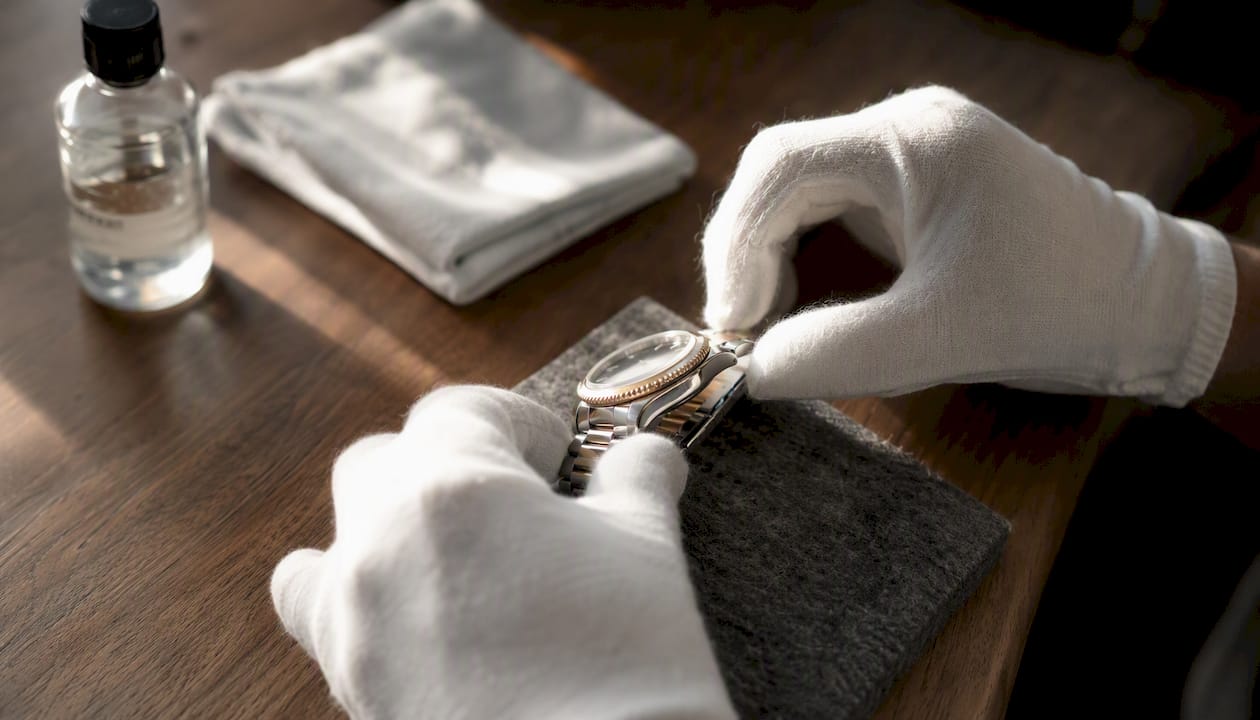
The most effective precaution is also the simplest: handle less. Designate one or two pieces per reference as “try-on” models and keep the primary display pieces on their cushions. When a customer wants to see a watch up close, bring it to them rather than passing it across a counter.
When handling is unavoidable, use cotton gloves or soft silicone finger covers. These aren’t just for vintage watches; any brushed or matte-finish case shows fingerprint oils within seconds of bare-hand contact, and those oils accelerate surface oxidation if left in place. For display case cleaning products that reduce fingerprint transfer to the surrounding display surfaces, ChronoCare’s retail guide covers the options.
Avoid placing watches on hard surfaces without a microfiber pad. Glass counters and metal trays scratch case backs and lugs faster than almost any other common retail surface. Keep a folded microfiber cloth at every display station.
Crown stress is underappreciated. Every time a customer or staff member picks up a watch by the crown, or sets it down crown-first, they’re applying lateral force to the stem. Over time, this loosens the crown tube and compromises water resistance. Train staff to always pick up a watch by the case, never the crown.
The case for restraint: a collector’s perspective on preservation
The conventional wisdom in retail is that a watch should always look its best, which usually means polishing. That instinct is understandable and almost always wrong for collector pieces.
The watches that hold value and attract serious buyers are the ones that look exactly as they left the factory, wear and all. A dial with original patina, a case with honest wear on the lugs, a bracelet with stretch that matches the age of the piece — these are not flaws to a collector. They’re evidence. They tell a story that a freshly polished watch cannot tell, and that story is often worth more than the shine.
The practical trade-off for retailers and private sellers is real: a polished watch may sell faster to a casual buyer, but it will sell for less to the buyer who matters most. The collector who pays full price for a reference is also the one who will walk away from a piece that’s been “cleaned up” too aggressively.
Conservative interventions — a gentle wipe with a microfiber cloth, a gasket replacement, a movement service that doesn’t touch the case — are not just acceptable. They’re the right call every time. The line to hold is against polishing compounds on the case, abrasive tools on the crystal, and any refinishing that removes original material. Clean the watch. Service the movement. Leave the finish alone.
ChronoCare keeps your floor-model watches display-ready
Maintaining display watches at collector grade means having the right tools within reach, not improvising with whatever’s in the supply closet.
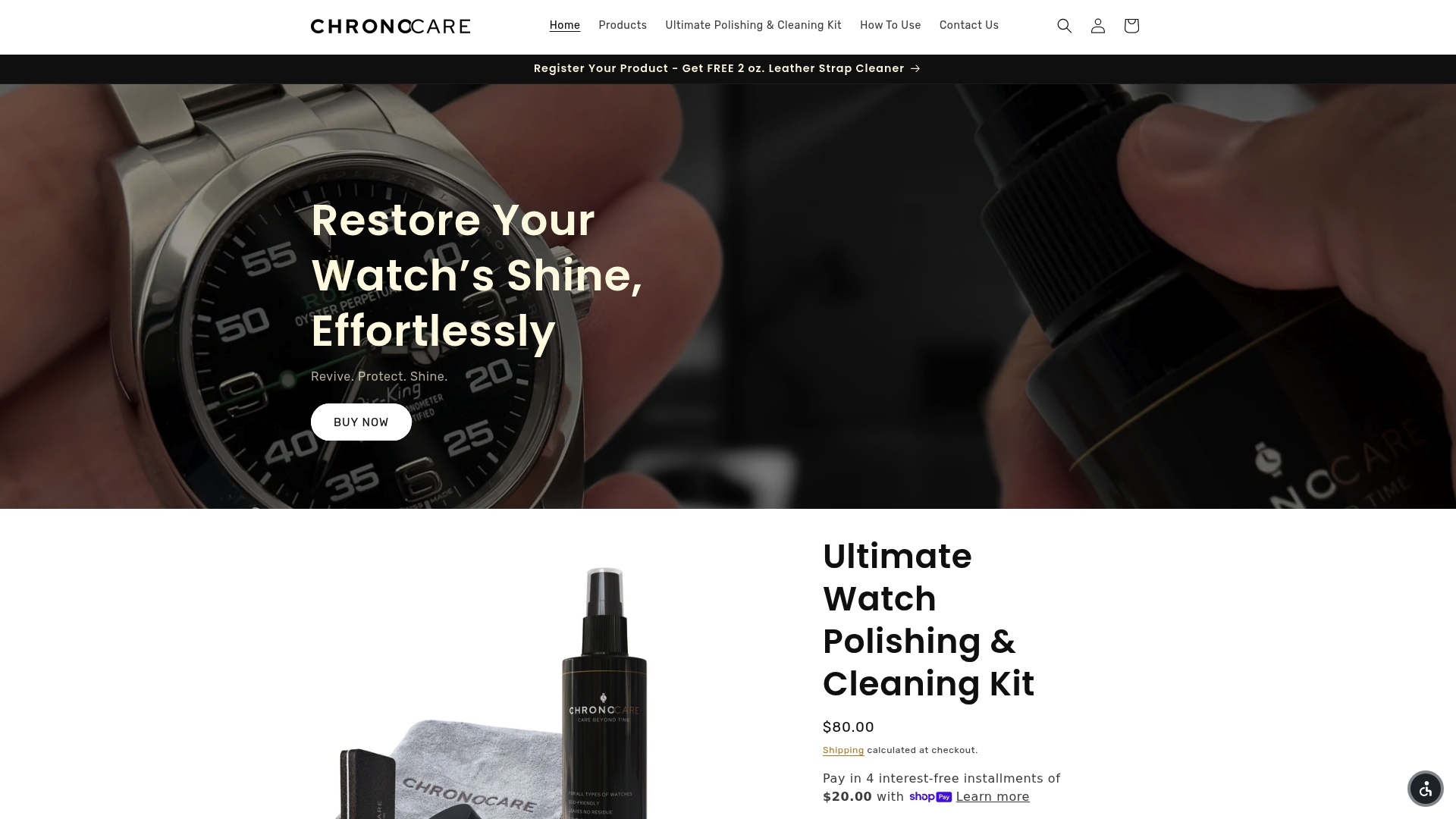
ChronoCare’s Ultimate Watch Cleaning Kit is formulated specifically for luxury timepieces and covers the daily wipe-down and bracelet cleaning steps in this guide. For pieces where selective surface restoration is appropriate, the Ultimate Watch Polishing & Cleaning Kit includes safe compounds and tools designed to minimize metal removal. When a light scratch on a low-collectibility piece needs addressing, the Watch Polishing Cream removes surface marks while staying gentle on factory finishes. All three products are formulated in the US and come with use instructions built around preservation-first outcomes. Skip the polishing cream on collector pieces; use the cleaning kit for routine display maintenance. Browse the full range at Shopchronocare and pick the kit that matches your workflow.
Sources
- How Often Should You Service a Watch? Complete Service Interval Guide by Brand - We Know Watches
- How to store a watch: essential tips for your timepieces - Longines
- Restore vs Preserve vintage watch - GoldsmithWorks
- How to Service Your Watch: Complete Maintenance Guide - The Watchology
- How to store and maintain your watch - Christie’s