

Why Watch Crystal Cleaning Matters for Your Timepiece
Regular crystal cleaning preserves optical clarity, prevents contaminants from degrading seals, and protects the resale value of your watch. The single most important daily action: wipe the crystal with a clean microfiber cloth after every wear. Paper towels and tissues are too coarse and can leave micro-scratches, especially on acrylic crystals.
Why it matters at a glance:
- Clarity: Oils, dust, and fingerprints obscure the dial and make reading the time harder than it should be.
- Seal protection: Grime and contaminants that collect around the crystal edge accelerate gasket wear, which compromises water resistance.
- Value preservation: A scratched or hazed crystal signals neglect to buyers and lowers resale price.
- Damage prevention: Catching a chip or crack early stops moisture from reaching the movement.
Table of Contents
- Why your watch crystal does more than you think
- How crystal material changes everything about care
- How to identify your crystal type quickly
- What to use for daily cleaning and what to skip entirely
- How to remove light scratches and when to stop
- How crystal condition connects to water resistance and service
- Common mistakes that damage crystals and hurt resale value
- Your simple weekly and monthly crystal care routine
- Key Takeaways
- The case for treating your crystal like the first line of defense
- ChronoCare has the right tools for every crystal type
- Useful sources and further reading
Why your watch crystal does more than you think
The crystal is not just a window. It is the first line of defense for everything inside the case: the movement, the dial, the hands. Optically, a clean crystal makes the dial legible and the watch look sharp on the wrist. Structurally, it forms part of the water-resistance seal alongside the gasket and case back. When that crystal is compromised, even tiny chips or hairline cracks allow moisture and dust to enter, which corrodes the movement and can cause complete mechanical failure.
A scratched or hazed crystal also hits resale value harder than most owners expect. Pre-owned watch buyers notice crystal condition immediately. Consistent cleaning, framed as preventative maintenance rather than cosmetics, is what separates a watch that holds its value from one that depreciates through neglect.
Seal failure risk: A cracked or chipped crystal immediately compromises water resistance. Avoid wearing any watch with crystal damage near water until it has been professionally replaced.
How crystal material changes everything about care
Not all crystals clean or repair the same way. The material determines what you can safely do at home and what will cost you a professional service bill.
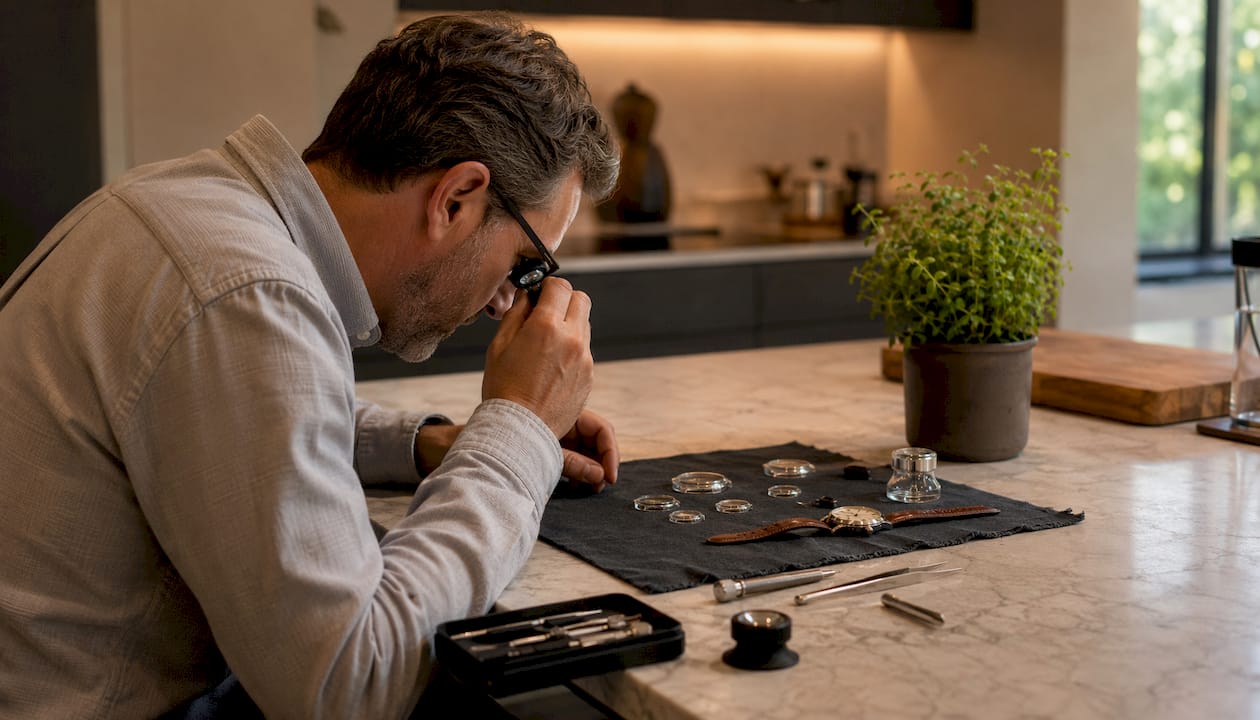
Different crystal materials require fundamentally different repair approaches: acrylic can often be polished back to clarity; mineral and sapphire typically require replacement for serious scratches.
| Material | Scratch Resistance | Polishable at Home | DIY Risk | Typical Repair Cost |
|---|---|---|---|---|
| Acrylic (Hesalite) | Low | Yes (Polywatch) | Low | — |
| Mineral glass | Medium | No | High | — |
| Sapphire | Very high (Mohs ~9) | No | Very high | — |
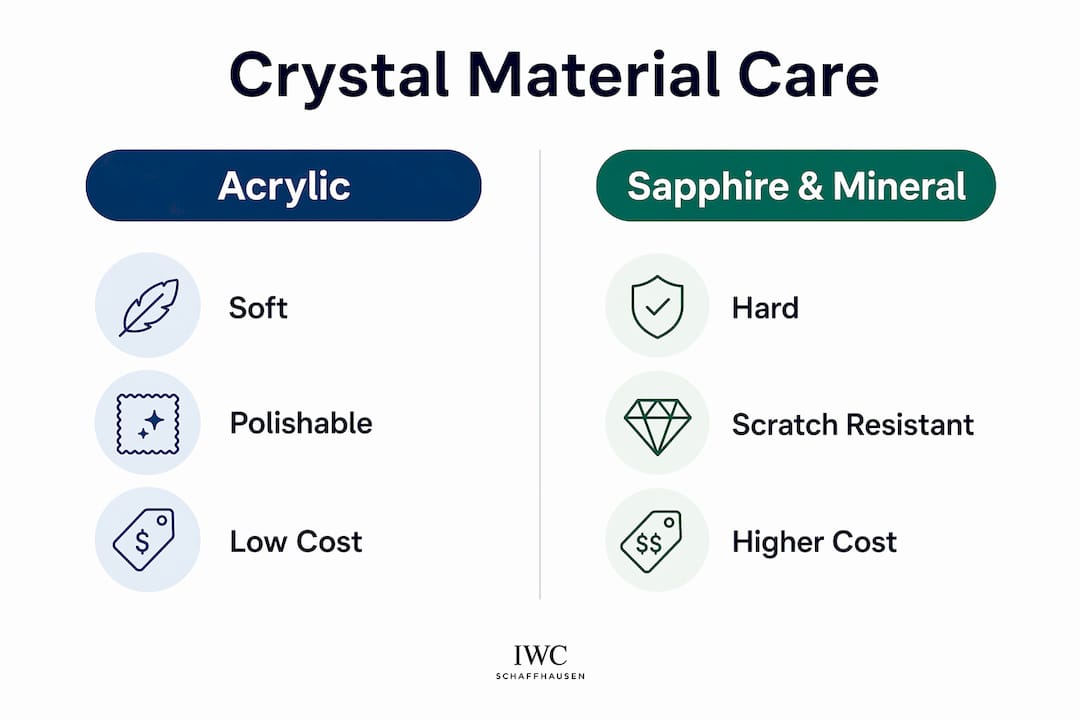
Acrylic (Hesalite) is soft, shatter-resistant, and inexpensive to replace. It scratches easily but polishes back well with the right compound. Vintage Rolex Submariner models used Hesalite for decades, and collectors still polish them at home.
Mineral glass sits in the middle: more scratch-resistant than acrylic, but scratches cannot be buffed out at home without specialized equipment. If it scratches badly, replacement is the practical answer.
Sapphire scores approximately Mohs 9 on the hardness scale, making it extremely scratch-resistant. The trade-off is brittleness: a sharp, concentrated impact can chip or shatter it. Many sapphire crystals also carry anti-reflective (AR) coatings that are more vulnerable to household chemicals than the sapphire itself.
- Acrylic: polish regularly, avoid solvents, replace cheaply if cracked.
- Mineral: clean gently, skip home polishing, budget for replacement.
- Sapphire: protect from hard impacts, never use alcohol or acetone on AR coatings, replace professionally if chipped.
Pro Tip: If your watch has a double-sided AR coating on sapphire, the outer layer is the most vulnerable part of the crystal. A smudge that won’t wipe off cleanly is often a damaged coating, not a scratch in the sapphire itself.
How to identify your crystal type quickly
You can narrow down your crystal material in under two minutes without any tools.
Visual cues: Sapphire crystals often show a faint blue or purple tint under certain lighting, caused by the AR coating. Acrylic tends to look slightly warmer and may already show fine surface scratches on older watches. Mineral glass looks clear and flat, similar to a smartphone screen.

The fog test: Breathe on the crystal. Acrylic holds condensation longer than mineral or sapphire, which clear almost instantly. It is not definitive, but it is a useful first filter.
Edge check: Under a loupe or magnifier, acrylic edges look slightly rounded and soft. Sapphire and mineral edges are sharper and more precise. Vintage watches with domed crystals are almost always acrylic.
When in doubt, check the manufacturer’s spec sheet or the original box. If the watch is a significant piece and you genuinely cannot confirm the material, ask a watchmaker before attempting any polishing. Inspecting the crystal closely before any damp cleaning is a good habit regardless of material: if the last service was more than three years ago or gasket condition is unknown, treat the watch as dry-clean only.
What to use for daily cleaning and what to skip entirely
Daily cleaning does not need to be complicated. A dry microfiber cloth handles most of what accumulates during a normal day: skin oils, dust, and light fingerprints. Use a fresh section of the cloth each pass so you are not dragging grit across the surface.
For a more thorough clean, a single drop of mild dish soap in lukewarm water works well for mineral and sapphire crystals on watches with confirmed water resistance. Apply the solution to the cloth, not directly to the crystal, and wipe gently. Rinse the cloth, wipe again, then dry immediately.
What to avoid:
- Paper towels and tissues: too abrasive for acrylic and will leave micro-scratches over time.
- Windex and window cleaners: household glass cleaners can strip AR coatings and damage case finishes.
- Acetone and alcohol: dissolve acrylic and destroy AR coatings on sapphire.
- Rough brushes on acrylic: any bristle harder than a soft toothbrush will scratch.
- Perfume and sunscreen: apply fragrances before putting on your watch, never after.
Pro Tip: Before any damp cleaning, push the crown fully in or screw it down. If you are unsure of your watch’s current water-resistance rating or when it was last pressure-tested, stick to a dry microfiber wipe only. Removing fingerprints from your luxury watch safely is almost always a dry-cloth job.
How to remove light scratches and when to stop
The fingernail test is the fastest way to judge scratch severity. Run your nail lightly across the scratch. If it catches, the scratch is deep enough that home polishing will not fix it cleanly and may make things worse. If your nail glides over it, it is a surface scuff worth attempting at home on the right material.
For acrylic crystals: Polywatch is the standard product, and it works. Apply a small pea-sized amount to a soft cloth, rub in gentle circular motions for 30–60 seconds, then wipe clean. Repeat two or three times for stubborn scuffs. The crystal will look slightly hazy mid-process; that clears as you buff. The crystal polishing guide from ChronoCare walks through material-specific technique in detail.
For mineral and sapphire: Do not attempt home polishing for anything beyond a very light surface smudge. Polishing mineral or sapphire at home risks creating surface waves and uneven finishes; diamond paste on sapphire is high-risk even for experienced hands. The right answer for a scratched mineral or sapphire crystal is almost always professional replacement.
Send it to a pro when:
- The fingernail catches on the scratch.
- There is any chipping, especially at the crystal edge.
- The AR coating shows peeling or uneven patches.
- There is fogging or condensation inside the case.
- Any structural damage is visible around the bezel seat.
How crystal condition connects to water resistance and service
A chip or crack does not have to be dramatic to cause real damage. Even a hairline fracture at the crystal edge breaks the seal between the crystal and the gasket, and moisture enters the case from there. The movement corrodes quietly, often before the owner notices anything wrong.
Mechanical watches typically need professional servicing every few years. Watches regularly exposed to water should receive annual water-resistance testing because gaskets degrade over time regardless of whether the crystal looks fine. Rubber and silicone gaskets dry out and lose elasticity; most manufacturers recommend a water-resistance check every 1–2 years for watches used near water.
Service interval reminder: Professional service every 4–6 years for mechanical watches; water-resistance testing annually if you swim, shower, or dive with your watch.
After any crystal replacement or significant polishing that involved removing the crystal, pressure testing is not optional. The gasket may have shifted or been nicked during the process. A watchmaker with a pressure tester confirms the seal before the watch goes back on your wrist near water. For corporate buyers and retailers sourcing watches in volume, professional pressure testing is a standard step before delivery.
Common mistakes that damage crystals and hurt resale value
The most frequent errors are not dramatic. They are small, repeated habits that accumulate into real damage.
- Paper towels: Used by almost everyone at some point, and they scratch acrylic every single time.
- Toothpaste: Occasionally recommended online as a DIY polish. It is mildly abrasive and unpredictable; skip it entirely.
- Over-polishing acrylic: Polywatch removes material. Polish too often or too aggressively and the crystal thins, changes curvature, and eventually fits the bezel seat less precisely, which affects the seal.
- Household glass cleaners on sapphire: The crystal survives; the AR coating does not.
- Ignoring chips: A small chip at the edge looks minor. Left alone, it grows under normal wear and eventually compromises the gasket seat.
From a dealer’s perspective, over-polished watches are a known problem. Surface waves, uneven AR coating removal, and a crystal that sits slightly proud of the bezel are all signs that someone polished too aggressively. These details reduce resale offers. The common DIY restoration mistakes that ChronoCare documents include exactly this pattern: owners who polish correctly once, then keep going until they cause the damage they were trying to fix.
Your simple weekly and monthly crystal care routine
Consistency matters more than intensity. A two-minute daily wipe prevents the buildup that leads to deeper cleaning sessions and the temptation to reach for the wrong product.
Keep on hand:
- Two or three clean microfiber cloths (dedicated to the watch, not shared with eyeglasses).
- Mild dish soap for occasional damp cleans on water-resistant pieces.
- Polywatch if you own any acrylic-crystal watches.
- ChronoCare Ultimate Watch Cleaning Kit for a complete, formulated solution that covers daily maintenance without guesswork.
| Frequency | Action | Water-Resistance Required | Risk Level |
|---|---|---|---|
| Daily | Dry microfiber wipe | No | None |
| Weekly | Inspect for chips, new scratches | No | None |
| Monthly | Damp clean with mild soap | Yes (confirmed) | Low |
| Annually | Professional water-resistance test | Recommended for water use | Low (pro) |
| Every 4–6 years | Full mechanical service | N/A | Pro only |
Keeping your watch dust-free between wears, especially in storage, reduces how much work each cleaning session requires.
Key Takeaways
Regular crystal cleaning is the single most effective habit for preserving a watch’s clarity, seal integrity, and long-term resale value.
| Point | Details |
|---|---|
| Daily wipe is non-negotiable | A dry microfiber cloth after every wear prevents buildup that degrades gaskets and scratches acrylic. |
| Material determines your options | Acrylic polishes at home with Polywatch; mineral and sapphire crystals with serious scratches need professional replacement. |
| Chips break seals immediately | Any chip or crack compromises water resistance; stop wearing the watch near water until a pro replaces the crystal. |
| Service on schedule | Mechanical watches need professional service every 4–6 years; water-resistance testing annually if used near water. |
| ChronoCare for safe at-home care | The ChronoCare Ultimate Watch Cleaning Kit provides a formulated, material-safe solution for daily and periodic maintenance. |
The case for treating your crystal like the first line of defense
Most watch owners think about the movement when they think about watch care. The crystal gets cleaned when it looks dirty, and that is about it. That framing gets it backwards.
The crystal is the component most exposed to the environment, every single day. It takes the impacts, the chemical exposure from sunscreen and soap, the micro-abrasions from sleeves and countertops. The movement, by contrast, sits protected inside the case. The crystal is what stands between a pristine dial and the outside world.
Material-specific decisions matter more than most guides acknowledge. Reaching for the wrong product on the wrong crystal, such as an acrylic polish on mineral glass or a household cleaner on an AR-coated sapphire, causes irreversible damage in minutes. The right routine is simple once you know your material. The wrong one is expensive.
The preventative mindset is what separates collectors who keep watches in excellent condition from those who end up paying for avoidable service work. A two-minute daily wipe costs nothing. A crystal replacement, a gasket reseat, and a pressure test after moisture ingress costs real money and time.
ChronoCare has the right tools for every crystal type
The ChronoCare Ultimate Watch Cleaning Kit is built around exactly the material-specific approach this article describes: premium microfiber cloths, a gentle cleaning solution formulated for luxury timepieces, and applicators that work safely on acrylic, mineral, and sapphire crystals. No guesswork about whether a product will strip an AR coating or scratch a soft acrylic surface.
For owners dealing with light surface scuffs on metal cases alongside crystal maintenance, the Watch Polishing Cream handles cosmetic restoration of metal surfaces within safe DIY limits. Both products are formulated in the US and designed for the collector who wants professional-grade results at home.
One honest note: the kit handles daily maintenance and light cosmetic care. Chips, deep scratches, and any crystal work that involves removing the crystal belong with a watchmaker. Use ChronoCare for everything in between, and send the serious repairs to a pro. Browse the full product range at shopchronocare.com to find the right kit for your collection.
Useful sources and further reading
- How To Care For A Watch Crystal — Analog Shift: Practical owner-level guidance on safe cleaning methods and material identification.
- Watch parts in focus: watch crystal — Chrono24 Magazine: Material hardness data and trade-offs between sapphire, mineral, and acrylic.
- How to polish a watch crystal and restore its shine — ECI Jewelers: DIY limits, nail-catch test, and when professional lapping is required.
- A Clear View of Time: Understanding the Watch Glass — Chrono Candy: Household chemicals to avoid and why microfiber is the baseline tool.
- Watch maintenance guide — Romans Jewelry: Service intervals and water-resistance testing frequency.
- How to clean a watch at home — Hewore: Pre-cleaning inspection checklist and safety guidance for damp cleaning.
- Watch Crystals: Acrylic, Mineral & Sapphire — Iglisi Watch: Material behavior comparison and repair approach by crystal type.
- Watch servicing guide for beginners — The Watch Lab: Preventative maintenance framing and chemical exposure risks.
- How Watch Crystal Polishing Works: A Material Guide — ChronoCare: Material-specific polishing technique and safe DIY scope.
- Why watch band cleaning matters for every collector — ChronoCare: Companion guide to crystal care covering strap and bracelet maintenance.