

The Role of Ultrasonic Watch Cleaning for Luxury Timepieces
Ultrasonic watch cleaning is defined as a precision maintenance process that uses high-frequency sound waves to remove contaminants from watch components through acoustic cavitation, without any physical abrasion. The role of ultrasonic watch cleaning in luxury watch care goes far beyond surface-level tidying. It reaches dirt, old lubricants, and oxidized residues in blind holes and recessed surfaces that no brush or cloth can touch. For collectors maintaining a Rolex, Patek Philippe, or IWC, this method represents the gold standard of component-level cleanliness. Understanding how it works, where it excels, and where it fails is the difference between a watch that runs accurately for decades and one that deteriorates quietly in a drawer.
How does ultrasonic watch cleaning work?
Ultrasonic cleaning operates on a principle called acoustic cavitation. A transducer converts electrical energy into high-frequency sound waves, which travel through a liquid-filled tank and create millions of microscopic bubbles. Those bubbles grow, become unstable, and implode. Each implosion releases a concentrated pressure jet that physically fractures and lifts contaminants from the surface of whatever is submerged. The result is a non-abrasive cleaning action that reaches geometry no manual tool can access.
Watch-grade ultrasonic machines typically operate between 20 and 40 kHz. Lower frequencies generate larger, more aggressive bubbles suited to metal bracelet links and case components. Higher frequencies produce finer cavitation, which is gentler on delicate movement parts. This frequency range is not arbitrary. It is calibrated to match the physical tolerances of watch components, where a single gear pivot can measure less than 0.1 mm in diameter.
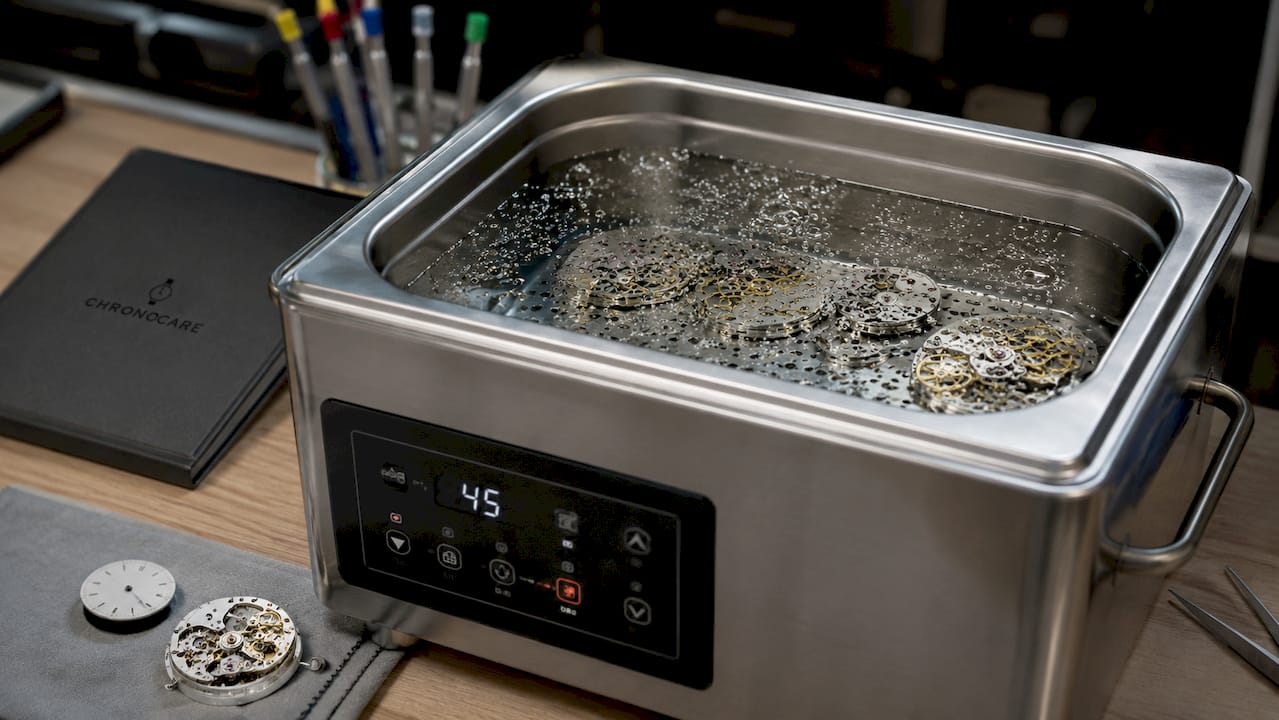
The contrast with traditional cleaning methods is significant. Manual cleaning with peg wood, brushes, and solvents requires direct contact and considerable skill. It misses recessed features and risks scratching polished surfaces. Ultrasonic cleaning reaches every cavity and blind hole in components, delivering a level of cleanliness that manual methods cannot replicate at scale or speed.
Pro Tip: Always use a cleaning solution formulated specifically for watch parts, such as Elma Red or L&R solutions, rather than household detergents. Generic soaps leave residues that interfere with lubrication and can corrode brass movement components.
Key factors that determine ultrasonic cleaning effectiveness:
- Frequency setting matched to the component type (low for cases, higher for movement parts)
- Cleaning solution chemistry and correct dilution ratio
- Solution temperature, typically between 40°C and 60°C for watch applications
- Cycle duration, usually 3 to 10 minutes per batch
- Degassing the solution before use to remove trapped air that reduces cavitation efficiency
What are the benefits and risks of ultrasonic watch care?
The benefits of ultrasonic cleaning for watch maintenance are concrete and measurable. Cavitation removes dirt, skin oils, old lubricants, and atmospheric deposits from every surface simultaneously. Ultrasonic cleaning removes old lubricants more thoroughly than any manual process, which directly preserves movement accuracy and extends the service interval. For a high-beat movement running at 28,800 vibrations per hour, contaminated lubricants are a primary cause of rate deviation and premature wear.
The non-contact nature of the process is equally significant. No brush bristle, no peg wood tip, and no cloth fiber touches the component. This matters for polished steel parts, jeweled bearings, and gilt movement bridges where abrasive contact would alter the finish or introduce micro-scratches.
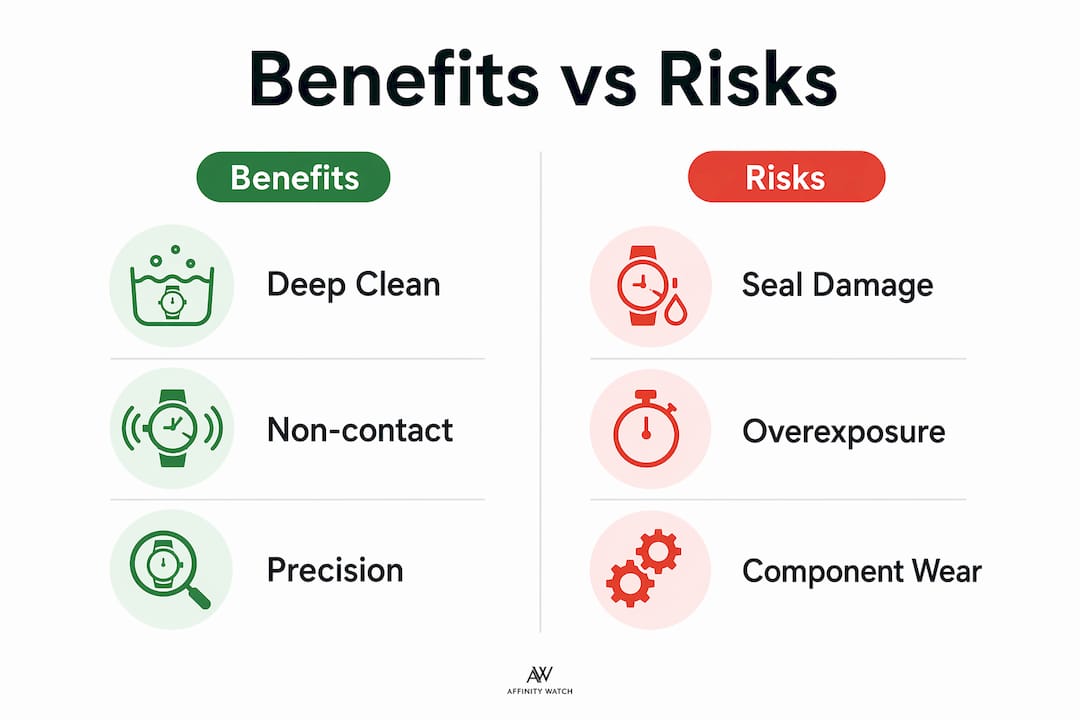
The risks, however, are real and frequently underestimated by hobbyists. Vibrations plus water exposure can weaken seals and gaskets, increasing the risk of water ingress long after cleaning. A watch rated to 100 meters of water resistance is tested under static pressure, not ultrasonic cavitation stress. These are entirely different physical conditions. Painted dials, luminous hands, and shellac-fixed components are particularly vulnerable. Even short cycles at low power can loosen adhesive bonds or lift paint from a vintage dial.
| Benefit | Risk |
|---|---|
| Reaches blind holes and recessed surfaces | Degrades seals and gaskets with repeated exposure |
| Removes old lubricants completely | Damages painted dials and luminous hands |
| Non-contact process protects polished surfaces | Loosens shellac-fixed components at low power |
| Faster and more consistent than manual cleaning | Consumer machines lack precision controls |
| Improves movement accuracy post-service | Incorrect solutions leave damaging residues |
Professional watchmakers mitigate these risks through full disassembly before any ultrasonic exposure, selective exclusion of vulnerable parts, and controlled machine parameters. The watch head, movement, and bracelet are never cleaned together or as an assembled unit.
How do professionals perform ultrasonic watch cleaning?
Professional ultrasonic cleaning follows a structured workflow that begins well before the machine is switched on. The watch is fully disassembled: movement removed from the case, bracelet separated, and individual movement components sorted by material and fragility. Dials, hands, and any painted or coated parts are set aside for manual cleaning only.
The cleaning sequence for movement parts typically runs as follows:
- Degrease components in an ultrasonic bath with a diluted cleaning solution such as Elma Red at 1:9 ratio in distilled water, run for 3 to 5 minutes.
- Transfer to a rinse bath of clean distilled water to remove solution residue.
- Run a second rinse cycle in fresh distilled water or a dedicated rinse solution.
- Dry components in a warm air cabinet or with controlled heat, never with compressed air that can introduce moisture.
- Inspect each part under magnification before lubrication and reassembly.
Professional machines from brands like Elma, L&R, and Zenith Ultrasonics include frequency, power, and temperature controls that consumer-grade units simply do not offer. Degassing is a standard step in professional workflows. Degassing solutions with distilled water removes dissolved air that would otherwise dampen cavitation and leave residues that impair lubrication after reassembly.
After cleaning, the service cycle continues with lubrication of every friction point using calibrated oils and greases, regulation of the movement’s rate, and a water resistance pressure test before the watch is returned to the customer. Ultrasonic cleaning alone is not a full service. It is one critical step in a larger process.
Pro Tip: Never place a basket of parts directly on the tank floor. Use a suspended mesh basket so components receive cavitation from all sides equally, and avoid stacking parts on top of each other, which creates shielded zones that clean unevenly.
When should you use ultrasonic cleaning at home vs. seek professional service?
Home ultrasonic cleaners are practical tools for one specific task: cleaning metal watch bracelets and cases that have been removed from the movement. A stainless steel Oyster bracelet from a Rolex Submariner, a titanium bracelet from a TAG Heuer Aquaracer, or a metal case back can all be safely cleaned in a consumer-grade machine. Review the bracelet cleaning checklist before you start to confirm the bracelet material is compatible.
The boundaries of safe home use are firm:
- Never place a complete watch with the movement installed into an ultrasonic cleaner
- Avoid ultrasonic cleaning of vintage watches, which often have degraded seals and shellac-fixed components
- Do not clean watches with acrylic crystals, as cavitation can cloud or crack the material
- Skip ultrasonic cleaning for any watch that has not been recently pressure-tested
- Use only purpose-formulated solutions, not dish soap, ammonia, or alcohol blends
For the watch head itself, manual cleaning with a watch cleaning spray and a soft brush handles fingerprints, dust, and surface grime without risk. If you notice condensation under the crystal, a sluggish movement, or visible corrosion on the case back, those are signs your watch needs professional cleaning and a full service, not a home ultrasonic session.
Consumer-grade ultrasonic cleaners lack the precision controls of professional machines, meaning frequency, power, and temperature are fixed or minimally adjustable. For bracelet cleaning, that limitation is acceptable. For movement components, it is not. Knowing where that line sits protects your investment and keeps your watch running correctly.
Key takeaways
Ultrasonic watch cleaning is the most effective method for removing contaminants from disassembled watch components, but its safety depends entirely on proper disassembly, correct solutions, and controlled machine parameters.
| Point | Details |
|---|---|
| Acoustic cavitation drives cleaning | Microscopic bubble implosions dislodge dirt from blind holes no brush can reach. |
| Full disassembly is non-negotiable | Never ultrasonic clean a complete watch with the movement installed. |
| Solution chemistry determines quality | Use watch-specific solutions like Elma Red at correct dilution in distilled water. |
| Painted and shellac parts need manual cleaning | Ultrasonic exposure risks loosening adhesives and lifting coatings on dials and hands. |
| Home use is limited to metal bracelets | Consumer machines lack controls for safe movement-part cleaning. |
Why ultrasonic cleaning deserves more respect from collectors
I have watched collectors spend five figures on a vintage Omega Speedmaster and then hand it to someone with a $40 ultrasonic cleaner from an online marketplace. The machine cleans the bracelet fine. The problem is when that same machine gets used on the case with the movement still inside, because the owner read somewhere that ultrasonic cleaning is “safe for watches.”
The biggest misunderstanding I see is treating ultrasonic cleaning as a single category of activity. It is not. Cleaning a stainless steel bracelet and cleaning a disassembled movement are two entirely different operations requiring different equipment, solutions, and expertise. The combined stress of liquid exposure and cavitation vibration on a watch seal is not equivalent to a static water resistance test. That distinction matters enormously for long-term watch health.
What I find genuinely underappreciated is how much cleaning solution chemistry affects the outcome. Proper dilution and handling are the hidden variables that separate a professional result from a mediocre one. A watchmaker who degasses their solution, uses distilled water, and runs the correct temperature will get a movement component so clean it looks factory-fresh. Someone using tap water and a generic detergent will get residue that interferes with lubrication within months.
My recommendation is straightforward. Use ultrasonic cleaning for what it does best: metal bracelets and disassembled case parts at home, and full movement service in the hands of a trained watchmaker. Pair it with a luxury watch care routine that includes regular surface cleaning and annual inspections. That combination keeps a luxury timepiece performing and looking as it should for decades.
— Raymond Jenkins
Keep your watch clean with the right tools
ChronoCare builds cleaning products specifically for collectors who take their watches seriously. Whether you are maintaining a metal bracelet between professional services or keeping a case back spotless, having the right solution matters as much as the technique.
The Ultimate Watch Cleaning Kit from ChronoCare includes everything needed for safe, thorough surface cleaning of luxury timepieces, with formulations that protect metal finishes and coatings. For collectors who want to go further, the Ultimate Watch Polishing and Cleaning Kit adds polishing capability to restore luster after cleaning. Both kits are formulated in the US and designed to complement professional ultrasonic service, not replace it.
FAQ
What is the role of ultrasonic cleaning in watch maintenance?
Ultrasonic cleaning removes dirt, old lubricants, and contaminants from disassembled watch components using acoustic cavitation, reaching surfaces no manual tool can access. It is a core step in professional watch servicing, not a standalone solution.
Is ultrasonic cleaning safe for all watches?
Ultrasonic cleaning is safe for disassembled metal components and bracelets, but not for complete watches with movements installed. Vintage watches, painted dials, and shellac-fixed parts should never be exposed to ultrasonic cavitation.
What solution should you use in an ultrasonic watch cleaner?
Use a watch-specific cleaning solution such as Elma Red diluted at a 1:9 ratio in distilled water. Generic detergents leave residues that damage movement components and impair lubrication after reassembly.
Can a home ultrasonic cleaner replace professional watch servicing?
No. Consumer-grade machines lack the frequency, power, and temperature controls required for safe movement-part cleaning. Professional service combines ultrasonic cleaning with lubrication, regulation, and water resistance testing that no home machine replicates.
How often should a luxury watch receive ultrasonic cleaning?
Ultrasonic cleaning of movement components occurs as part of a full service, which most manufacturers recommend every three to five years. Metal bracelets can be cleaned more frequently, as needed, without risk to the watch.