

What Does Watch Hand Setting Involve: 2026 Guide
Watch hand setting is defined as the technical process of physically attaching and aligning the hour, minute, and second hands onto a watch movement’s pinions to produce accurate time indication. This is not the same as turning the crown to adjust the time on your wrist. Watchmakers distinguish between user time-setting and the precise, tool-driven procedure of mounting hands with correct tolerances. What does watch hand setting involve at its core? Controlled force, specialized tools, a strict installation sequence, and clearance checks that protect the movement for years to come.
What does watch hand setting actually require?
Watch hand setting requires physically pressing each hand onto its corresponding pinion with calibrated force and verified alignment. The difference between crown adjustment and true hand setting is significant. When a watchmaker sets hands, they attach them to the canon pinion, the hour wheel pipe, and the seconds pinion with tolerances measured in hundredths of a millimeter. A misaligned hand does not just look wrong. It rubs against the dial or another hand, creating friction that degrades movement accuracy over time.
The canon pinion sits at the center of this process. It holds the minute hand and transfers torque from the movement to the hour wheel through a friction-based coupling. That friction is what lets you turn the crown to set the time without stopping the gear train. Get the hand fit wrong, and the canon pinion either slips under load or binds completely.

What tools and equipment are essential for precise watch hand setting?
Professional hand setting requires a movement holder, a dial protector, and a hand-setting press with interchangeable tips. Manual finger pressure causes the majority of bent hands and dial scratches in amateur repairs. Each tool in this kit serves a specific protective function.
The core toolkit includes:
- Movement holder: Secures the movement and dial assembly without flexing or scratching the case back seat.
- Dial protector: A thin film or rigid shield placed over the dial surface before any hand work begins.
- Hand-setting press: A lever or push-type press that applies even, vertical force directly to the hand’s pipe.
- Interchangeable tips: Matched to the pipe diameter of each hand. Using an oversized tip crushes the pipe; an undersized tip applies off-center force and bends the hand.
- Nylon-tipped hand removers: Used to lift hands without scratching the dial or deforming the pipe during disassembly.
Selecting the correct tip size is not optional. Even a 0.1mm mismatch in tip diameter produces uneven pressure that seats the hand at an angle. An angled hand will clear the dial at one position and drag at another, which forces a complete rework.
Pro Tip: Before pressing any hand, test-fit the tip against the hand pipe on a scrap movement first. The tip should seat flush with no wobble.
What are the correct steps and sequence for setting watch hands?
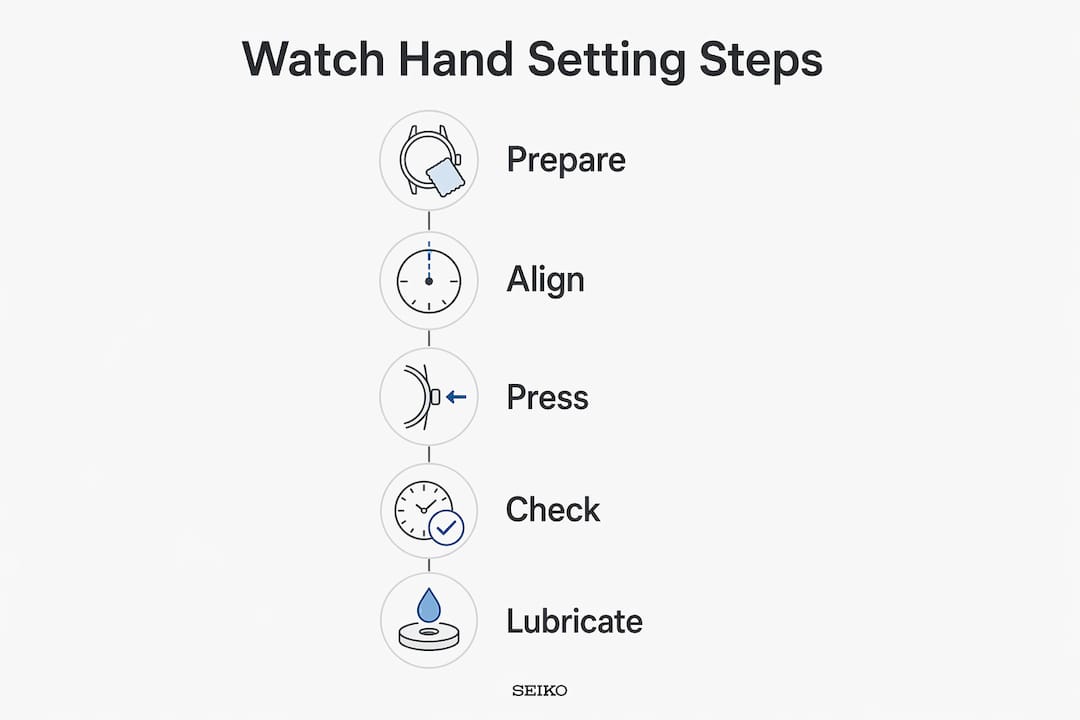
The installation sequence follows a fixed order: hour hand first, then minute hand, then seconds hand, with all three installed at the 12:00 position. Starting at 12:00 aligns the hands with the movement’s design geometry and avoids accidentally engaging date or complication mechanisms mid-installation.
Follow these steps in order:
- Prepare the movement. Place it in the movement holder with the dial protector in position. Confirm the crown is in the time-setting position so the gear train is disengaged.
- Install the hour hand at 12:00. Slide the hand pipe over the hour wheel pipe. Use the hand-setting press with the correct tip to press it down with a single, controlled stroke. The hand should sit flat and parallel to the dial.
- Install the minute hand at 12:00. Press it onto the canon pinion directly above the hour hand. Verify it does not touch the hour hand by viewing from the side at eye level.
- Check clearance. Slowly rotate the hands clockwise through a full 12-hour cycle. Watch for any contact between the minute and hour hands at every position.
- Install the seconds hand at 12:00. Press it onto the seconds pinion. The seconds hand sits closest to the dial, so its clearance from the dial surface is the most critical measurement.
- Run a 24-hour clearance check. Observing clearance through a full rotation at every dial position is required before final casing. Any rubbing at any point means the affected hand must be removed and reseated.
Pro Tip: Use a strong loupe at 5x or 7x magnification during the clearance check. Hands that appear clear to the naked eye often show contact under magnification.
What mistakes commonly occur during watch hand setting and how to avoid them?
The most damaging mistake in the watch hand adjustment process is rotating the hands counterclockwise. Advancing time counterclockwise damages mechanical gear trains by forcing the keyless works and date mechanism against their designed direction of travel. If you overshoot the target time, always continue forward clockwise through a full rotation rather than reversing.
Common errors to avoid:
- Forcing an improperly sized hand onto a pinion. If a hand does not seat with light press pressure, the pipe bore is wrong. Forcing it splits the pipe or deforms the pinion.
- Bending an installed hand. Attempting to bend hands while they are mounted on the watch causes permanent deformation and inconsistent clearance. Remove the hand, adjust it on a flat surface, and reseat it properly.
- Changing the date between 9:00 PM and 3:00 AM. The date-changing mechanism operates during this window on most mechanical watches. Forcing a date change in this zone can permanently strip the date wheel teeth.
- Ignoring a loose hand. A loose hand is not a cosmetic issue. Loose hands can snag on the dial or other hands and cause severe internal damage if the movement is not stopped immediately. Pull the crown out at once to halt the gear train.
“A loose hand is more than an aesthetic problem. It is a mechanical hazard that can destroy a movement in minutes if left unchecked.”
Knowing when to seek professional help is part of responsible watch ownership. If a hand will not seat correctly after two attempts, stop and consult a qualified watchmaker.
How does proper watch hand setting affect timekeeping accuracy and watch longevity?
The canon pinion is the mechanical link between accurate hand setting and long-term timekeeping reliability. It holds the minute hand through friction, not a fixed connection. That friction must be calibrated precisely. Too tight, and the crown becomes hard to turn. Too loose, and the minute hand slips independently of the gear train, causing the displayed time to drift without any movement fault.
Lubrication is the variable most collectors overlook. A single drop of Moebius 9501 on the canon pinion provides the correct friction coefficient for smooth hand tracking. Both insufficient and excessive lubrication cause tracking problems. Too little oil creates stick-slip friction that jerks the hand forward in uneven increments. Too much oil migrates onto the dial surface or into the gear train, attracting debris and accelerating wear.
The table below shows how hand setting quality directly affects movement performance:
| Setting factor | Correct execution | Result of error |
|---|---|---|
| Hand pipe fit | Matched to pinion diameter | Slippage or split pipe |
| Installation position | 12:00 on all three hands | Misalignment, complication damage |
| Clearance verification | Full 24-hour rotation check | Rubbing, dial scratches, hand drag |
| Canon pinion lubrication | Single drop of Moebius 9501 | Time drift or gear seizure |
| Rotation direction | Clockwise only | Gear train damage |
Collectors who use quality watch repair kits with proper tools consistently report fewer hand-related service issues over the life of a timepiece. The investment in the right equipment pays back in avoided repair costs and preserved movement integrity.
Key Takeaways
Correct watch hand setting requires the right tools, a fixed installation sequence, clockwise-only rotation, and a full 24-hour clearance check before the movement is cased.
| Point | Details |
|---|---|
| Installation sequence matters | Always install hands in order: hour, minute, then seconds, all at 12:00. |
| Use matched tip sizes | Select a hand-press tip that matches the pipe diameter to prevent bending or off-center seating. |
| Clockwise rotation only | Never reverse hand direction; advance forward through a full rotation if you overshoot. |
| Lubricate the canon pinion | Apply one drop of Moebius 9501 for correct friction. More or less causes time drift or gear damage. |
| Verify clearance fully | Rotate hands through a complete 24-hour cycle and inspect at every position before casing. |
A watchmaker’s honest view on hand setting
Most collectors underestimate how much of watch hand setting is about feel rather than force. You are not driving a screw. You are pressing a thin metal pipe onto a pinion with just enough pressure to hold it securely without collapsing the bore. That distinction takes practice to internalize.
The clearance check is where I see the most shortcuts taken. Collectors will rotate the hands through one or two positions, see no contact, and call it done. A hand that clears at 12:00 and 6:00 can still drag at 3:00 or 9:00 because the hand is seated at a slight angle. The full 24-hour rotation is not a formality. It is the only way to confirm the hand is truly flat.
The counterclockwise mistake is also more common than people admit. Setting the time on a mechanical watch by reversing direction feels natural because quartz watches tolerate it. Mechanical movements do not. The gear train is designed for one direction of travel, and reversing it under load stresses the keyless works in ways that show up as service problems years later.
My practical advice: if you are working on a watch worth more than the cost of a professional service, invest in a proper hand-setting press and movement holder before you touch the hands. The tools pay for themselves the first time they prevent a bent hand or a scratched dial. For anything involving luxury watch service standards, the margin for error is essentially zero.
— Raymond Jenkins
ChronoCare’s watch care kits for collectors who take precision seriously
Proper hand setting protects the movement. Proper cleaning and polishing protect everything else. A watch that runs accurately but shows a scratched dial or dull case has lost half its value.

ChronoCare’s Ultimate Watch Cleaning Kit is formulated specifically for luxury timepieces, covering the dial, case, and bracelet without damaging coatings or gaskets. For collectors who want a complete solution, the Ultimate Watch Polishing and Cleaning Kit adds metal surface restoration to the routine. Both kits are formulated in the US and built for the collector who treats maintenance as part of ownership, not an afterthought.
FAQ
What does watch hand setting involve at a basic level?
Watch hand setting involves physically pressing the hour, minute, and seconds hands onto their respective pinions using a hand-setting press and matched tips. It requires correct sequencing, clearance verification, and canon pinion lubrication to produce accurate timekeeping.
Can I set watch hands without professional tools?
Setting watch hands without a movement holder, dial protector, and hand-setting press significantly increases the risk of bent hands and dial scratches. Manual finger pressure is the leading cause of hand damage during amateur repairs.
Why must hands always be installed at the 12:00 position?
Installing all three hands at 12:00 aligns them with the movement’s mechanical design and prevents accidental engagement of date or complication mechanisms during the pressing process.
What happens if a watch hand becomes loose?
A loose hand can snag on the dial or adjacent hands and cause severe internal movement damage. Pull the crown out immediately to stop the gear train and take the watch to a watchmaker for reseating.
How does lubrication affect watch hand performance?
A single drop of Moebius 9501 on the canon pinion sets the correct friction level for smooth hand tracking. Too much lubricant migrates into the gear train and attracts debris. Too little causes stick-slip motion and visible time drift.