

What Does Watch Detailing Involve? A 2026 Guide
Watch detailing is the comprehensive maintenance process that restores and preserves both the mechanical function and physical appearance of a timepiece through expert disassembly, cleaning, lubrication, polishing, and performance testing. For luxury and mechanical watches, this process is the difference between a timepiece that lasts decades and one that quietly degrades from the inside out. What does watch detailing involve goes far beyond a surface wipe. It covers everything from ultrasonic cleaning of movement components to gasket replacement and timing regulation. Whether you own a Rolex Submariner, an Omega Speedmaster, or a vintage Seiko, understanding the full detailing process helps you protect both the function and the financial value of your watch.
What does the professional watch detailing process involve?
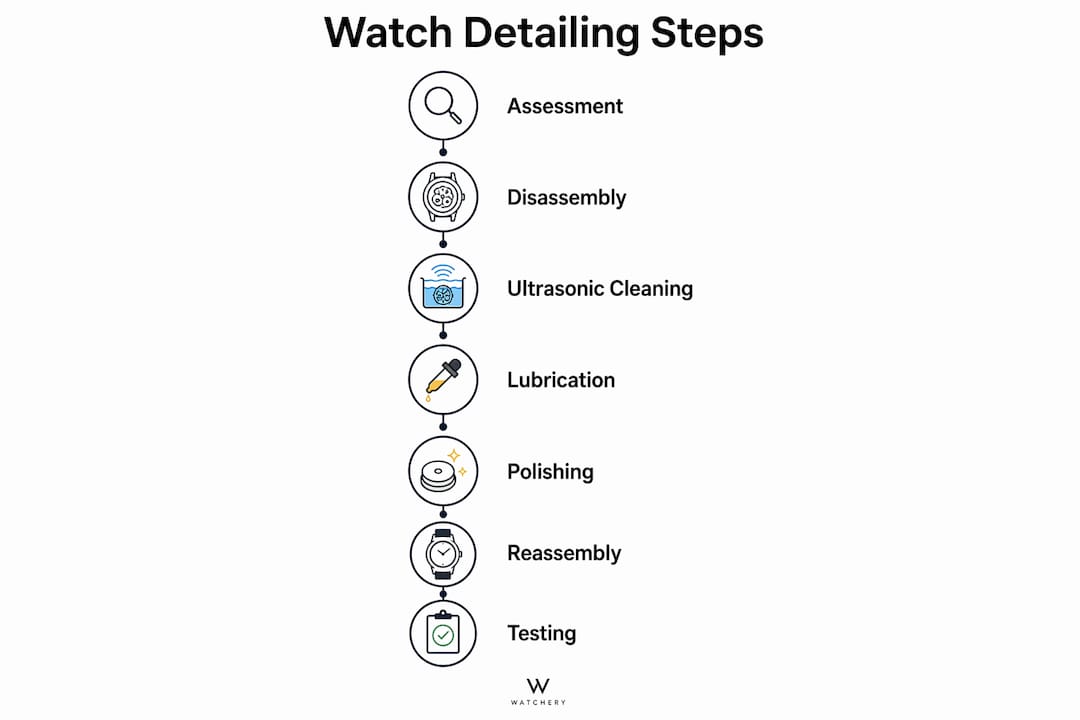
A full watch service covers seven distinct stages, each with a specific technical purpose. Skipping any one of them compromises the result.
-
Initial assessment and documentation. The watchmaker photographs the watch from every angle before touching it. High-resolution photographic intake documents the condition before work begins, establishing accountability and guiding precision restoration. This step protects both the owner and the technician.
-
Complete disassembly. The movement is removed from the case, and every component, including the bracelet, crown, and crystal, is separated. Movement removal before polishing is non-negotiable. Polishing with the movement inside can dry out lubricants or damage balance springs from heat and vibration.
-
Ultrasonic cleaning. All disassembled parts go into an ultrasonic bath with a specific chemical solution. High-frequency sound waves dislodge dried lubricants, dust, and debris from surfaces that no brush can reach. This is the step that separates professional detailing from anything you can replicate at home.
-
Inspection and parts replacement. The watchmaker examines every component under magnification. Worn gears, cracked jewels, and degraded gaskets are replaced. Rubber gaskets are replaced every 2 to 3 years to maintain water resistance, since that rating is not permanent.
-
Precision lubrication. This is where expertise matters most. Professional lubrication involves applying different viscosity grades of Moebius oils to specific components to manage friction without excess. Too much lubricant attracts debris. Too little causes wear. The placement is precise, not general.
-
Polishing and case refinishing. Professional polishing uses a controlled progression of abrasives from coarse to fine grits to restore a uniform, scratch-free finish while preserving sharp factory lines. Brushed surfaces stay brushed. Polished bevels stay geometrically correct.
-
Reassembly, regulation, and testing. The watch is reassembled, then placed on a timing machine to measure accuracy across multiple positions. Pressure and vacuum testing simulate factory water resistance ratings and detect micro-leaks invisible to the naked eye.
Pro Tip: Ask your watchmaker for the timing machine printout after service. A well-regulated mechanical watch should run within plus or minus 5 seconds per day. If they cannot provide that data, find a different technician.
How does detailing differ by material and watch type?
Not every watch is detailed the same way. Material and movement type determine which techniques are safe and which are destructive.
- Stainless steel cases and bracelets tolerate ultrasonic cleaning and mild polishing compounds well. Steel is forgiving but still requires controlled abrasives to avoid rounding off factory edges.
- Gold and precious metal cases demand softer polishing compounds and shorter machine exposure. Gold scratches more easily than steel, and over-polishing removes measurable metal mass over time.
- Leather straps never go near water or ultrasonic baths. They are cleaned separately with a dedicated leather conditioner and replaced when cracking or odor develops.
- Crystal type changes everything. Sapphire crystal resists scratching but can chip under impact. Mineral crystal accepts light polishing to remove surface marks. Acrylic crystal, common on vintage pieces, polishes out beautifully with a plastic polish like Polywatch but scratches again quickly.
- Vintage watches require a different philosophy. Patina on a dial or case is part of the watch’s history and often its market value. A full restoration that strips that patina can reduce the value of a vintage Rolex or Patek Philippe significantly. The decision to restore versus preserve requires a watchmaker with genuine vintage experience.
- Quartz movements need far less frequent internal servicing than mechanical ones, since they have fewer moving parts and no mainspring. However, the external detailing process, cleaning, polishing, and gasket replacement, applies equally.
Mild dish soap like Dawn is the only safe household cleaning agent for watch cases and bracelets. Jewelry cleaners, bleach, and multi-surface sprays cause damage to coatings, gaskets, and metal finishes.
Pro Tip: Before any wet cleaning at home, check your crown is fully pushed in or screwed down. An open crown is the most common entry point for moisture damage, and it is entirely preventable.
What tools and techniques do professionals actually use?
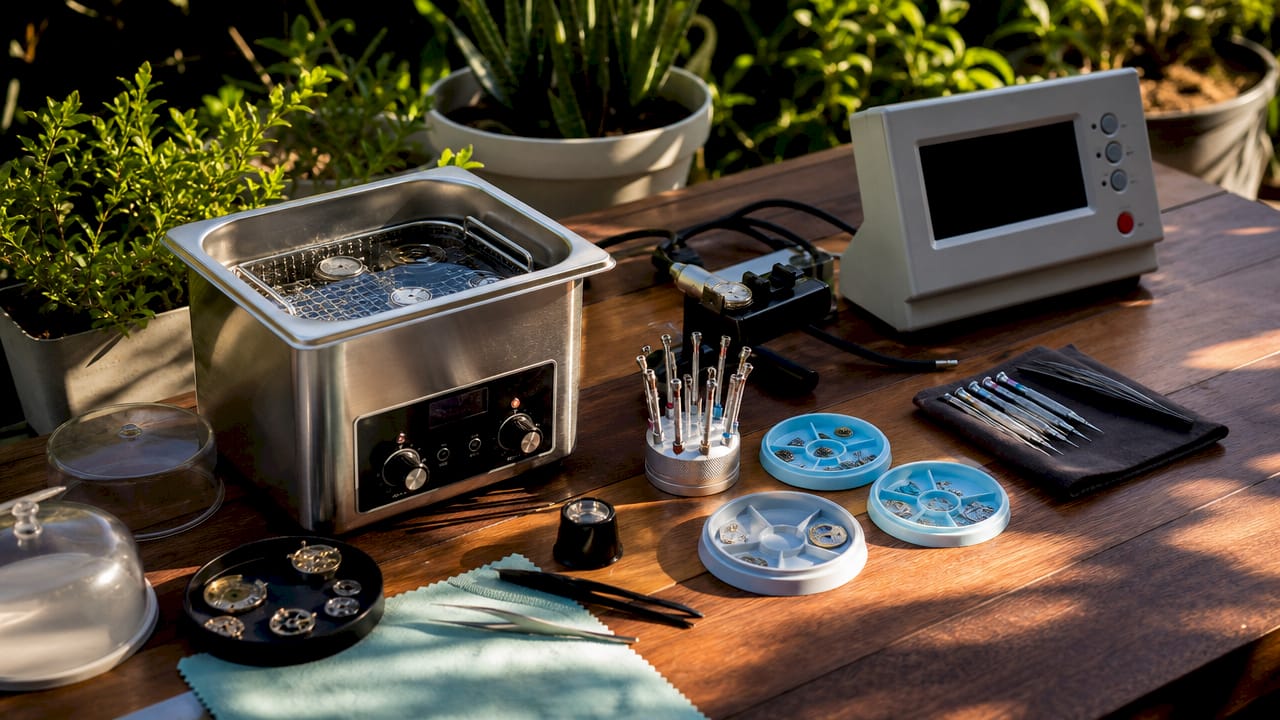
Understanding the toolkit behind watch detailing explains why professional results differ so dramatically from home attempts.
| Tool or Technique | Purpose | Home Alternative |
|---|---|---|
| Ultrasonic cleaning bath | Removes debris from all surfaces via high-frequency vibration | Soft brush with mild soap (limited effectiveness) |
| Moebius lubricants (various grades) | Precise friction management at specific movement points | None safe for home use |
| Polishing wheels and lapping machines | Restore factory finish geometry on case and bracelet | Polywatch for acrylic crystal only |
| Timing machine (Witschi or similar) | Measures accuracy in six positions to regulate movement | Timegrapher app (basic approximation) |
| Vacuum and pressure tester | Detects micro-leaks in water resistance seals | None available for home use |
| Microfiber cloths and pegwood sticks | Gentle surface cleaning without scratching | Directly replicable at home |
The ultrasonic bath is the most misunderstood tool in watch detailing. Frequency and solution chemistry matter as much as the machine itself. Using the wrong solution can strip coatings or damage gaskets. Professionals select solutions based on the specific metals and finishes present.
Timing machines like the Witschi Analyzer measure beat error, amplitude, and rate across multiple positions. A watch running accurately face-up may lose 15 seconds per day when worn on the wrist. Regulation across positions is what separates a properly serviced watch from one that was simply cleaned and reassembled.
Over-polishing is the most common professional error and the most common amateur one. Amateur detailing mistakes like over-polishing ruin sharp factory lines permanently. Once those edges are rounded, no amount of subsequent polishing restores them. Professional restorers use precision lapping machines to maintain geometric surfaces.
How can you safely maintain your watch at home?
Home maintenance does not replace professional servicing. It extends the interval between services and prevents avoidable damage. A solid watch care routine built around a few consistent habits makes a real difference.
- Wipe the case and bracelet with a dry microfiber cloth after every wear to remove skin oils, sweat, and dust before they accumulate.
- For water-resistant watches, use a soft toothbrush with a small amount of mild dish soap to clean bracelet links and case sides monthly. Rinse briefly under lukewarm water and dry thoroughly.
- Never use hot water. Heat degrades rubber gaskets faster than normal wear does.
- Avoid ultrasonic jewelry cleaners sold for home use. They are not calibrated for watch components and can loosen crystal adhesives or damage gaskets.
- Store your watch in a watch box or pouch away from direct sunlight and magnetic sources like speakers and phone chargers. Magnetism causes timekeeping issues in mechanical watches and can be detected with a compass needle test.
- Check the crown position before any contact with water. Screw-down crowns must be fully engaged.
Pro Tip: Keep a simple log of when you last had your watch serviced and note any changes in accuracy or appearance. A mechanical watch that suddenly starts losing 30 seconds per day is telling you something. Catching it early costs far less than a full movement overhaul.
For leather strap care, avoid all water contact and apply a leather conditioner every few months. Knowing the safe cleaning spray ingredients in your products prevents accidental damage to coatings and finishes.
How often should you schedule professional watch detailing?
Most mechanical watches require professional servicing every 4 to 7 years to prevent premature wear from dried lubricants. That interval shortens with daily wear, exposure to moisture, or use in high-vibration environments.
| Watch Type | Recommended Service Interval | Key Trigger for Earlier Service |
|---|---|---|
| Mechanical (daily wear) | Every 4 to 5 years | Accuracy loss greater than 15 sec/day |
| Mechanical (occasional wear) | Every 5 to 7 years | Visible moisture inside crystal |
| Quartz | Every 5 to 7 years (battery + gasket) | Battery replacement needed |
| Vintage mechanical | Every 3 to 5 years | Any change in rate or power reserve |
Dial restoration timelines range from 14 days for simple cleaning to 6 to 10 weeks for complex restorations involving hand-painting or custom luminous application. Plan accordingly if you need a watch for a specific event.
Treating servicing as scheduled maintenance rather than waiting for a failure dramatically extends watch lifespan and reduces repair costs. A watch that runs on dried lubricants is grinding its own components into dust. The cost of a full movement overhaul after neglect is typically three to five times the cost of a routine service.
Key takeaways
Watch detailing is a structured, multi-step process that preserves both mechanical performance and aesthetic value, and skipping or delaying any part of it accelerates wear and reduces resale value.
| Point | Details |
|---|---|
| Detailing is a seven-step process | It covers assessment, disassembly, ultrasonic cleaning, parts replacement, lubrication, polishing, and testing. |
| Service intervals matter | Mechanical watches need professional servicing every 4 to 7 years to prevent damage from dried lubricants. |
| Material determines method | Steel, gold, acrylic, and sapphire each require different cleaning agents, abrasives, and techniques. |
| Home care extends service life | Daily microfiber wiping and monthly mild soap cleaning reduce buildup between professional services. |
| Over-polishing is irreversible | Rounding factory edges permanently reduces both aesthetic quality and resale value of luxury watches. |
Why watch detailing is more than cosmetic upkeep
I have seen collectors spend five figures on a watch and then balk at a $400 service quote. That calculation never makes sense to me. The movement inside a well-made mechanical watch is a precision instrument with tolerances measured in microns. Dried lubricants do not just slow a watch down. They grind bearing surfaces, score gear teeth, and create wear patterns that no amount of future lubrication can reverse.
The external side of detailing carries its own lessons. The most common mistake I see from enthusiasts who attempt home polishing is treating the case like a car hood. They grab a polishing cloth and work in circles until the scratches disappear. What they also remove are the crisp angles and brushed surfaces that define the watch’s design. A Rolex Datejust with rounded lugs looks wrong even if you cannot immediately identify why. Once you know what to look for, you cannot unsee it.
What I find genuinely satisfying about proper watch detailing is that it is one of the few areas of ownership where discipline directly translates to value. A watch that has been serviced on schedule, cleaned carefully, and stored properly will outperform and outlast one that has been neglected, regardless of the original price difference. Knowing when to call a professional is as much a skill as any cleaning technique.
The emotional dimension matters too. A watch that belonged to your grandfather, or one you bought to mark a milestone, deserves the care that keeps it functional for the next generation. Detailing is how that continuity happens.
— Raymond Jenkins
Keep your watch performing at its best with ChronoCare
ChronoCare designs its products specifically for the demands of luxury watch care, not general cleaning. The Ultimate Watch Cleaning Kit gives you professional-grade tools formulated for metal cases, bracelets, and crystals, so your between-service routine actually protects your watch instead of risking it. For owners who want to address light surface scratches and restore luster to metal surfaces, the watch polishing cream delivers controlled results without the risk of over-polishing. Every ChronoCare product is formulated in the US with ingredients chosen for watch-specific surfaces. Your timepiece deserves tools built for it.
FAQ
What does watch detailing involve at a basic level?
Watch detailing involves disassembly, ultrasonic cleaning, lubrication, polishing, reassembly, and performance testing of both the movement and external case. It restores mechanical accuracy and physical appearance to near-factory condition.
How often should a mechanical watch be professionally detailed?
Most mechanical watches require professional servicing every 4 to 7 years, depending on usage and brand. Daily wear or exposure to moisture shortens that interval.
Can you detail a watch at home safely?
Home detailing is limited to surface cleaning with a microfiber cloth and mild dish soap for water-resistant models. Internal lubrication, ultrasonic cleaning, and polishing require professional equipment and should not be attempted at home.
What is the difference between watch detailing and watch restoration?
Watch detailing focuses on cleaning, lubricating, and polishing a watch to maintain its current condition. Watch restoration goes further, addressing damaged dials, refinished cases, and replacement of aged components to return a watch to an earlier state.
How long does a full professional watch service take?
A standard full service typically takes 2 to 4 weeks. Dial restoration or complex refinishing work can extend that timeline to 6 to 10 weeks depending on the scope of the restoration required.