

What Is Watch Polishing Cream? A Practical Guide
Most watch owners reach for the closest polish and hope for the best. That is the wrong approach, especially when you own something worth protecting. Watch polishing cream is a specialized abrasive compound formulated specifically for delicate watch surfaces, designed to remove light scratches and restore surface luster without chewing through the metal or altering the finish. Understanding what it is, how it works, and when to use it separates collectors who preserve their watches from those who unknowingly damage them. This guide gives you the full picture.
Table of Contents
- Key takeaways
- What watch polishing cream is: composition and function
- Matching polishing cream to your watch material
- How to apply watch polishing cream safely at home
- Benefits, risks, and when to call a professional
- My take on polishing carefully and preserving value
- Restore your watch with the right products
- FAQ
Key takeaways
| Point | Details |
|---|---|
| Specialized formula matters | Watch polishing cream uses micro-abrasives like aluminum oxide or diamond particles to safely restore surfaces. |
| Match cream to material | Different polishing creams suit different metals; using the wrong type risks permanent finish damage. |
| Less is more at home | Experts recommend polishing at home only once or twice a year to avoid removing too much material. |
| Avoid cross-contamination | Never use the same cloth or cream on polished and brushed finishes or you will create visible swirl marks. |
| Know when to stop | Vintage and high-value watches often benefit more from professional servicing than from DIY polishing. |
What watch polishing cream is: composition and function
Watch polishing cream is not furniture polish with a different label. It is a precisely engineered abrasive compound where the active agents are micro-abrasive particles like diamond dust or aluminum oxide suspended in a carrier medium. The cream format allows controlled application and minimizes the risk of compound migrating into crown seals or case joints.
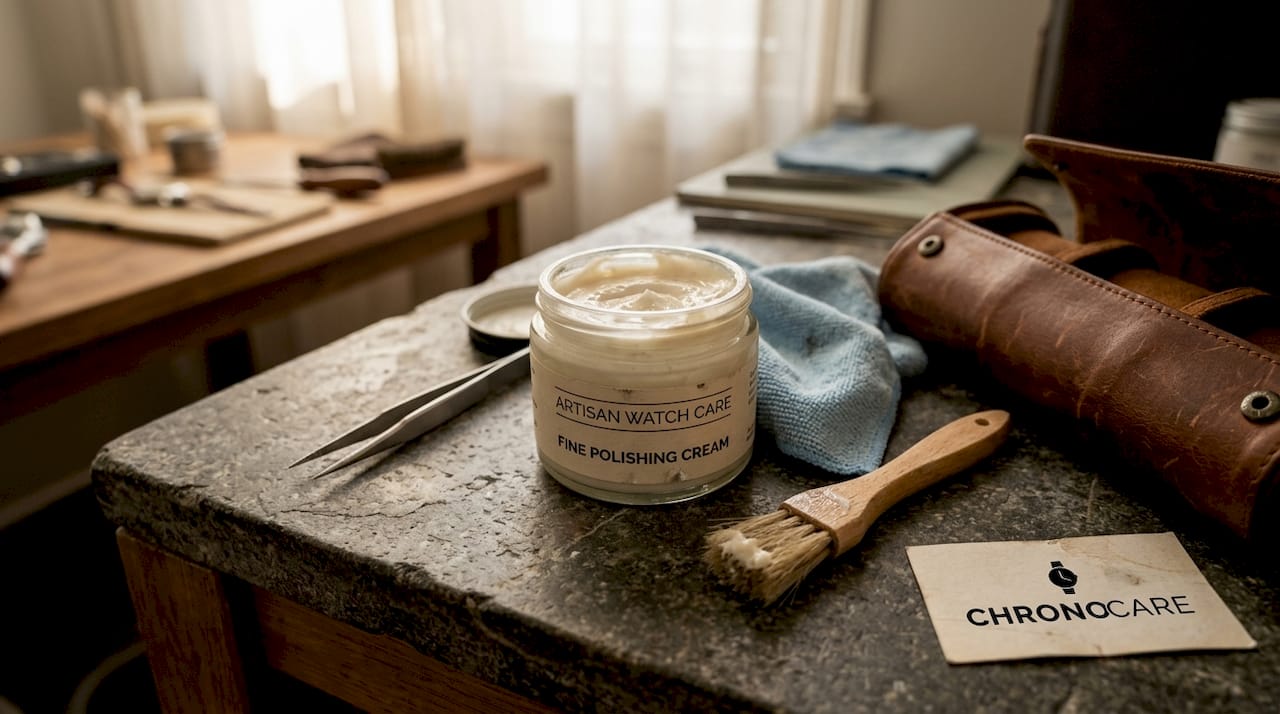
Diamond-powered pastes often contain up to 20% ultra-fine diamond particles. These particles physically shear away the tops of microscopic surface scratches, leveling the metal so light reflects uniformly again. Aluminum oxide compounds work similarly but at a lower hardness level, making them better suited for softer metals like gold.
The science involves three simultaneous processes. Mechanical abrasion removes tiny amounts of material. Mild chemical agents in some formulas dissolve surface oxides that cloud the finish. And the friction itself generates localized heat that slightly softens the surface layer, helping abrasive particles cut more cleanly. Together, these effects turn a scratched, dull surface back into something that looks intentional.
Professional restorers understand that compound stages must be followed from coarser to finer grits in sequence. Skipping steps or using a grit that is too aggressive for the metal’s hardness produces visible gouges or uneven patches rather than a clean shine.
Comparing polishing compound types
| Compound Type | Abrasive Agent | Best For | Effect |
|---|---|---|---|
| Cutting compound | Coarse aluminum oxide | Deep scratches, stainless steel | Removes material faster, restores flat surface |
| Polishing compound | Medium aluminum oxide | General metals | Removes fine scratches, improves clarity |
| Finishing compound | Ultra-fine diamond or silica | Gold, platinum, sapphire | High-gloss final shine |
| Jeweler’s Rouge | Iron oxide | Soft precious metals | Gentle buff, removes oxidation |
Matching polishing cream to your watch material
This is where most DIY attempts go wrong. There is no single watch polish product that works equally well on every material. Using a stainless steel compound on a gold case, for example, will scratch the softer metal aggressively because the abrasive grit is too coarse.
Here is how the main compounds align with watch materials:
- Jeweler’s Rouge is ideal for gold, platinum, and silver. Its iron oxide base is gentle enough for soft precious metals, removing oxidation and restoring warm luster without cutting too deep.
- Tripoli Compound suits stainless steel cases and bracelets where a faster cut is needed to address more pronounced surface marks.
- Diamond Paste is the right choice for sapphire crystals and ceramic cases. These are extremely hard materials, and only diamond abrasives can address their surface scratches effectively. According to the material compatibility guide from recommended compounds by material, this distinction is non-negotiable.
- Aluminum oxide cream offers the most versatility. It handles minor touch-ups on stainless steel, titanium, and even some gold alloys, making it a practical option for first-time users.
The watch restoration cream you choose also depends on the type of finish on the surface, not just the material itself. Brushed (matte) finishes require a directional compound applied with the grain. Polished (mirror) finishes require circular motion with a finishing-grade compound. Mixing these up destroys the original texture.
Quick reference: material and cream compatibility
| Watch Material | Recommended Cream | Finish Type | Notes |
|---|---|---|---|
| Stainless steel | Tripoli Compound | Brushed or polished | Apply with the grain for brushed surfaces |
| Gold (all karats) | Jeweler’s Rouge | Polished | Gentle pressure only |
| Platinum | Jeweler’s Rouge | Polished | Extremely malleable; use sparingly |
| Sapphire crystal | Diamond Paste | Polished | Only diamond abrasives are effective |
| Ceramic case | Diamond Paste | Polished | High hardness requires high abrasive hardness |
| Titanium | Aluminum Oxide | Brushed or polished | Lighter touch than steel |
How to apply watch polishing cream safely at home
Good technique matters as much as the right product. The watch polishing cream application steps below come from watchmaker best practices, not guesswork.
Step 1: Clean the watch thoroughly. Use mild soap and water or a dedicated cleaner to remove all dirt, oils, and debris. Proper cleaning before application helps prevent abrasive particles from dragging grit across the surface and creating new scratches during polishing.
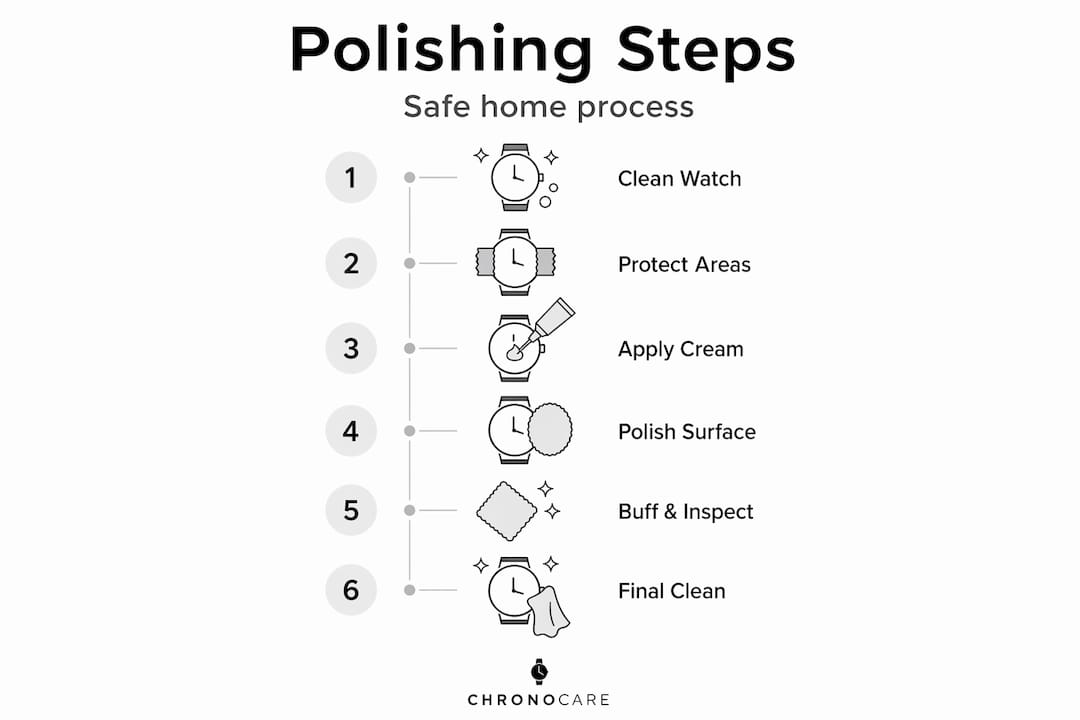
Step 2: Protect what should not be polished. Tape off the crystal, crown, pushers, engravings, and any brushed sections if you are working on a polished area. Painter’s tape or low-tack masking tape works well. This step is easy to skip and painful to regret.
Step 3: Apply a small amount of cream. You need far less than you think. A dot the size of a pencil eraser is enough for a standard case section. Apply it to a microfiber or soft jewelry cloth, not directly to the watch.
Step 4: Work in controlled motions. For polished finishes, use small circular strokes with light, consistent pressure. For brushed finishes, move strictly with the grain in straight lines. Rushing or pressing hard will not produce a better result. It will produce an uneven one.
Step 5: Buff and inspect. Wipe away residue with a clean cloth, then inspect under good lighting. If a scratch is still visible, repeat the process rather than pushing harder in a single pass.
Step 6: Final clean. Remove all trace cream from case joints, lug gaps, and bracelet links before wearing or storing the watch. Residue left in crevices can attract moisture.
Pro Tip: Never use the same cloth or compound on polished and brushed sections of the same watch. Cross-contamination between finishes causes swirl marks that are visible under certain light and difficult to correct without professional equipment.
Regarding frequency, home polishing done once or twice a year is the safe ceiling for most watches. More frequent polishing gradually removes case material and softens the sharp design edges that define a quality timepiece.
Benefits, risks, and when to call a professional
Understanding the role of watch polishing cream means understanding both sides of the equation.
The real benefits:
- Restores surface shine and removes light scratches, maintaining the watch’s aesthetic appeal between professional service intervals.
- Costs significantly less than professional refinishing, which can run hundreds of dollars at authorized service centers.
- Gives you control over minor cosmetic maintenance without needing to ship the watch away.
- Using a watch restoration cream for routine upkeep can genuinely extend the watch’s appearance and longevity over time.
The real risks:
- Every polishing session removes a thin layer of metal. Repeated polishing rounds off case edges, erodes engravings, and changes the geometry of a carefully designed case.
- Over-polishing diminishes structural integrity and historic authenticity, which matters enormously for vintage or collector watches.
- Using the wrong compound on the wrong material can scratch a surface permanently within seconds.
- Home polishing rarely achieves the level of finish that professional equipment delivers.
“A large dollop of patience is the hardest tool to find — but better to protect a vintage watch by avoiding home polishing entirely than risk irreversible damage.”
When should you stop and call a professional? If the watch is vintage, rare, or part of a collection where originality affects value, take it to a certified watchmaker. If the scratches are deep gouges rather than surface marks, no amount of cream will fix them cleanly. And if the case shows previous amateur polishing damage like rounded lugs or blurry edges, a professional with the right wheels and compounds is the only path forward.
My take on polishing carefully and preserving value
I have seen what happens when a beautiful watch gets over-polished by someone in a hurry. The lugs go soft, the brushed texture disappears into a murky blur, and what was once a sharp, intentional design starts looking like a generic piece of metal. That kind of damage is subtle at first and obvious later.
What I have learned from working with watch care over the years is that knowing your watch’s material and finish is more important than having the best product. You can have the finest watch polishing cream on the market and still ruin a case if you apply it to the wrong surface with the wrong motion.
My honest view is that home polishing should be treated like a maintenance task, not a restoration project. A light pass once a year to address minor surface marks is smart. Chasing deep scratches at home is not. The patience and care required in polishing are as important as the product itself. You have to be willing to stop, assess, and accept when a job needs professional hands.
Where I think people get it most wrong is assuming that shinier equals better. Vintage watches carry patina and wear patterns that authenticate their history. Polishing that away does not add value. It erases it.
— Eduardo
Restore your watch with the right products
If this guide has convinced you that the right watch polish product makes all the difference, ChronoCare has the tools to back that up.
ChronoCare’s watch polishing cream is formulated for all metal watch surfaces, delivering professional-grade results without the professional-grade risk. For those who want a full home maintenance setup, the ultimate polishing and cleaning kit includes polishing cream, microfiber cloths, and precision cleaning tools in one package. Whether you own a daily wearer or a collector’s piece, having purpose-built products in your kit means every session is safer, more controlled, and more effective. You can also learn more about safe fingerprint removal for between-polish care.
FAQ
What is watch polishing cream made of?
Watch polishing cream contains micro-abrasive particles like aluminum oxide or diamond dust suspended in a cream carrier. These particles physically level microscopic surface scratches to restore shine.
Is watch polish necessary for luxury watches?
For maintaining appearance between professional services, yes. Light polishing removes surface marks and restores luster, but it should be used sparingly to avoid removing too much material over time.
How often should I use watch polishing cream at home?
Experts recommend home polishing no more than once or twice a year. More frequent use gradually erodes case metal and softens the sharp design edges that define quality watchmaking.
Can I use any polishing cream on my watch?
No. Different materials require different formulas. Jeweler’s Rouge suits gold and platinum, Tripoli Compound works for stainless steel, and Diamond Paste is needed for sapphire crystal or ceramic surfaces.
When should I take my watch to a professional instead of polishing at home?
Take your watch to a certified watchmaker when it shows deep scratches, has rounded edges from previous over-polishing, or is a vintage or rare piece where originality affects its value.