

How to Remove Green Verdigris from a Watch Safely
If your watch has green powder or crusting on the case, gently lift it off with pegwood or a dry soft brush before you touch any chemical. Move to mild cleaning only if the deposit won’t budge, and stop the moment you see plating loss, pitting, or corrosion near the movement. That order matters more than any single product.
Before you start:
- Remove the battery if it’s a quartz movement, and keep the caseback sealed unless you know exactly what’s inside.
- Work somewhere ventilated, wear nitrile gloves, and tape off the dial and crystal.
- Stop immediately if you see flaky deposits near jewels or pivots, deep pitting, plating that’s lifting, or anything you can’t identify. Call a watchmaker instead.
Key Takeaways
Removing green verdigris from a watch safely means starting with dry mechanical tools, escalating only to mild chemical methods when necessary, and stopping the moment plating, pitting, or movement contamination appears.
| Point | Details |
|---|---|
| Start dry, always | Use pegwood or toothpicks and a soft brush before touching any chemical. |
| Match method to metal | Reserve acids, ammonia, and Evapo-Rust for solid brass or bronze, never plated cases. |
| Know the stop signals | Flaking, pitting, or color change to bare metal means it’s time for a watchmaker. |
| Seal after cleaning | A thin coat of Renaissance Wax slows verdigris from reforming on treated cases. |
| Consider a curated kit | The ChronoCare Ultimate Watch Cleaning Kit bundles mild, non-abrasive tools matched to these exact steps. |
Table of Contents
- How Do You Identify Verdigris on a Watch?
- What Tools and Supplies Do You Need?
- What Are the Best Ways to Remove Verdigris?
- When Should You Stop and Call a Watchmaker?
- What Mistakes Cause Permanent Damage?
- How Do You Prevent Verdigris from Coming Back?
- How Long Does DIY Cleaning Take, and What Does a Pro Fix Cost?
- What Do Watch Professionals Recommend?
- A Conservator’s Note on Patina
- A Safer Way to Clean Verdigris at Home
- Frequently Asked Questions
- Sources
How Do You Identify Verdigris on a Watch?
Verdigris shows up as a chalky or crusty green-blue buildup, usually where sweat, saltwater, or humidity have sat against brass, bronze, or base-metal alloys. It’s powdery, sometimes almost fuzzy, and tends to collect around the case back, lugs, and under bracelet links where moisture lingers. That’s different from battery leakage, which produces a white or crusty residue near the movement, or worn plating, which shows as a dull yellow or pink undertone with no texture at all.
Before you decide how to remove watch verdigris, run through a short mental checklist: Is the movement exposed or sealed? Is the case solid bronze or brass, or is it plated? Is the deposit loose powder or fused to the metal? Does the piece have collector value that raises the stakes on a mistake?
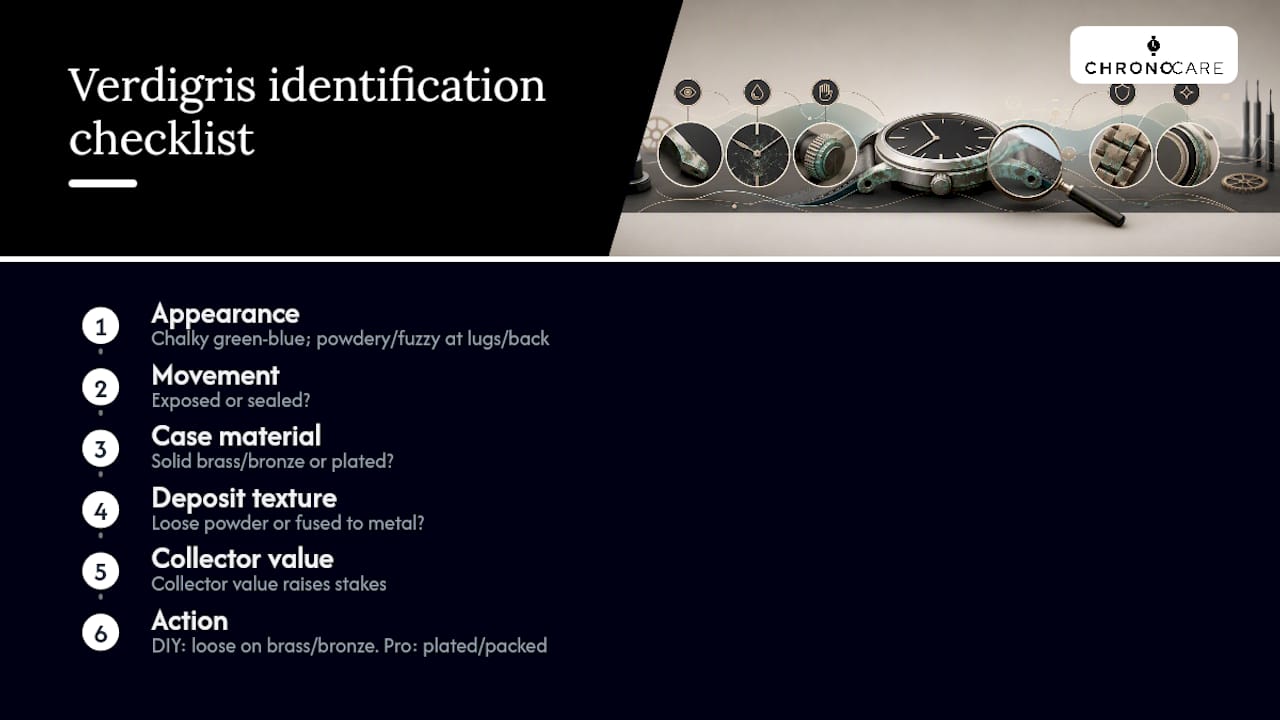
Small, loose spots on a solid bronze or brass case are usually safe for a careful DIY pass. Verdigris that’s crept under the dial, is packed into the crown tube, or sits on a gold-plated or gilt surface is a different problem entirely, and it’s one you should hand to a professional.
Pro Tip: Powdery verdigris is unstable and can migrate into the movement if left alone, so flaky deposits near moving parts deserve prompt, careful removal rather than a “wait and see” approach.
What Tools and Supplies Do You Need?
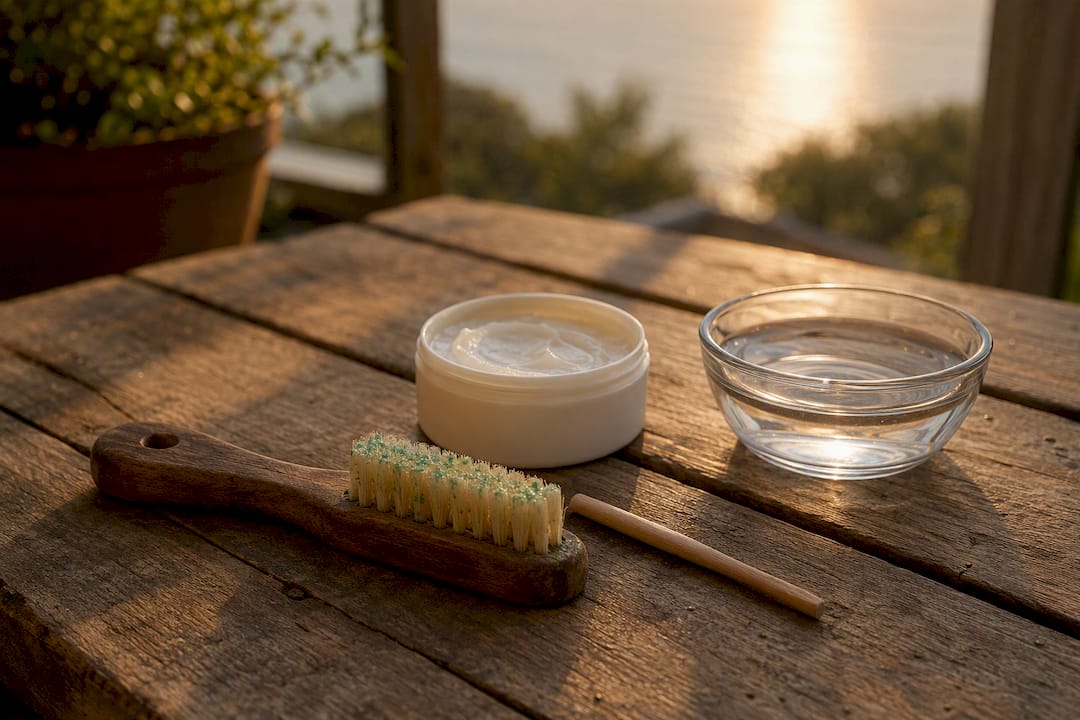
Gather everything before you start so you’re not improvising mid-cleaning, which is when mistakes happen. You’ll want pegwood or plain wooden toothpicks, a soft-bristled brush (camel or horsehair works well), a soft brass brush reserved strictly for solid brass or bronze, microfiber cloths, a loupe or magnifier, and nitrile gloves.
For chemical options, keep a baking soda and water paste on hand at roughly a 3:1 ratio, along with diluted white vinegar or lemon juice for tougher spots. Some collectors use a heavily diluted ammonia solution, such as Hoppe’s No. 9 bore cleaner cut with water, but this is a stronger step reserved for solid, non-plated cases. Skip acetone and other strong solvents entirely unless you fully understand the risk to seals and finishes.
- Renaissance Wax or a clear microcrystalline wax for sealing afterward
- The ChronoCare Ultimate Watch Cleaning Kit for a pre-assembled, non-abrasive option
- Good ventilation and zero open flames near any solvent-based product
Verdigris itself isn’t a simple oxide. It’s a mix of copper salts formed by reactions with acids, chlorides, and sulfates, which is exactly why mild acids dissolve it so effectively.
What Are the Best Ways to Remove Verdigris?
Work from the gentlest method to the most aggressive, and stop as soon as the deposit is gone. Skipping ahead to a stronger method “to save time” is how solid bronze becomes pitted bronze.
-
Dry mechanical removal. Under magnification, use pegwood or a wooden toothpick to flake off loose verdigris, then follow with a soft brush. Collectors on watch forums consistently recommend this as the first move, and it solves the problem more often than you’d expect.
-
Mild wet cleaning. Warm water with a drop of mild soap and a soft brush handles what dry tools leave behind. Dry the case immediately and thoroughly; lingering moisture just restarts the corrosion cycle. A baking soda paste applied for two or three minutes, then rinsed and dried, handles most surface deposits that soap alone won’t touch.
-
Acidic soft cleaning. Diluted lemon juice or white vinegar dissolves stubborn verdigris because the acid reacts directly with the copper salts. Apply briefly, no more than a minute or two, then neutralize with a baking soda rinse and dry completely. Never let acid sit near gaskets or crown seals, since it degrades rubber and threatens water resistance.
-
Ammonia-based approach. A heavily diluted ammonia cleaner works on solid brass or bronze cases with entrenched grime, but it’s not for plated or gilt surfaces. Ventilate the room, limit contact time, and rinse thoroughly.
-
Last-resort methods. An overnight soak in Evapo-Rust followed by a light pass with Flitz metal polish can rescue a heavily corroded solid-metal case, but this is a long, deliberate process, not a quick fix, and it’s strictly off-limits for anything plated. Acetone is sometimes mentioned in forums, but its flammability and tendency to strip lacquer and plating make it a poor choice for most watches.
Watch for warning signs at every stage: flaking that exposes bare base metal, a sudden color shift, or pitting where the verdigris used to be. Any of those means stop.
Pro Tip: Test whatever method you’re using on a small, hidden spot, like the inside of a lug, before treating the whole case. Five minutes of caution beats an hour of regret.
When Should You Stop and Call a Watchmaker?
Some jobs aren’t DIY jobs, no matter how careful you are. Removing a caseback or movement should only happen if you’ve got the specific tools and genuine experience with that case design. Guessing your way through it risks scratching the movement or losing tiny parts you’ll never find again.
Hand the watch to a professional when:
- Verdigris has worked its way near pivots, jewels, or other movement components.
- You see deep pitting or pivots that look brittle or crumbly.
- Water has clearly gotten past the gaskets and reached the movement.
- The watch is rare, high-value, or has sentimental weight that makes a mistake unacceptable.
If you’re already at that point, here’s what to do next:
- Photograph the current condition from multiple angles before you touch it again.
- Stop all further cleaning attempts immediately.
- Write down exactly which chemicals and tools you’ve already used, so the watchmaker isn’t guessing at what’s already reacted with the metal.
That documentation genuinely speeds up diagnosis and keeps a tarnished case restoration from turning into a second round of trial and error.
What Mistakes Cause Permanent Damage?
A few actions turn a fixable problem into an expensive one, and they’re more common than you’d think.
- Scrubbing plated surfaces with a brass brush or abrasive pad, which strips the plating down to bare base metal.
- Leaving acid on the case for too long, which pits solid metal and eats straight through thin plating.
- Soaking a non-water-resistant watch without removing the movement first.
- Using acetone anywhere near gaskets, seals, or painted dial text.
Forum threads are full of cautionary examples: collectors who polished away gilt lettering on a dial, or watched a steel pivot essentially dissolve after a acid bath ran too long. Household acids and abrasives work fast, and that speed is exactly why they’re risky in careless hands.
Removing patina isn’t neutral. The same acid that dissolves verdigris also strips away decades of honest wear, and on a plated case it can expose base metal permanently. Once that happens, no amount of wax brings it back.
If you’ve already made a mistake, act fast: neutralize any acid with a baking soda rinse, dry the case completely, and stop. Don’t try to fix a fix with a stronger method.
How Do You Prevent Verdigris from Coming Back?
Verdigris forms when sweat and saltwater react with copper alloys, so the single best prevention habit is simple: wipe the case down after you wear it, especially after a swim or a sweaty day. Dry it fully before storage, keep silica gel packets in the watch box, and skip airtight containers that trap humidity.
After cleaning, seal the surface. A thin coat of Renaissance Wax buffed into a solid bronze or brass case slows oxidation noticeably, and most collectors reapply it every few weeks depending on how often the watch gets worn.
| Coating Option | Best Suited For |
|---|---|
| Renaissance Wax | Solid bronze/brass cases needing renewable, low-maintenance protection |
| Clear microcrystalline sealant | Vintage pieces where a natural look matters more than gloss |
| Ceramic coating | Modern solid-metal cases where a harder, longer-lasting barrier is preferred |
- Wipe down daily after wear.
- Check weekly for any new green spotting, especially around lugs and case backs.
- Do a light clean monthly, and reapply wax roughly every few weeks in humid climates.
For broader storage habits, ChronoCare’s guide on keeping a watch dust free covers the daily routine side of this in more depth.
How Long Does DIY Cleaning Take, and What Does a Pro Fix Cost?
Assessment takes 10 to 20 minutes. Dry mechanical removal runs 15 to 60 minutes depending on how widespread the deposit is. Mild wet cleaning adds another 30 to 90 minutes with drying time factored in, and stronger treatments like an Evapo-Rust soak stretch overnight or longer.
- Movement servicing, pivot replacement, or re-plating pushes costs up fast, since those repairs require specialized tools most owners don’t own.
- A rare or sentimentally significant piece justifies paying a professional even for moderate corrosion, since one wrong move can permanently lower its value.
What Do Watch Professionals Recommend?
Test a hidden spot first, document what you find, and always reach for the mildest method that actually works. Aggressive polishing that erases historic patina can quietly reduce a vintage watch’s value, even when the case looks “better” afterward.
Community favorites include Blue Rodico for lifting grime off delicate dials without abrasion, and pegwood for anything close to movement components. Ultrasonic cleaners belong strictly with trained technicians using a waterless rinse; on a full watch, they’re a real risk to fragile parts. ChronoCare and Raymond Jenkins built these recommendations around exactly that kind of conservation-first practice.
A Conservator’s Note on Patina
Some collectors treasure a patina; I respect that instinct. But powdery, unstable verdigris isn’t patina worth keeping. Stabilize it, remove what’s loose, and let the rest of the finish tell its story.
A Safer Way to Clean Verdigris at Home
If you’d rather not hunt down pegwood, baking soda, diluted ammonia, and wax separately, the ChronoCare Ultimate Watch Cleaning Kit bundles the non-abrasive tools and mild formulas this guide walks through into one package built specifically for luxury and vintage cases.
It skips the guesswork of mixing your own dilutions and gives you a wax finish step already matched to the cleaning products, so you’re not second-guessing compatibility. For watches that need actual finish renewal after the verdigris is gone, the Ultimate Watch Polishing & Cleaning Kit adds light polishing to the same conservative approach. And if the corrosion has already reached the movement or pitted the case, stop here and book time with a watchmaker instead. No kit fixes that. Start with the cleaning kit product page to see exactly what’s included before your next cleaning session.
Frequently Asked Questions
Is it safe to remove green verdigris from a watch myself? Yes, for small, loose surface deposits on solid brass or bronze cases. Verdigris under the dial, near the movement, or on plated surfaces calls for a watchmaker instead.
What household items work to clean verdigris on a watch? Baking soda paste, diluted white vinegar, and diluted lemon juice all dissolve verdigris effectively on solid metal cases, followed by a thorough rinse and complete drying.
Can vinegar damage a watch while removing verdigris? Yes, if it’s left on too long or touches gaskets and seals. Limit exposure to a minute or two, neutralize with a baking soda rinse, and dry the case fully afterward.
Should I use an ultrasonic cleaner to remove verdigris from a watch? Only with extreme caution, and ideally not at all unless you’re a trained technician. Ultrasonic cleaning can loosen movement parts or damage a dial that isn’t built to handle that vibration.
How do I stop verdigris from coming back after cleaning? Wipe the watch down after wear, dry it fully before storage, keep silica packets nearby, and apply a thin coat of Renaissance Wax every few weeks to slow oxidation.