

The Types of Watch Case Opening Tools Every Beginner Needs
Ten tools cover almost every case back you will encounter: a case knife, a case back wrench (often called a Jaxa wrench), a friction ball, a fish-eye opener, precision screwdrivers, a case press, a case holder, a spring bar tool, a demagnetizer, and a loupe. Each one matches a specific case back family, and using the wrong tool is the fastest way to scratch a bezel or strip a notch. If you’re buying your first kit, start with a case knife, an adjustable three-jaw wrench with interchangeable pins, and a case holder. That combination alone opens the majority of snap-off and screw-down watches sitting in most collections.
- Case knife – snap-off/press-fit backs
- Case back wrench (Jaxa) – screw-down, notched backs
- Friction ball / fish-eye opener – smooth, domed backs
- Precision screwdrivers – small-screw backs
- Case press – reseating any back type after service
- Case holder, spring bar tool, loupe, demagnetizer – bench support tools
Key Takeaways
Matching the tool to the exact case back type, and applying zero-slip technique with properly sized pins or dies, prevents nearly all the damage beginners cause when opening a watch.
| Point | Details |
|---|---|
| Identify the back first | Check for notches, screws, or a smooth surface before choosing a tool. |
| Match pins and dies exactly | A wrench or opener that doesn’t fit the case diameter will slip and scratch. |
| Use zero-slip torque | Seat the tool with no play, then turn with the smallest force that breaks the seal. |
| Buy fewer, better tools | A case knife, three-jaw wrench, and case holder outperform a cheap all-in-one kit. |
| Stop at soldered or stuck backs | Sealed or heat-fused cases need professional or specialist ring-cutter removal. |
Table of Contents
- The Main Types of Watch Case Opening Tools by Case Back
- Case Knives for Snap-Off and Press-Fit Backs
- Case Back Wrenches for Screw-Down Notched Backs
- Friction Ball and Fish-Eye Openers for Smooth Backs
- Precision Screwdrivers for Small-Screw Case Backs
- Case Press, Holders, and Bench Inspection Tools
- Building a Starter Kit: What to Buy First
- Safety, Common Mistakes, and Quick Fixes
- What Actually Separates a Clean Opening From a Damaged Case
- Sources
The Main Types of Watch Case Opening Tools by Case Back
Watch case backs fall into four practical groups: snap-off (press fit), screw-down/notched, small-screw, and smooth or “fish-eye” backs. Getting this identification right before you touch a tool matters more than the tool itself.
- Snap-off backs have a visible pry notch along the case edge, often a small indent near the 6 o’clock position.
- Screw-down backs show two or more slots or notches cut into the metal, meant to grip a wrench.
- Small-screw backs have visible screw heads around the perimeter, common on dive watches and some dress pieces.
- Smooth/fish-eye backs show no notches, no screws, just a flat or domed surface, often on vintage or high-polish cases.
Force the wrong tool onto any of these and you risk scratching the case, stripping a notch so badly a wrench can never grip it again, or crushing a gasket that was sealing the movement from moisture.
Pro Tip: Run your thumbnail around the case edge in bright light before reaching for a tool. Notches and pry points catch the light differently than a smooth back, and that ten-second check saves you from guessing.
Case Knives for Snap-Off and Press-Fit Backs
A case knife with a 3mm or 5mm tip is the correct tool for most snap-off backs. Reaching for a flat screwdriver instead is one of the most common beginner mistakes, and it usually ends with a gouged notch or a scratched lug.
- Match the blade width to the pry notch. A 3mm tip suits smaller, delicate cases; 5mm gives more leverage on sportier pieces.
- Seat the case firmly in a case holder before you insert the blade.
- Slide the tip into the notch, then apply steady downward pressure while rotating slightly. Do not stab or lever wildly.
- Listen for the pop. It should release with modest resistance, not a fight.
- Stop immediately if the back won’t budge after two or three controlled attempts, if the lip looks bent, or if you suspect a soldered or heat-fused seal. Vintage cases sometimes fall into this category, and forcing them open risks real damage that only a ring cutter or professional heat removal can fix safely.
Case Back Wrenches for Screw-Down Notched Backs
The three-jaw wrench, often sold as a Jaxa-style tool, is the standard opener for screw-down backs. Two-pin pocket wrenches and fixed-die models cover the same job with less adjustability but a lower price.
- Adjustable three-jaw wrenches fit a range of case diameters and notch spacing, useful if you work on multiple watches.
- Two-pin pocket wrenches are compact and cheap, but only fit one or two notch spacings well.
- Fixed-die models grip a specific case pattern exactly, offering the cleanest fit when you know what you’re servicing.
Match the pin diameter to the notch before you apply any pressure, then press down to remove all play between pin and slot. This is the zero-slip torque method: seat the tool with zero play, then turn with the smallest force that breaks the seal.
Pro Tip: Use several small turns instead of one big twist. A wrench that slips under heavy torque is what strips a notch permanently, and once that happens, no wrench will ever grip cleanly again.
Friction Ball and Fish-Eye Openers for Smooth Backs
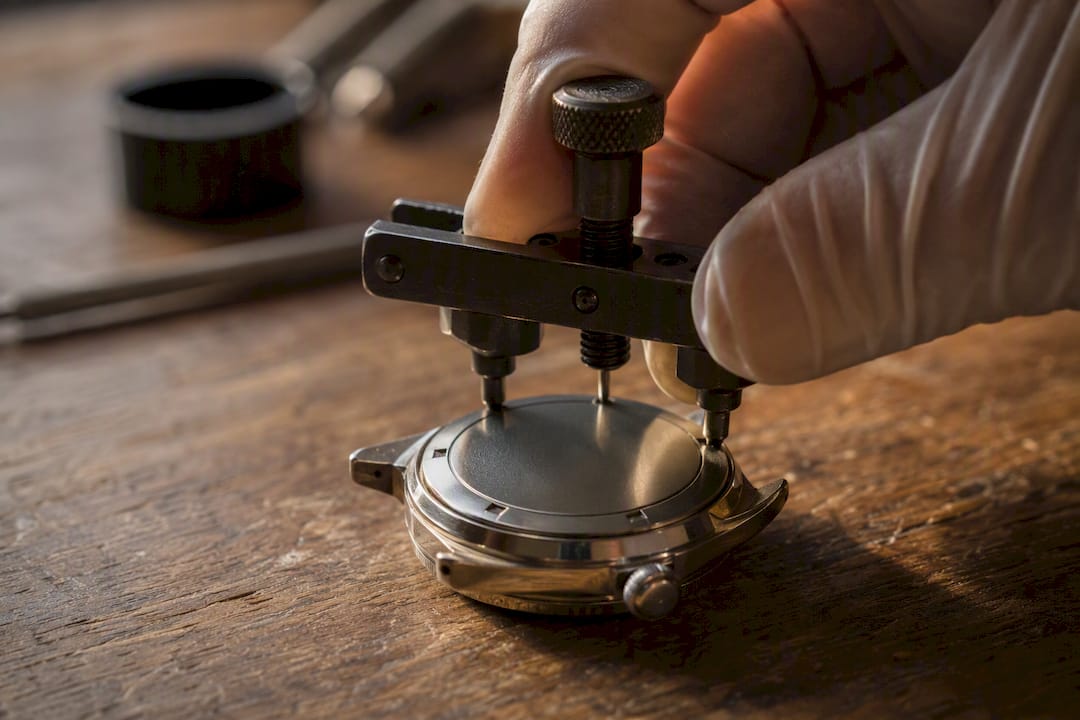
Smooth, domed backs give a wrench nothing to grip, so friction and compression tools do the job instead. A friction ball uses rubber contact and hand pressure to twist the back loose, relying on grip strength rather than mechanical leverage.
- Fish-eye openers use a cup or die sized precisely to the case diameter, creating enough contact area to turn without slipping.
- Diameter matching is everything here. A die that’s even a millimeter off will spin against the case rather than grip it.
- These tools slip more easily than a pinned wrench, and repeated slipping scuffs the finish. On stubborn vintage pieces, a specialist die set or a professional’s help beats forcing a friction tool that keeps sliding.
Precision Screwdrivers for Small-Screw Case Backs
Small-screw backs, common on dive watches, need screwdrivers with the right tip, typically 1.0mm to 1.5mm, ground flat to match the screw slot exactly. A tip that’s too narrow or rounded will chew up the slot in seconds.
- Back out screws evenly, a little at a time, rather than fully removing one before touching the next.
- Store screws in a labeled tray immediately. They’re easy to lose and often sized differently from one position to another.
- Check the gasket for cracking or flattening before closing the case back again.
- Choose non-magnetic, hardened drivers, and pick up ceramic or ESD-safe tweezers for handling screws and small parts without static risk.
Case Press, Holders, and Bench Inspection Tools
Getting a case open is half the job. Closing it correctly matters just as much. A case press with matched dies seats the back evenly around its full circumference, which is what actually preserves water resistance. Pressing unevenly, by hand or with a mismatched die, can crush a gasket on one side while leaving a gap on the other.
- Case holders grip the watch securely so you’re not relying on your palm to stop it from spinning or slipping mid-task.
- A 10x loupe lets you spot hairline gasket cracks or debris that the naked eye misses entirely.
- A demagnetizer clears residual magnetism that throws off timekeeping, and it’s one of the cheapest, most useful additions to any home bench.
Building a Starter Kit: What to Buy First
A sensible beginner kit doesn’t need to be large. It needs to fit the watches you actually own.
- Case knife with at least one 3mm and one 5mm blade.
- Adjustable three-jaw wrench with a full pin set covering common notch spacings.
- Case holder to protect the finish and keep the watch steady.
- Screwdriver set with hardened, non-magnetic tips from 0.8mm to 2.0mm.
- Loupe for inspection before and after work.
- Basic case press with a couple of common dies, added once you’re closing backs regularly.
Standard beginner kits built this way cover most everyday quartz watches with snap-on or screw-down backs. Prioritize hardened tips, replaceable pins or dies, and solid metal construction over a big box of accessories. Spend the most on the wrench and knife since those touch the case directly; a loupe or spring bar tool can be midrange without hurting results. A broader look at home repair kits breaks down what typically ships in entry-level versus intermediate sets.
Safety, Common Mistakes, and Quick Fixes
Tool matching, not the wrench’s brand, is usually what decides whether an opening succeeds or damages the case. A stripped notch looks rounded or chewed at the edges. Stop the moment you see it. Continuing to turn only widens the damage.
- Light scratches from a slipped blade can often be buffed out; deep gouges into the metal usually need professional restoration instead.
- Inspect the gasket every time you close a back. Flattened, cracked, or brittle gaskets should be replaced, not reused.
- Slipping tools cause most of the aesthetic damage reported by beginners, which is exactly why the zero-slip torque method exists.
For deeper scratch recovery guidance, see how to remove deep scratches from your watch case, and for a rundown of the mistakes that cause most of this damage in the first place, DIY watch restoration common mistakes to avoid covers the patterns worth knowing before you start.
Author Note: Raymond Jenkins on ChronoCare’s Bench Approach
ChronoCare’s advice on tool selection comes from handling high-value, often vintage pieces where a single slipped blade can cost real money in restoration. That bench experience shapes a simple rule: match the tool to the case first, then worry about speed. For post-service care, ChronoCare’s step-by-step cleaning guide picks up where this article leaves off.
Once a case back is open and serviced, the metal underneath the crystal often shows years of grime a cloth alone won’t lift. That’s where a proper cleaning kit earns its keep. The Ultimate Watch Cleaning Kit from ChronoCare is formulated specifically for luxury cases and bracelets, restoring shine without stripping finish, and it pairs naturally with the tool work covered above.
What Actually Separates a Clean Opening From a Damaged Case
The conventional advice treats tool selection like a shopping problem: buy the right wrench, and you’re set. That misses the real variable. It’s the fit between pin and notch, and the discipline to stop turning the moment resistance feels wrong. A $200 wrench with a loose pin will strip a case just as fast as a $15 one.
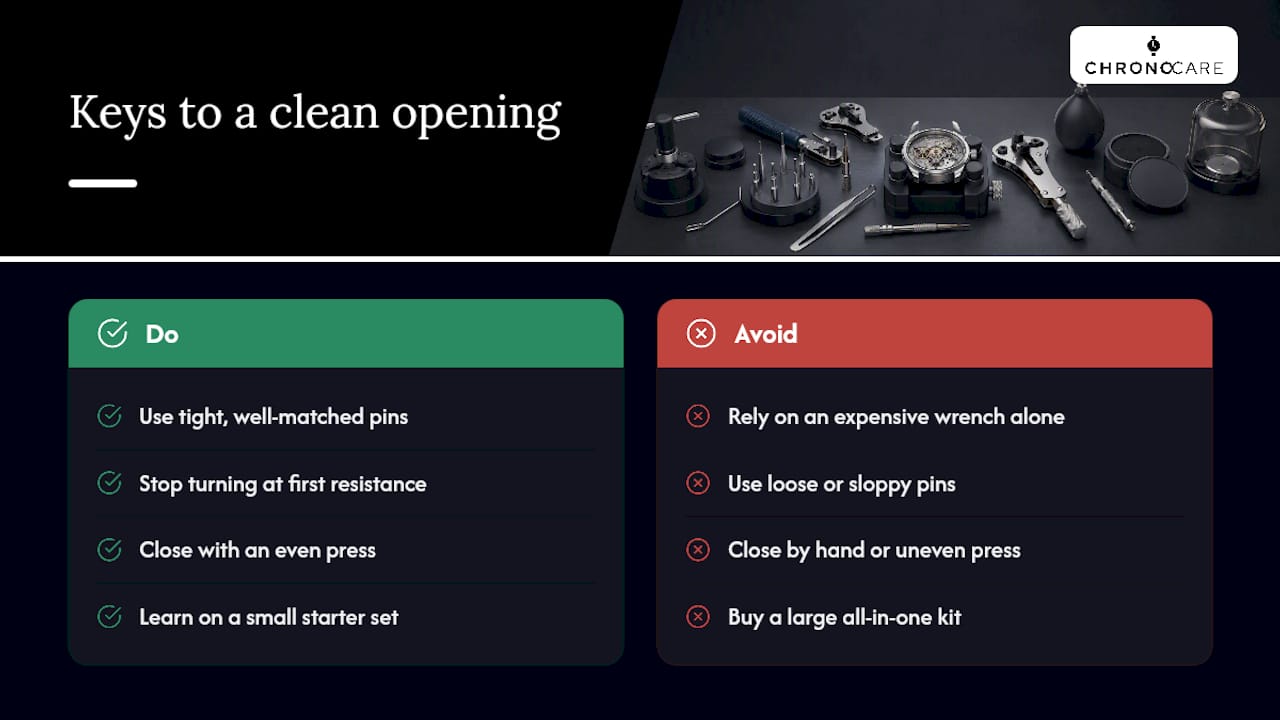
Beginners also overrate the case press. It matters, but it matters second. If you open a back cleanly and then close it with an uneven press or by hand, you’ve undone the careful work that came before. Sequence matters here as much as tool quality.
My honest read: skip the temptation to buy a large all-in-one kit. A tight, well-matched starter set, used with patience on the first few openings, teaches you more about your own watches than any bundle of forty accessories ever will. The zero-slip method isn’t a nice technique to know. It’s the difference between a watch that looks untouched and one that shows every mistake you made learning.
Sources
- Watch Case Opening Tools: Complete UK Guide (2026) · Toolsmith
- How to Open the Back of a Watch Safely | Soflypart
- Rapidrepair
- Modds
- Watch Repair Tools: Open Cases & Replace Batteries | HomeDIYer