

Types of Watch Screwdriver Sets for Beginners
The best pick for most beginners is a color-coded, 6 to 9 piece replaceable-blade screwdriver set mounted on a rotating stand, covering roughly 0.50mm to 2.00mm. That range matches nearly every screw you’ll meet on a standard movement, keeps blades sorted by color instead of guesswork, and lets you swap a chipped tip instead of buying a whole new set.
Other formats worth knowing about, in case a listing or a forum thread mentions them:
- Fixed-blade sets (cheaper, but you replace the whole driver when a tip rounds)
- T-blade drivers (better grip on tight bracelet or case screws)
- Socket/TX sets (for the occasional Torx screw on cases or clasps)
Pro Tip: Buy the set first, then upgrade one or two of your most-used sizes to a premium individual driver once you know which ones you reach for constantly.
Key Takeaways
A color-coded, 6 to 9 piece replaceable-blade screwdriver set on a rotating stand covers the sizes and organization most beginners need to start repairing watches safely.
| Point | Details |
|---|---|
| Start with 0.50–2.00mm | This range covers nearly every common movement, bracelet, and case screw. |
| Prioritize replaceable blades | Swap worn tips instead of replacing the whole driver. |
| Match tip to slot precisely | A blade that’s too narrow or wide will chew up the screw head. |
| Dress before you replace | A fine stone restores most rounded tips without buying new blades. |
| Mix premium into your set later | Add one or two Bergeon or Horotec drivers once you know your go-to sizes. |
Table of Contents
- What Types of Watch Screwdriver Sets Should You Know About?
- What Watch Screwdriver Sizes Do You Actually Need?
- Which Brands and Materials Actually Matter?
- How Do You Choose the Right Set for Your Bench?
- How Do You Maintain and Dress Watch Screwdriver Tips?
- What Should You Buy First by Budget Tier?
- Frequently Asked Questions
- Sources
What Types of Watch Screwdriver Sets Should You Know About?
Two design choices separate almost every set on the market: fixed blades versus replaceable blades, and loose drivers versus a rotating stand.
Fixed-blade drivers are one solid piece. They’re cheap and simple, but once the tip rounds or chips, the whole driver is trash. Replaceable-blade sets use a collet system, so you unscrew the worn blade and drop in a new one, which is why most premium and mid-range sets today build around this design.
Rotating-stand sets hold each driver upright in a labeled, color-coded block, and each holder often stores a spare blade underneath. That organization matters more than it sounds. A nine-piece set on a rotating stand cuts down the time you spend hunting for the right size mid-repair, and it keeps tiny blades from rolling off the bench.
As for tips, you’ll run into four families: flat-head (called “plano” in some catalogs and still the most essential tip for traditional movement screws), Phillips or cross-head, Torx (TX), and socket drivers for hex-style screws. A newer variant, the T-blade, uses a thicker T-shaped profile that resists twisting under load, which is why it shows up on bracelet and case screws that fight back a little.
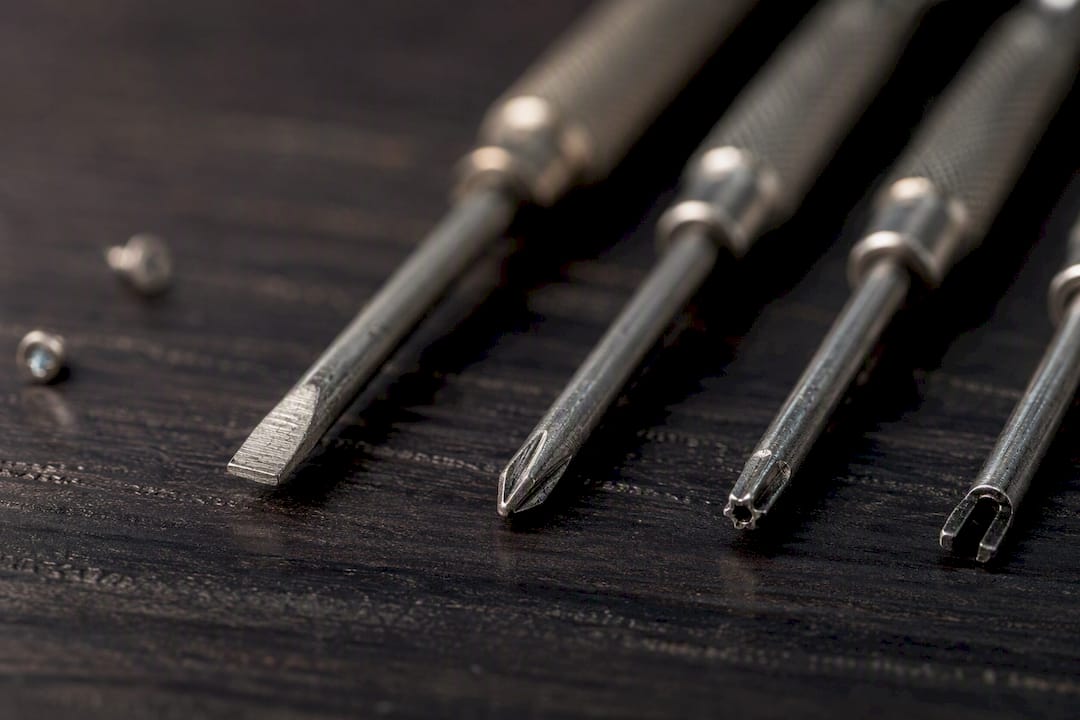
When you’re comparing sets, look for a smooth, ball-bearing rotating cap (it should spin freely under light finger pressure), hardened steel blades, and visible spare-blade storage. Those three details separate a set built for real use from one built to look good in a photo.
What Watch Screwdriver Sizes Do You Actually Need?
Every screwdriver set built for watch work is sized in millimeters, referring to the width of the blade tip. The progression you’ll see again and again runs 0.50, 0.60, 0.80, 1.00, 1.20, 1.40, 1.60, and 2.00mm.
You won’t use all eight sizes equally. The middle of that range does most of the work.
| Size (mm) | Common use | Risk level |
|---|---|---|
| 0.50–0.80 | Smallest movement screws (regulator, balance bridge) | High, blades snap easily |
| 1.00–1.40 | Everyday movement screws (bridges, plates, dial feet) | Low, most-used range |
| 1.60–2.00 | Larger movement, bracelet, and case screws | Low to moderate |
| — | Case backs and larger hardware | Low, but rarely needed for movements |
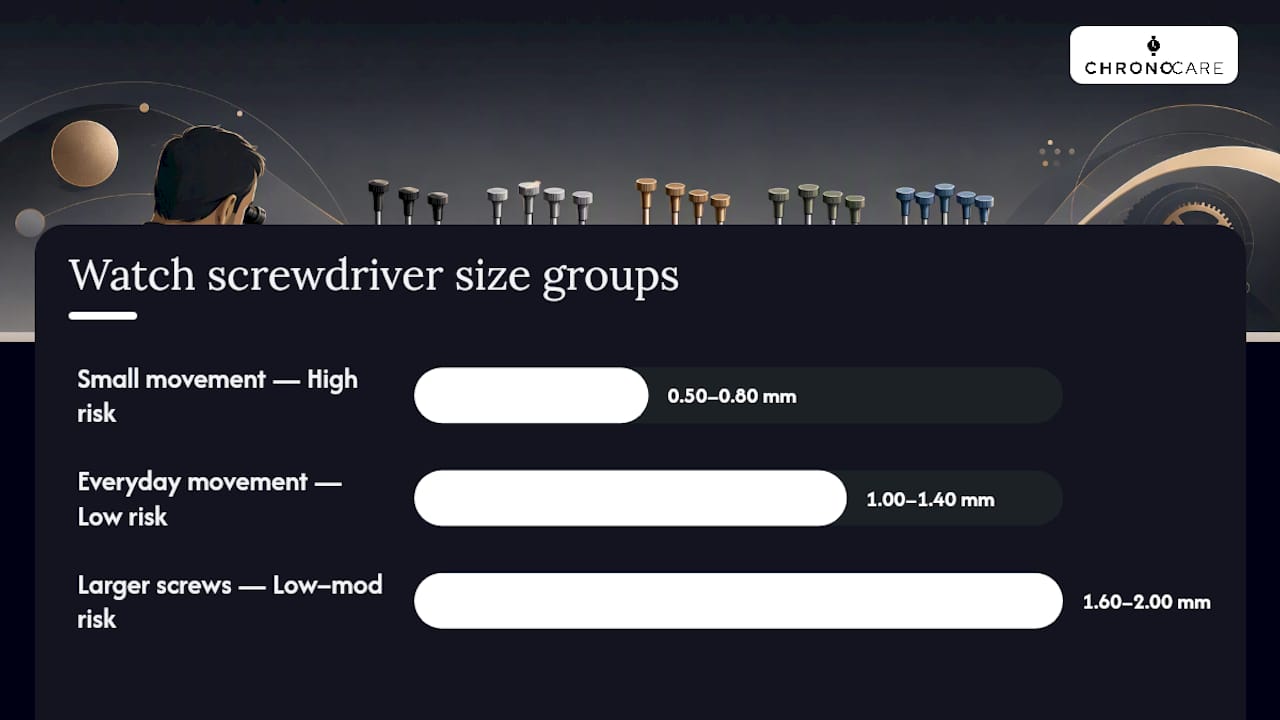
That’s roughly how professionals map size to task, and it’s a useful cheat sheet to tape inside a drawer.
A few habits keep you from snapping a tip or chewing up a screw head:
- Match the blade width to the slot width, not just the screw’s overall size.
- Apply light, steady pressure. Watch screws don’t need torque, they need control.
- Seat the blade fully in the slot before turning, so it doesn’t slip and scar the plate.
Pro Tip: Keep your 1.00, 1.20, and 1.40mm drivers within arm’s reach. They handle the majority of everyday repair work, so dress and maintain those three before worrying about the rest of the set.
Which Brands and Materials Actually Matter?
Blade material and finish decide how long a tip stays sharp, and that’s where price differences start making sense. Hardened steel, stainless variants, and anti-corrosion coatings resist rounding and rust, while replaceable blades and ball-bearing caps add real day-to-day comfort.
Premium sets from Swiss makers deliver tighter tolerances, smoother caps, and easy access to replacement blades, which is exactly why many working watchmakers mix premium individual drivers for their two or three most-used sizes with a cheaper set for everything else. Mid-range sets land in the sweet spot: solid steel, decent caps, and blades that hold up fine as long as you dress them occasionally. Budget sets are a fair starting point for learning, but their softer blades round off faster, so treat them as tools you’ll dress or replace often rather than trust on an irreplaceable vintage screw.
Bergeon and Horotec sit at the top of that quality ladder, and Esslinger is a common source for spec sheets, photos, and beginner-friendly sets that show exactly what’s included before you buy.
Watch repair forums, including the active community on r/watchrepair, generally agree on one thing: spend more on your screwdrivers than you think you should. A rounded screwdriver tip does more damage to a movement than almost any other tool mistake a beginner makes.
How Do You Choose the Right Set for Your Bench?
Run through this checklist before you buy:
- Sizes included (does it cover 0.50 to 2.00mm without big gaps?)
- Replaceable blades versus fixed
- Rotating cap that spins smoothly under light pressure
- A stand or holder, ideally color-coded
- Availability of spare or replacement blades
- Blade finish (matte hardened steel resists corrosion better than shiny chrome)
- Handle shape and grip material
- Total price relative to piece count
Watch for these red flags:
- Tips that look rounded or uneven straight out of the box.
- A cap that wobbles or doesn’t spin at all.
- Blades that feel loose in the collet.
- Missing common sizes, like a jump straight from 0.80 to 1.40mm with nothing between.
Before buying, check whether the listing names exact blade sizes (not just “assorted”), confirms replacement blades are sold separately, and shows real photos of the tips rather than stock renders. Once you’ve logged a few repairs and know your two most-used sizes, that’s the moment to buy a premium individual driver in just those sizes instead of upgrading the whole set.
How Do You Maintain and Dress Watch Screwdriver Tips?
A cheap blade lasts a long time if you dress it. Draw the flat tip across a fine dressing stone or jig at a shallow, consistent angle, checking the edge against a loupe until both sides sit flush and square again. If a tip has more than a light burr, or it’s visibly chipped, that’s a replace situation, not a dressing one. Retire a blade entirely once dressing has worn it noticeably shorter or thinner than its neighbors.
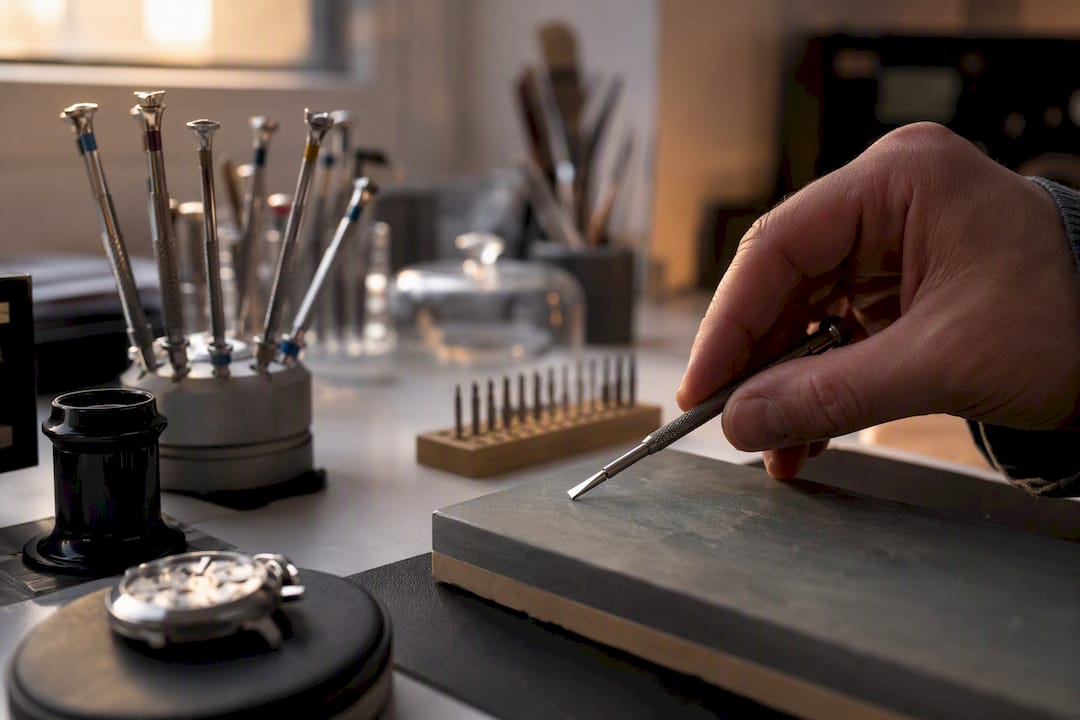
Store drivers upright in their stand, color side visible, and keep loose screws in a separate parts tray so nothing rolls into the wrong compartment. Avoid letting tips near strong magnets. A magnetized blade will pick up steel screws in ways that make precise placement much harder.
Pro Tip: A $10 ceramic dressing stone will keep an entire budget set usable for years. Just never force a stuck screw. If it resists, stop and check the seating instead of adding torque.
What Should You Buy First by Budget Tier?
A budget learner set is where most beginners should start, an 8 to 10 piece replaceable-blade kit in the $20 to $40 range, usually covering 0.50mm through 2.00mm on a basic stand. It won’t hold an edge forever, but it teaches you sizing and technique without much financial risk. A mid-range hobbyist set, typically $50 to $100, adds a color-coded rotating stand, better steel, and often spare blades included in the box. That tier is where most hobbyists happily stay for years. A value-oriented premium option means buying one or two individual Bergeon or Horotec drivers in your most-used sizes, often $15 to $30 each, and pairing them with your existing set for everything else.
Once you know your two most-used sizes, mixing in a premium driver stretches your budget further than buying an entirely new set.
A beginner’s note on the learning curve
Every hobbyist rounds a tip early on, usually on a stubborn dial screw, and that mistake teaches more than any guide can. ChronoCare’s focus on watch care extends naturally here: buy the recommended starter set, add a polishing and cleaning kit, and you’re set up to maintain both the movement and the case.
Frequently Asked Questions
How many pieces should a beginner watch screwdriver set have? A beginner set generally includes multiple pieces covering sizes commonly used in watch repair, spanning a range that accommodates most screws encountered in standard movements. Larger 12 to 17 piece sets add extra flat and Phillips heads, which suit collectors working on more varied pieces rather than someone just starting out.
What’s the difference between fixed-blade and replaceable-blade screwdrivers? Fixed-blade drivers are one solid piece, so a damaged tip means replacing the whole tool. Replaceable-blade sets use a collet, letting you swap in a new blade for a few dollars instead.
Do I need Torx or socket drivers for watch repair? Not right away. Flat-head remains the most common tip for traditional movement screws. Torx and socket drivers matter mostly for specific case or clasp hardware you’ll encounter as you branch into more brands.
Is it worth buying premium brands like Bergeon or Horotec as a beginner? Not for your whole kit. Start with a solid mid-range or budget set, then buy one or two premium individual drivers in your most-used sizes once you know what those are.
How do I know when a screwdriver tip needs replacing instead of dressing? If a fine stone restores a flush, square edge in a few passes, dress it. If the tip is visibly chipped, twisted, or noticeably shorter than its neighbors after repeated dressing, replace the blade.
Sources
- Bergeon 3044A screwdriver set (product/spec page) — Kassoy
- Watchmaker screwdriver | Everything you need to know — Bianditz
- Watchmakers’ screwdrivers UK guide 2026 — Toolsmith (blog)
- How to choose the right watchmaker screwdriver set — WatchComponents
- Best watchmaker screwdrivers for beginners — WahaWatches