

The Role of Watch Service Documentation for Collectors
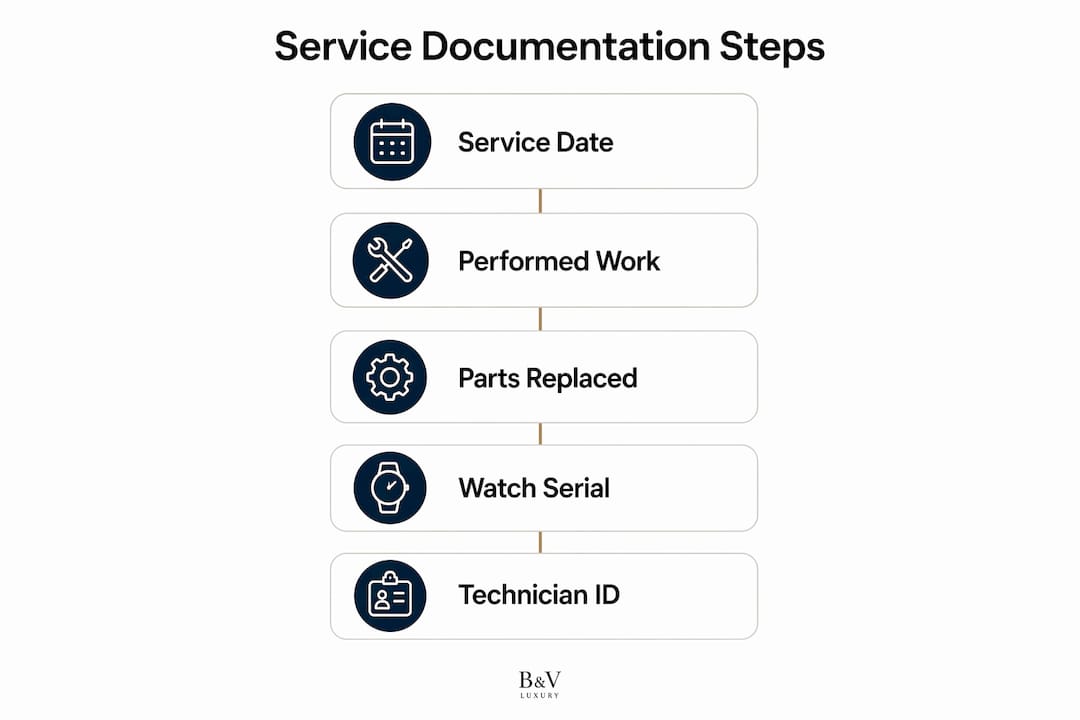
Watch service documentation is the formal, detailed record of all maintenance, repairs, inspections, and parts replacements performed on a luxury timepiece after its initial sale. The role of watch service documentation goes far beyond a simple receipt. It establishes mechanical assurance, supports originality verification, and gives collectors real pricing leverage when buying or selling. A complete service record lists the service date, the workshop name, the watch’s serial and reference numbers, a description of all work performed, every component replaced, and any warranty attached to the service. Without this paper trail, even a well-maintained watch loses credibility in the eyes of serious collectors.
What information should proper watch service documentation include?
Thorough service documentation separates a trustworthy record from a vague invoice that tells buyers almost nothing. Detailed service records listing specific repairs and replaced parts are prioritized by collectors over generic paperwork. That preference reflects a simple truth: specificity is proof.
A complete service record should include all of the following:
- Service date: The exact date the work was completed, not just the year
- Workshop name and contact: Whether an authorized service center or a reputable independent watchmaker performed the work
- Serial and reference numbers: These must match the watch in hand, without exception
- Work description: A line-by-line account of every procedure, from movement cleaning to gasket replacement
- Parts replaced: Explicit identification of each replaced component, noting whether original manufacturer parts were used
- Warranty or guarantee details: The duration and scope of any post-service guarantee
The difference between a useful document and a useless one often comes down to a single line. A record that says “movement serviced” tells a buyer nothing. A record that says “full movement disassembly, ultrasonic cleaning, mainspring replacement with original part, timing regulation to +3 seconds per day” tells a buyer everything.
Pro Tip: Ask your watchmaker to list every replaced part by name and part number on the invoice. Generic descriptions like “parts replaced as needed” carry no weight with serious collectors or auction specialists.

How does watch service documentation support authenticity and originality reviews?
Service records and provenance documents are not the same thing, and confusing them is one of the most common mistakes collectors make. Archive extracts confirm production information, such as the original dial color, case material, and delivery date. Service records document what happened to the watch after it left the factory. Both are necessary. Neither replaces the other.
Service history bridges provenance and authentication, revealing what happened to a watch post-retail. One cannot rely solely on archival or certificate documents. Service history rounds out the full authenticity picture by showing every intervention the watch has undergone since leaving the manufacturer.
Service documentation reveals whether a watch has been altered in ways that affect its originality and value. A record showing a dial replacement, for example, signals a significant modification. A record showing only movement cleaning and lubrication confirms the watch remains largely original. Collectors must read invoices line by line, not just confirm that a service happened.
Inconsistencies between documentation and the physical watch are serious red flags. Invoices with mismatched serial numbers can invalidate the entire documentation set. That mismatch may indicate the paperwork belongs to a different watch, or that records have been altered. Either scenario lowers the watch’s trustworthiness and its market value immediately.
The practical approach is to cross-reference every document against the watch itself. Check that the serial number on the case back matches every invoice. Verify that service dates are chronologically consistent. Look for gaps in the service timeline that might suggest undisclosed work. A complete service history with no unexplained gaps is the gold standard for collectors evaluating authenticity.
In what ways does watch service documentation influence resale value and buyer confidence?
Well-maintained documentation offers mechanical reassurance, originality verification, and real pricing leverage when a watch changes hands. Buyers pay more for watches they can trust. Documentation is the primary tool that builds that trust.
The sequence below shows how documentation affects a transaction at every stage:
- Buyer requests service history. A complete record signals that the seller has maintained the watch responsibly.
- Buyer reviews work descriptions. Detailed invoices confirm the movement is in good mechanical condition and that no value-impacting modifications occurred.
- Buyer verifies service provider. Work performed by an authorized service center or a recognized independent watchmaker carries more weight than anonymous repairs.
- Buyer assesses parts originality. Records showing original manufacturer parts were used support a higher asking price.
- Buyer checks for consistency. Serial numbers, dates, and condition all align, removing doubt and supporting the seller’s price.
Poorly documented or amateur services can decrease long-term value even when the watch has technically been serviced. A watch that was opened and worked on by an unqualified technician, with no detailed record of what was done, creates doubt rather than confidence. That doubt translates directly into lower offers or no offer at all.
Updating documentation after every service is not optional for serious collectors. Each new record adds to the watch’s verifiable history and strengthens its position in the market. Collectors who treat watch care and value as a long-term investment keep their paperwork as carefully as they keep the watches themselves.
How should luxury watch owners manage and maintain service documentation?
Effective documentation management requires both physical and digital organization. A single lost invoice can create a gap in the service timeline that buyers will notice and question. The goal is a complete, accessible, and verifiable record that travels with the watch throughout its life.
Key practices for managing service records include:
- Collect everything after each service: Receipts, timing test results, movement photographs if provided, and the watchmaker’s invoice
- Keep both physical and digital copies: Scan every document and store copies in a secure cloud folder alongside the originals
- Organize by date: File records chronologically so the full service timeline is immediately readable
- Update after every significant event: A new service, a change of ownership, or a newly discovered provenance document all warrant an update to the file
- Verify provider legitimacy before the service: Confirm the watchmaker is either an authorized service center or a recognized independent with a verifiable track record
Pro Tip: Before handing your watch to any technician, ask for a written estimate that lists every procedure planned. That document becomes part of your service record even before the work begins.
The luxury timepiece maintenance checklist approach works well here: treat documentation as a living file, not a static archive. Every time the watch is serviced, the file grows. Every time the watch is sold, the file transfers with it.
| Documentation element | Why it matters |
|---|---|
| Service date and provider | Confirms who did the work and when, supporting legitimacy |
| Serial number on invoice | Ties the record directly to the specific watch |
| Parts replaced with detail | Reveals originality status and quality of service |
| Warranty or guarantee | Shows the watchmaker stands behind the work performed |
| Digital backup | Protects records against loss, damage, or theft |
Who performed the service and how clearly that is documented are the two factors that most directly sustain a luxury watch’s long-term value. Collectors who understand this treat their paperwork with the same care they give the watch itself.
Key Takeaways
Complete, specific service documentation is the single most reliable tool a collector has for protecting a luxury watch’s authenticity, mechanical integrity, and resale value.
| Point | Details |
|---|---|
| Documentation specificity matters | Detailed invoices listing exact parts and procedures outperform vague records every time. |
| Service records differ from provenance docs | Archive extracts confirm factory specs; service records document post-sale maintenance only. |
| Serial number consistency is non-negotiable | Any mismatch between invoice and watch invalidates the documentation and signals risk. |
| Provider legitimacy affects value | Work by authorized centers or recognized independents commands higher buyer confidence. |
| Digital and physical copies protect your investment | Maintaining both formats prevents gaps in the service timeline that buyers will question. |
Why I think collectors underestimate the power of their paperwork
Most collectors spend significant time researching which watch to buy and far less time thinking about the paper trail that comes with it. That imbalance is a mistake I have seen cost collectors real money.
A watch with a complete, detailed service history commands a stronger position in any negotiation. The documentation does not just confirm the watch works. It tells the story of how it was treated, by whom, and with what level of care. That story is worth money. Collectors who walk into a sale with a thin folder of vague receipts are leaving value on the table, even when the watch itself is in excellent condition.
The other mistake I see regularly is over-relying on a single impressive document. An original certificate or archive extract is meaningful, but it only covers the watch’s life up to the point of sale. Everything that happened after that point lives in the service records. A collector who has the original box and papers but no service history for a 20-year-old watch is presenting an incomplete picture. Buyers notice.
My advice is to start treating documentation as part of the watch itself. Build the habit of collecting every piece of paper after every service. Store it carefully. Review it before any sale. The collectors who do this consistently are the ones who sell with confidence and buy without regret. That discipline, applied over years, is what separates a refined collection from an expensive hobby.
— Raymond Jenkins
How ChronoCare helps you protect what your documentation proves
Physical condition and service records work together. A watch with excellent documentation but visible surface wear tells a conflicted story to buyers. ChronoCare’s Ultimate Watch Cleaning Kit is formulated specifically for luxury timepieces, giving collectors a reliable way to maintain the appearance that matches the quality of their service history.
ChronoCare products are developed in the US using locally and globally sourced materials, with formulas designed for the metal surfaces, crystals, and straps found on high-end watches. Pairing a thorough polishing and cleaning routine with complete service documentation gives any collector the full picture: a watch that looks as good as its records prove it to be. When the paperwork and the physical condition align, the watch sells itself.
FAQ
What is watch service documentation?
Watch service documentation is the formal record of all maintenance, repairs, and parts replacements performed on a luxury timepiece after its initial sale. It includes the service date, workshop name, serial numbers, work descriptions, and any warranty attached to the service.
How does service history differ from an archive extract?
An archive extract confirms the watch’s original factory specifications, such as dial color and case material. Service records document what happened to the watch after it left the manufacturer, covering all post-sale maintenance and modifications.
Can missing service records reduce a watch’s resale value?
Yes. Gaps in service history create doubt about the watch’s mechanical condition and originality. Poorly documented services lower buyer confidence and often result in reduced offers or failed sales.
What makes a service invoice credible to collectors?
A credible invoice lists the exact procedures performed, every part replaced by name, the serial number of the watch, and the identity of the service provider. Generic descriptions carry no weight with experienced collectors or auction specialists.
How often should luxury watch owners update their service documentation?
Owners should update their documentation file after every service, every change of ownership, and every time new provenance information is discovered. Treating the file as a living record tied to the watch’s full history is the standard practice among serious collectors.