

How to Condition a Leather Watch Strap the Right Way
Yes, you should condition a leather watch strap periodically. The safe method is simple: remove the strap, clean it gently, apply a small amount of leather-specific conditioner, buff off the excess, and let it rest. Skip any one of those steps and you risk darkening the leather, trapping grime, or leaving a sticky residue that attracts more dirt.
Leather is a natural material that loses moisture over time, especially with daily wear, sweat exposure, and dry indoor air. Conditioning replenishes those oils, keeps the strap supple, and prevents the hairline cracks that start at the buckle holes and spread inward. A strap that gets this treatment every few months will outlast one that never does by a wide margin.
Pro Tip: If the strap feels stiff when you flex it gently between your fingers, or if you can see a faint whitish cast along the edges, those are the two clearest signals that conditioning is overdue.
Key Takeaways
Conditioning a leather watch strap correctly requires the right sequence, the right product, and restraint with quantity — every step matters.
| Point | Details |
|---|---|
| Follow the sequence | Remove strap, clean and dry fully, apply conditioner, flex gently, rest, then buff. |
| Condition every 2–3 months | Under regular daily use; less often for occasional-wear straps. |
| Use the right product | Light balms for finished top-grain leather; avoid boot oils, food oils, and alcohol-based cleaners. |
| Less is more | A pea-sized amount applied with fingertips prevents over-darkening and sticky residue. |
| ChronoCare Leather Strap Cleaner/Conditioner | Formulated for fine leather; use at the cleaning and conditioning steps, test-spot first. |
Table of Contents
- What to Do and What to Avoid When Conditioning Leather
- How Often Should You Condition a Leather Watch Strap?
- Which Products Are Safe for Fine Watch Leather?
- Step-by-Step: How to Condition and Soften a Leather Watch Strap
- How to Handle Stains and Odors Before You Condition
- Storage and Daily Habits That Extend Strap Life
- When Conditioning Won’t Help and Replacement Is the Right Call
- Common Myths and Expert Techniques Worth Knowing
- Why This Routine Matters More Than Most People Realize
- ChronoCare Products That Fit This Method
- Sources
What to Do and What to Avoid When Conditioning Leather
A quick reference before you open any product.
Do:
- Remove the strap from the watch before you start
- Wipe off surface dust with a dry soft cloth first
- Clean the strap and let it fully dry before applying conditioner
- Use a conditioner formulated for fine or finished leather
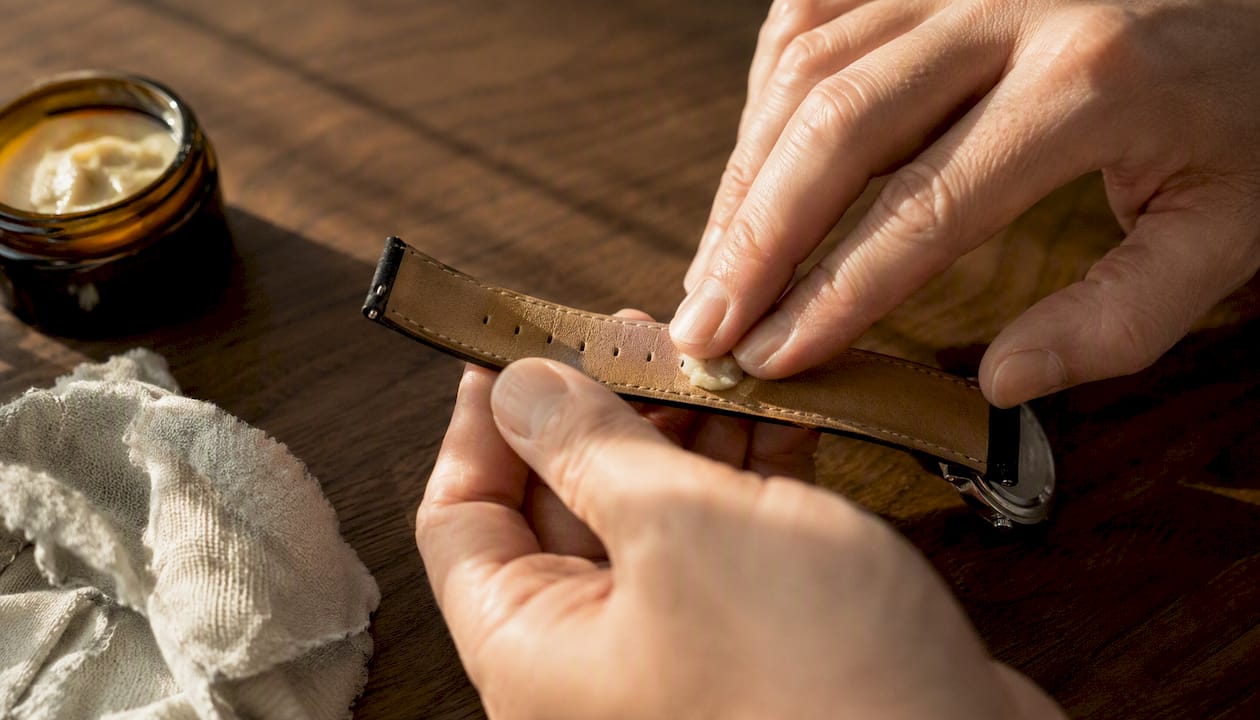
- Apply a pea-sized amount and work it in with your fingertips
- Test on a hidden area (inside near the lug end) before treating the full strap
- Buff off any excess with a clean, dry cloth
- Let the strap rest for at least an hour before wearing
Don’t:
- Use boot oils, heavy mink oil, or neatsfoot oil on fine watch leather
- Apply food oils like olive oil (they oxidize, go rancid, and stain)
- Saturate the leather; more product does not mean better results
- Use heat to speed up drying or absorption
- Apply conditioner to a wet or damp strap
- Use alcohol-based cleaners or aggressive waterproofing sprays
As Hodinkee notes, heavy oils that darken or over-soften fine leather are one of the most common mistakes watch owners make. The goal is to preserve the strap’s structure, not saturate it.
Pro Tip: Apply roughly half the amount of conditioner to the underside (the lining) compared to the top grain. The lining sits against your skin and absorbs product faster; too much leaves a tacky surface that feels unpleasant and traps sweat.
How Often Should You Condition a Leather Watch Strap?
Frequency depends on how often you wear the watch and where you live. Under regular daily use, conditioning every 2–3 months is a reasonable baseline, according to premium-watch care guidance from Maven Watches. For a strap you wear only on weekends or for special occasions, twice a year is usually enough.
Beyond the calendar, watch for these physical cues:
- The leather feels noticeably stiffer when you flex it
- The surface looks dull or has lost its sheen
- Hairline cracks are forming at the buckle holes or along the edges
- The strap smells stale after a day of wear
- You’ve been in a particularly dry climate or the strap got damp and dried out
Situational triggers matter as much as the schedule. After a long day of heavy sweating, after the strap got caught in rain, or after a period of storage in a dry environment, condition it regardless of when you last did. Longines advises letting any wet strap dry completely at room temperature before treating it, and to keep it away from heat sources and direct sunlight during that process.
Which Products Are Safe for Fine Watch Leather?
The short answer: light balms and creams formulated specifically for finished or top-grain leather. Anything heavier than that risks permanent color change or structural softening on a watch strap.
Safe product types:
- Light leather balms or creams designed for finished, top-grain leather
- Non-scented, low-solvent formulas
- Products labeled for fine leather goods (shoes, bags, watch straps)
Products to avoid:
- Heavy boot oils and waterproofing waxes
- Mink oil and neatsfoot oil (both designed for thick work leather, not fine bands)
- Olive oil and other food-grade oils (they oxidize and go rancid on leather)
- Alcohol-based cleaners
- Silicone sprays
Burton Goods makes the point clearly: over-conditioning with the wrong product is one of the most frequent causes of uneven color change and sticky surfaces on fine watch straps. The fix is choosing a lighter formula and using less of it.
How to test before you commit:
Apply a small amount of your chosen conditioner to the inside of the strap near the lug end. Wait 10–15 minutes. If the leather darkens significantly, feels tacky, or the finish looks uneven, that product is too heavy for this strap. If the color returns to near-normal and the surface feels smooth, you’re good to proceed.
Pro Tip: For open-pore or vegetable-tanned leather straps, use even less product than you think you need. These leathers absorb conditioner faster and darken more easily than finished top-grain. A thin, even coat is always safer than a generous one.
Step-by-Step: How to Condition and Soften a Leather Watch Strap
Follow these steps in order. Skipping the cleaning phase and going straight to conditioning is the single most common mistake, and it seals in grime rather than removing it.
-
Remove the strap. Use a spring-bar tool to detach both ends from the watch case. Timex recommends always removing the strap before cleaning or conditioning to protect the case, seals, and movement from product contact. It also prevents accidental scratches on the watch head.
-
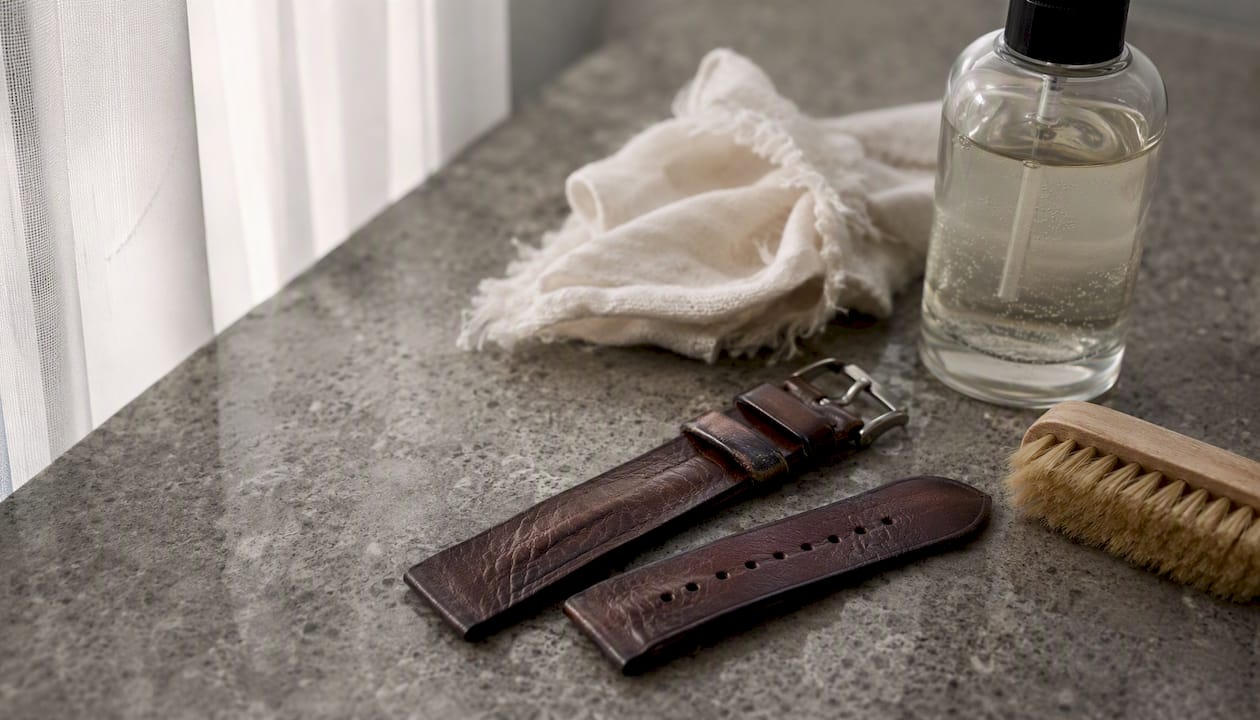
Dry wipe. Run a soft, lint-free cloth over both sides to lift surface dust and loose debris. For finished leathers, follow with a barely damp cloth and a tiny drop of mild soap if there’s visible grime. For suede or nubuck, skip water entirely and use a dedicated suede brush to restore the nap instead.
-
Dry completely. Let the strap air-dry at room temperature. No hairdryers, no radiators, no direct sunlight. Longines is explicit on this point: heat warps and cracks leather. Even a few minutes under a hairdryer can damage the finish permanently.
-
Apply conditioner. Squeeze out a pea-sized amount onto your fingertip. Work it into the top grain using small circular motions, covering the entire surface evenly. Then apply roughly half that amount to the underside. The fingertip technique matters: your body heat warms the product slightly and helps it penetrate the leather fibers more evenly than a cloth would.
-
Soften and flex. Once the conditioner is worked in, gently roll and flex the strap lengthwise between your palms. Leatherity’s step-by-step softening guide describes this as the key technique for speeding up break-in safely, producing a comfortable fit within hours rather than weeks. Avoid sharp folds or creasing across the width; those can leave permanent marks.
-
Rest, then buff. Set the strap flat on a clean surface and let it sit for at least an hour. Then buff the surface with a dry cloth using light circular strokes to remove any excess product and bring up a subtle sheen. Reattach carefully.
Safety warnings: Never condition a wet strap. Avoid getting product on the stitching or dyed edges, where it can cause bleeding or weakening. If the strap has a painted or lacquered edge, test that area separately.
Pro Tip: A careful cleaning sequence — dry wipe, then barely damp cloth with mild soap, then full air-dry — is the most effective way to revive an older strap before conditioning. Rushing past this step is what causes most conditioning failures.
How to Handle Stains and Odors Before You Condition
Conditioning over a stained or smelly strap locks the problem in. Deal with it first.
For fresh stains (sweat, sunscreen, perfume, food):
- Blot immediately with a dry cloth; do not rub
- Follow with a barely damp cloth and a small amount of mild soap for finished leather
- Rinse the soap off with a second barely damp cloth, then air-dry fully
For persistent sweat stains and odors:
- Clean thoroughly first using a leather-safe cleaner
- Air the strap in a ventilated, shaded spot for several hours
- Avoid placing baking soda directly on leather; it can dry out the surface unevenly
- For detailed guidance on sweat-specific staining, ChronoCare’s guide on removing watch strap sweat stains covers the full process
For ink or oil-based spills:
- Act fast; blot with a dry cloth
- Do not use acetone, nail polish remover, or rubbing alcohol on finished leather
- A leather-specific cleaner applied with a cotton swab is the safest option
When to escalate:
If the odor persists after two cleaning cycles, or if the lining has started to delaminate, professional leather cleaning is worth considering. If the smell is coming from inside the lining layers, no surface treatment will fix it. At that point, replacement is the more practical answer.
Pro Tip: For suede and nubuck straps, skip water-based cleaning entirely. Use a dry suede brush for surface dirt and a suede-specific eraser for spot stains. Water and creams darken open-pore finishes in ways that are very difficult to reverse.
Storage and Daily Habits That Extend Strap Life
How you store and handle a strap between wears matters almost as much as how you condition it.
Storage:
- Store straps flat or loosely rolled, never folded
- Keep them in a cool, ventilated spot away from direct sunlight and heat sources
- In humid climates, add a silica gel packet to the storage box to control moisture
- Avoid airtight containers for everyday storage; leather needs airflow
Rotation:
- If you own more than one strap, rotate them regularly
- Resting a strap allows sweat and skin oils to dissipate naturally, which materially extends its life compared with wearing the same strap every day
- Let a rested strap air out in a shaded, ventilated area before returning it to storage
Daily habits:
- Wipe the strap with a dry cloth after each wear
- Remove the watch before applying perfume, lotion, or sunscreen; let those products absorb fully before putting the watch back on
- Take the watch off before swimming, showering, or any activity involving prolonged water exposure
- For high-sweat activities, a rubber or NATO strap is a better choice; ChronoCare’s guide on cleaning rubber watch straps covers that alternative
When Conditioning Won’t Help and Replacement Is the Right Call
Conditioner moisturizes surface fibers. It cannot repair structural damage. Knowing the difference saves you time and prevents you from conditioning a strap that should be replaced.
Replace rather than condition when you see:
- Layer separation (the top grain is peeling away from the backing)
- Deep cracks running across the grain, not just at the edges
- Torn or stretched buckle holes that no longer hold the pin securely
- Broken or fraying stitching along the edges
- Persistent odor after two thorough cleaning cycles
- A lining that has hardened, cracked, or begun to flake
Conditioning a strap with any of these problems can actually make things worse by softening the remaining structure and accelerating delamination. WatchGecko notes that restoration techniques work best on straps that are dry and dull but structurally sound; once the layers separate, no surface treatment reverses that.
When replacing, match the lug width, buckle style, and leather finish as closely as possible to the original. If the strap is from a high-end watch with a proprietary buckle, a professional watch service center can source the correct replacement. For general guidance on why straps fail structurally, ChronoCare’s article on why watch straps crack over time explains the underlying causes.
Common Myths and Expert Techniques Worth Knowing
A few things circulate online that are genuinely harmful to fine leather.
Myth vs. fact:
- “Olive oil works as a conditioner.” False. Food-grade oils oxidize on leather and go rancid, producing persistent odors and staining that are very hard to remove. Use a product formulated for leather.
- “More conditioner means better results.” False. Burton Goods is direct on this: over-conditioning causes uneven darkening, sticky residue, and structural softening. Less is consistently better.
- “A hairdryer speeds up drying safely.” False. Heat damages the finish and can cause the leather to warp or crack at the surface. Room temperature air-drying is the only safe method.
- “Heavy boot treatments work on any leather.” False. Boot oils are formulated for thick, porous work leather. On fine watch straps, they over-soften the structure and leave a dark, greasy surface.
Expert techniques that actually make a difference:
- Use your fingertips, not a cloth, to apply conditioner. Body heat warms the product and helps it penetrate more evenly.
- Apply less to the lining than the top grain. The lining absorbs faster and sits against skin; excess product there causes tackiness.
- After flexing, let the strap rest flat before buffing. Buffing too soon can pull product back out of the leather before it has absorbed.
- Test-spot patience is real: wait the full 10–15 minutes before judging whether a product is too heavy. Darkening that looks alarming at five minutes often fades back significantly by fifteen.
Pro Tip: The fingertip massage technique is the single biggest difference between a professional result and an amateur one. Pros apply conditioner in small, circular motions and let the warmth of their hands do the work. A cloth applies product unevenly and can leave streaks on finished leather.
Why This Routine Matters More Than Most People Realize
The standard advice to “condition your leather strap occasionally” undersells what’s actually at stake. A quality leather strap on a fine watch is a precision-cut piece of finished leather, often with hand-stitched edges and a specific surface treatment. Treating it the same way you’d treat a pair of work boots is a category error.
The routine described here, clean first, condition lightly with the right product, flex gently, rest and buff, is not overcautious. It reflects how leather actually behaves. Conditioning without cleaning first seals in grime. Conditioning with the wrong product changes the color and texture in ways you cannot undo. Conditioning too often softens the structure until the strap loses its shape.
What most articles miss is the asymmetry: under-conditioning is easy to fix (just condition), but over-conditioning or using the wrong product can permanently alter a strap you may have paid a significant amount for. The conservative approach, less product, right formula, test first, is not timidity. It’s how you protect the investment.
ChronoCare’s products are formulated with exactly this balance in mind: effective enough to restore suppleness, controlled enough not to over-saturate fine leather.
ChronoCare Products That Fit This Method
The clean-condition-buff workflow described in this guide maps directly onto ChronoCare’s product line.
- ChronoCare Leather Strap Cleaner/Conditioner: Use this at Step 2 and Step 4. The formula is designed for finished top-grain leather, low-solvent, and safe for dyed edges. Apply sparingly and test-spot first, as described above.
- ChronoCare Ultimate Watch Cleaning Kit: The all-in-one kit covers the full clean-to-buff workflow in a single purchase, with the tools and formulas matched to each step. Ideal if you want everything in one place rather than sourcing products individually.
- ChronoCare Watch Polishing Cream: This is for the metal case, not the leather. After conditioning the strap, use the polishing cream to bring the case back to its original finish. Keep it off the leather entirely.
All three are available at Shopchronocare. Use the test-spot method before applying any product to a new strap, and remember: a small amount, worked in with your fingertips, is always the right starting point.
Sources
- Leather Watch Straps: care guide | LONGINES US
- How to clean and care for your watch straps — Hodinkee
- How To Clean Your Leather Watch Strap — Timex
- How to Restore Old Leather Straps | WatchGecko
- How to Condition Leather Watch Band Right – Burton Goods LLC®
- How To Soften Leather Watch Strap | 10 Easy Steps (2026)