

Why Watch Straps Crack over Time: A Care Guide
If you’ve ever noticed a web of tiny lines forming along the inside edge of your watch strap, you already know the frustration. Watch strap cracking, known in materials science as flex fatigue degradation, doesn’t happen overnight, and it’s rarely just about “old age.” The real reasons why watch straps crack over time are rooted in material chemistry, moisture loss, UV exposure, and daily mechanical stress. Most owners miss these causes entirely until the damage is already visible. This guide breaks down every culprit, by material type, environment, and habit, so you can act before cracks turn into a replacement.
Table of Contents
- Key Takeaways
- Why watch straps crack over time: material by material
- Environmental and mechanical causes of cracking
- Practical steps to prevent strap cracking
- When to replace a watch strap
- My honest take after years around watch straps
- Protect your strap with the right products
- FAQ
Key Takeaways
| Point | Details |
|---|---|
| Material determines failure mode | Leather, silicone, rubber, and resin each crack through distinct chemical and mechanical processes. |
| Cracks often start hidden | Leather cracks begin underneath the strap at flex points, not on the visible top surface. |
| Chemical exposure is underestimated | Sanitizers and insect repellents strip plasticizers from resin straps, causing rapid rigidity and cracking. |
| Conditioning timing matters | Reconditioning leather every 2 to 3 months significantly delays crack progression at fold points. |
| Replacement has clear signals | Deep cracking, delamination, and oval buckle holes mean care products can no longer reverse the damage. |
Why watch straps crack over time: material by material
Before you can stop the damage, you need to understand what your strap is actually made of. The word “watch strap” covers four fundamentally different material families, and each one fails through a completely different process.
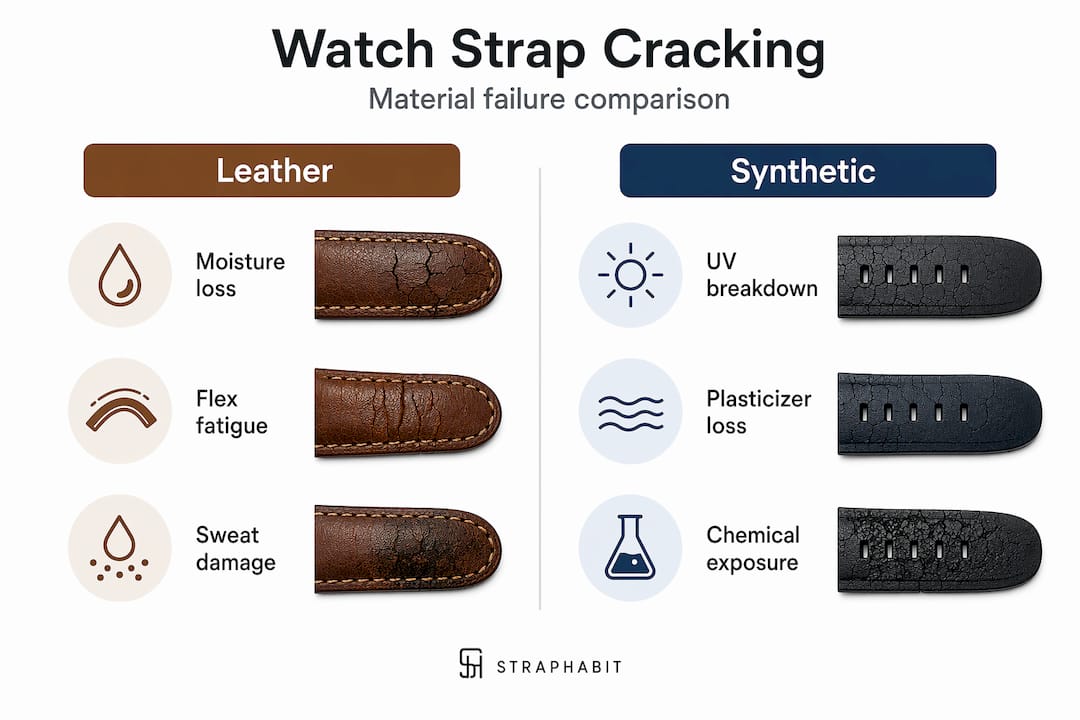
Leather is natural animal skin, which means it depends on moisture retention to stay flexible. When that moisture leaves, the fibers grow brittle. Sweat, salt, and skin oils pull moisture out of leather gradually, and the damage clusters at high-flex areas like the buckle fold and lug connection. Full-grain leather with a thick profile holds up longer, but coated or corrected-grain leather, especially pieces thinner than 3.5mm, shows coating failure and adhesive breakdown much sooner.
Silicone feels almost indestructible at first. It resists water and most chemicals. But prolonged UV exposure and heat cause surface degradation and stickiness that most owners misread as dirt. Silicone straps often show visible wear within six months to two years of daily use, while FKM (fluoroelastomer) rubber takes five to ten years to show comparable breakdown, largely because its chemical structure resists UV and heat far better than standard silicone. If your rubber strap is cracking fast, there’s a good chance it’s silicone-grade, not FKM.
Resin and urethane straps fail through a process most people never hear about: plasticizer loss. Plasticizers are the chemical compounds added during manufacturing to keep resin flexible. Over time, they evaporate or get washed away, and the strap grows rigid and develops micro-cracks. This isn’t drying in the way leather dries. It’s an irreversible chemical aging process that accelerates sharply when straps come into contact with hand sanitizers, sunscreen, or insect repellent.
| Material | Primary failure mechanism | Typical lifespan (daily wear) |
|---|---|---|
| Full-grain leather | Moisture loss, flex fatigue | 3 to 8 years with conditioning |
| Coated/corrected leather | Coating delamination | 1 to 3 years |
| Silicone | UV degradation, surface stickiness | 6 months to 2 years |
| FKM rubber | Gradual polymer fatigue | 5 to 10 years |
| Resin/urethane | Plasticizer evaporation | 2 to 6 years |
Environmental and mechanical causes of cracking
The environment you wear your watch in matters as much as what your strap is made of. Several overlapping forces work against strap durability every single day.

Moisture cycling is one of the most damaging patterns for leather. When you sweat heavily, moisture saturates the strap fibers. Then the strap dries, often fast if you’re in air conditioning or direct sun. This wet-and-dry cycle stresses the fibers repeatedly, and forced rapid drying accelerates crack formation more than the moisture itself. The leather is least vulnerable when it dries slowly at room temperature.
Flex fatigue is the mechanical side of strap wear. Every time you bend your wrist, the strap folds at the same points: the buckle fold, the lug curve, and the keeper ring. Repeated bending concentrates stress at these locations and initiates micro-cracks that are invisible at first. Cracks usually start on the backside of the strap, where contact with skin is constant and ventilation is minimal, before they ever appear on the face you see every day.
UV radiation is a silent accelerator. Direct sun breaks down polymer chains in both silicone and resin straps, making them brittle at a molecular level. The degradation is cumulative. A strap worn outdoors for an hour daily will show visible cracking months faster than one kept mostly indoors. The color change you sometimes see in lighter straps is a visible clue the same process is happening underneath the surface.
Chemical exposure strips plasticizers from resin straps faster than almost anything else. Hand sanitizer, perfume, and sunscreen are regular offenders that many collectors never consider a threat. Rinsing a resin strap after exposure to these chemical agents preserves flexibility and meaningfully extends its service life.
Temperature swings and salt air add another layer of stress, especially for anyone in coastal climates. Salt particles abrade strap surfaces microscopically, and repeated expansion and contraction from heat cycling compounds the structural fatigue that eventually leads to cracking.
Practical steps to prevent strap cracking
Good maintenance isn’t complicated, but timing and product choice matter more than most people realize. Here’s a routine that works across material types.
- Condition leather every 2 to 3 months. Use a product designed for watch straps specifically, not shoe polish or general leather conditioners. These replenish the oils that delay crack progression at fold points and keep fibers supple through repeated flexing. Apply a small amount, work it in with a soft cloth, and let it absorb for at least an hour before wearing.
- Let leather dry naturally after sweat exposure. Remove the watch after a workout or hot day and let the strap air dry at room temperature. Never use a hair dryer or leave it on a sunny windowsill. Heat accelerates the exact moisture loss that leads to cracking.
- Rinse silicone and resin straps with fresh water after chemical exposure. This applies after workouts involving heavy sweat, any session where sunscreen or insect repellent was applied, or a day near salt water. A quick rinse takes ten seconds and preserves months of strap life.
- Rotate between two straps if you wear one watch daily. This single habit halves the flex fatigue accumulated at buckle folds and lug curves. Even a basic secondary strap used two or three days a week gives your primary strap time to recover structurally.
- Check and adjust strap fit. A strap worn too tight puts constant stress on the leather or resin fibers. One worn too loosely creates uneven mechanical load at the spring bar points. Proper fit reduces mechanical stress and extends strap life in ways that no conditioning product can replicate.
- Avoid harsh cleaning products. Alcohol-based cleaners and aggressive sprays strip oils from leather and dissolve plasticizers in resin. Review cleaning spray ingredients before applying anything to a strap you want to preserve.
Pro Tip: When conditioning a leather strap, pay extra attention to the backside, especially the area that sits over the buckle fold. That’s where micro-cracks form first, and it’s the spot most people skip entirely.
When to replace a watch strap
Conditioning and careful maintenance can delay cracking for years. They cannot reverse it. Knowing when care has reached its limit saves you from wearing a strap that’s one hard flex away from snapping.
Look for these signals:
- Deep cracking through the full thickness of the leather. Surface cracks can be slowed with conditioning. Cracks that reach through the core of the strap mean the structural integrity is compromised.
- Delamination or peeling coating. When the top coating separates from the base material, no product will reattach it. The adhesive bond has failed, and the process will continue.
- Oval-shaped buckle holes. Round holes that have stretched oval indicate the material has lost its tensile strength. That section will tear under normal use.
- Persistent stickiness in silicone or resin. This signals polymer breakdown at a molecular level. The strap is no longer structurally sound.
- Cracking that appears after conditioning. If you apply a quality conditioner and the strap cracks further when flexed, the fibers have lost too much structural integrity to respond to treatment.
For leather, strap thickness and hide quality are the biggest predictors of how long you get before reaching this point. Thicker, full-grain leather with minimal coating holds up far longer than bonded or painted alternatives. When you’re choosing a replacement, the strap material comparison guide from ChronoCare lays out durability differences across materials in practical terms worth reading before you buy.
My honest take after years around watch straps
What surprises me most, even now, is how often owners blame cracking on a “cheap strap” when the real culprit is something they did every day without realizing it. I’ve seen beautifully made leather straps fail in eighteen months because the owner conditioned them once at purchase and never again. And I’ve seen basic straps last six years on someone who rotated two straps and conditioned consistently.
The other misconception I keep running into is that cracking only matters aesthetically. It doesn’t. A cracking strap puts uneven mechanical stress on your watch’s spring bars. That stress can eventually cause a spring bar to fail, and a falling watch is far more expensive than a new strap.
My honest advice on material selection: if your lifestyle involves regular outdoor activity, chemical exposure, or coastal environments, FKM rubber is worth the price premium. If leather is what you love, commit to the conditioning schedule or accept you’ll be replacing straps every two to three years. Half-measures produce half the lifespan. The owners I’ve seen get the most from their straps treat conditioning as a scheduled task, not something they do when the strap “looks dry.”
Small, consistent habits compound over years. That’s not a motivational line. It’s just what the wear patterns show.
— Raymond Jenkins
Protect your strap with the right products
Knowing the causes of strap cracking is only useful if you have products that can act on that knowledge.
ChronoCare’s watch care cleaning kit is formulated specifically for luxury timepieces, covering leather conditioning, surface cleaning, and protective care in one set. For leather straps specifically, the leather strap cleaner spray removes sweat residue and oils without stripping the natural moisture balance that keeps leather supple. For a full overview of everything ChronoCare offers to help you extend strap life and maintain your watch’s overall appearance, visit shopchronocare.com. Every product is formulated in the US for collectors who take the condition of their watches seriously.
FAQ
Why do leather watch straps crack on the inside first?
Leather cracks begin on the backside because that surface has the highest sweat contact and the least airflow. Flex fatigue concentrates stress there before any visible damage appears on the outer face.
Can you stop a cracking strap from getting worse?
Conditioning can slow crack progression in leather, but once cracks are deep or delamination has started, the damage is irreversible. Early conditioning every 2 to 3 months is the only way to genuinely prevent it.
What watch strap material lasts the longest?
FKM rubber lasts the longest under daily wear conditions, typically five to ten years, because its polymer structure resists UV, heat, and chemical exposure far better than silicone or resin alternatives.
Does hand sanitizer really damage watch straps?
Yes, especially resin and urethane straps. Chemical sanitizers strip plasticizers from the material, causing it to harden and develop micro-cracks much faster than normal aging would produce.
How do I know when it’s time to replace my watch strap?
Replace your strap when you see deep through-thickness cracks, peeling coating, oval buckle holes, or persistent stickiness in synthetic materials. At that stage, conditioning products cannot restore structural integrity.