

6 Steps to Clean DLC Watches Without Edge Chipping for Collectors
Clean a DLC watch with mild pH-neutral soap, lukewarm water, a soft-bristled brush, and a microfiber cloth. Never use ammonia-based cleaners, abrasive polishes, or ultrasonic cleaning on Diamond-Like Carbon surfaces. If you notice edge chipping, cloudiness, or flaking near the case edges, stop cleaning and get the watch to a professional for a proper strip-and-recoat instead of trying to fix it yourself.
TL;DR:
- Frequent, gentle cleaning with lukewarm water and mild soap prevents buildup and preserves the DLC coating’s appearance, especially for daily wear in sweaty or salty conditions.
- Ultrasonic cleaners and abrasive polishing products should be avoided because their high vibrations and rough abrasives can cause micro-delamination or edge chipping of the very thin DLC coating.
- Small chips, haze, or signs of micro-delamination near edges indicate the need for professional repair, as DIY fixes cannot restore the vacuum-deposited coating properly.
- Avoid ammonia-based cleaners, bleach, metal polishes, and any rough cloths, as these materials degrade the DLC’s molecular bonds and can accelerate coating failure.
- Use only pH-neutral soap, soft brushes, microfiber cloths, and soft wooden tools; reserve stronger solvents like alcohol for occasional spot cleaning, not routine maintenance.
Table of Contents
- Tools and Supplies That Are Safe for DLC-Coated Watches
- How Do You Clean a DLC Watch Every Day?
- How Do You Deep Clean the Case and Bracelet?
- Fixing Fingerprints, Smudges, and Sticky Residue
- What Chemicals and Methods Will Ruin a DLC Coating?
- When Should You Call a Professional Instead of Cleaning It Yourself?
- What ChronoCare Knows About Keeping DLC Watches Right
- Editorial Perspective: Wear It or Preserve It?
- Keep Your DLC Watch Looking the Way It Should
- Sources
- FAQ
Tools and Supplies That Are Safe for DLC-Coated Watches
Diamond-Like Carbon is a thin film of amorphous carbon bonded to the metal underneath, deposited through a vacuum process called PVD or CVD. It measures somewhere between 2,000 and 3,000 on the Vickers hardness scale, which puts it well above stainless steel. That hardness fools a lot of owners into treating DLC like it’s bulletproof. It isn’t. The coating itself is only 1 to 3 microns thick, thinner than a human hair, so the wrong cleaner or the wrong tool can still cause real damage even though the surface feels rock hard.
Here’s what belongs in your cleaning kit:
- Neutral pH dish soap (a small drop diluted in water)
- A bowl of lukewarm water, never hot
- A soft-bristled toothbrush (baby toothbrushes work well)
- Microfiber cloths, at least two, kept separate for wet and dry use
- A pegwood stick or soft wooden toothpick for tight gaps
- Cotton swabs for crown and pusher recesses
Isopropyl alcohol at 70% has a place, but only for occasional spot work. It’s fine for lifting a stubborn oil smear once in a while, but repeated alcohol contact dries out rubber gaskets over time, and a watch with compromised seals is a watch that lets water in. Treat it as a rescue tool, not a daily habit.
What you should never reach for: ammonia-based glass cleaners, bleach, any metal polish, and rough cloths or paper towels that carry hidden grit. These aren’t just “not ideal.” They’re the fastest way to shorten the life of a DLC finish, and the reasoning behind that gets its own section below.
Pro Tip: Keep one microfiber cloth exclusively for drying watches. A cloth that’s touched lotion, sunscreen, or household cleaners can transfer residue right back onto the case you just cleaned.
How Do You Clean a DLC Watch Every Day?
A quick weekly wipe does more for a DLC watch’s long-term look than any deep clean ever will, because it stops sweat salts and skin oils from sitting on the coating long enough to dull the finish or work into the bracelet links.
Before anything touches water, confirm the crown is fully screwed down if your watch has a screw-down crown. A crown left even slightly unscrewed turns a routine rinse into a moisture problem.
- Fill a small bowl with lukewarm water and add one drop of neutral dish soap. Swirl gently so it doesn’t foam up.
- Dip the soft-bristled toothbrush and work it lightly across the case back, lug gaps, and bracelet links. Small circular motions, no pressing.
- Pay extra attention to the underside of the bracelet, where dead skin cells and sweat residue tend to collect and where DLC scuffs are least visible until they aren’t.
- Rinse under a light stream of lukewarm tap water, keeping the watch face angled slightly downward so water doesn’t pool near the crown.
- Pat dry immediately with a dedicated microfiber cloth. Don’t rub, just press and lift.
- Open the clasp fully and let the watch sit for a few minutes so any trapped moisture in the links can evaporate before you close it back up.
How often you run this depends entirely on how the watch gets worn. Daily wearers who sweat regularly, hit the gym, or work outdoors should rinse weekly at minimum. Office wearers who mostly sit at a desk can stretch that to once a month. If you’ve been near saltwater, whether that’s a beach day or a boat trip, clean the watch the same day. Salt crystallizes as it dries and becomes mildly abrasive against the coating, which defeats the whole point of a quick clean in the first place.
This routine isn’t a substitute for the deeper clean below. However, it’s the single habit that prevents most of the buildup that eventually demands one.
How Do You Deep Clean the Case and Bracelet?
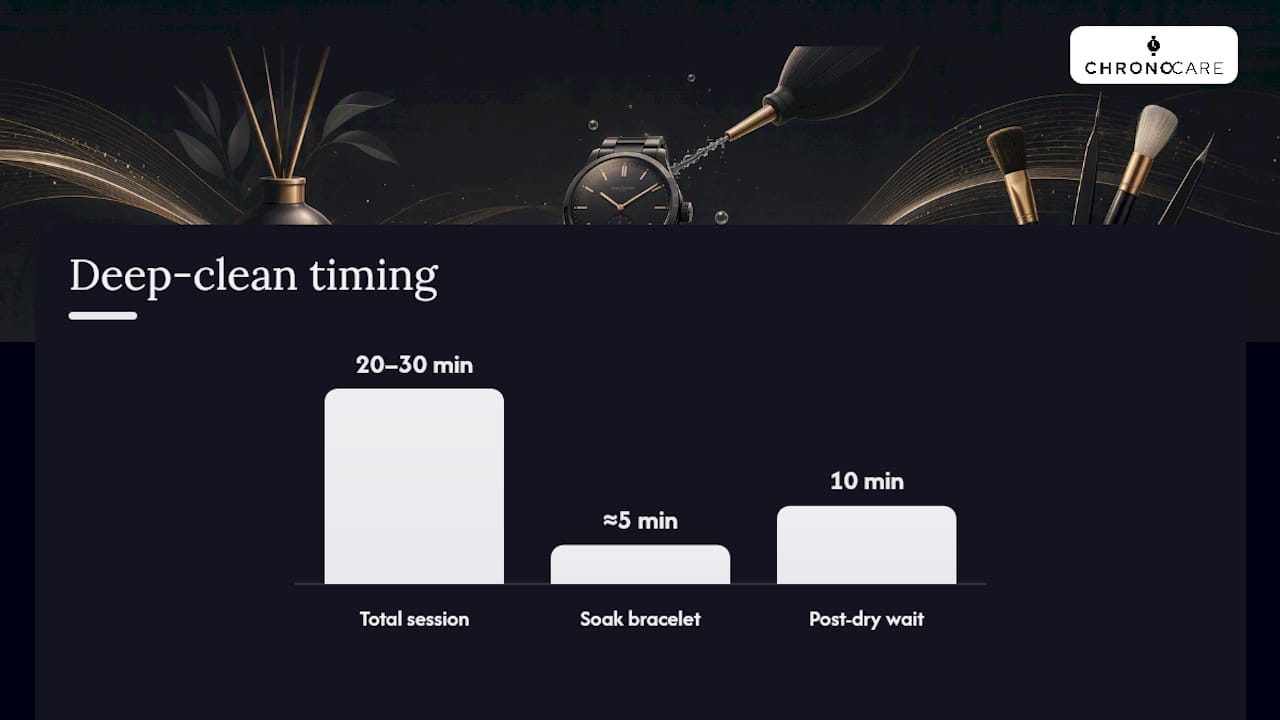
A deep clean tackles the grime that a weekly wipe can’t reach: the film that builds up inside bracelet links, around bezel teeth, and in the crevices where the case meets the lugs. Set aside 20 to 30 minutes, work over a towel on a well-lit table, and keep small parts away from drains.
Preparation
- Confirm the crown is screwed down or pushed fully in before any water touches the watch.
- If the bracelet has quick-release spring bars, remove it from the case. This isn’t required, but it gives you far better access to the clasp mechanism and the underside of each link.
- Lay out your tools within reach: brush, pegwood, two microfiber cloths, the soap solution, and a small bowl for rinsing.
Soaking and brushing
A metal bracelet on its own can tolerate a brief soak, five minutes or so, in the mild soap solution. That loosens grime lodged in the links before you brush. The case itself is a different story. Lukewarm water and mild soap with a soft brush is the safe method for both bare titanium and DLC-coated surfaces, but a coated case and bracelet should never go anywhere near an ultrasonic cleaner. Ultrasonic baths work by generating high-frequency vibration through the liquid, and that energy can transmit into sharp coated edges and encourage micro-delamination that you won’t notice until the coating starts flaking weeks later.
Work the soft brush into the bezel teeth using short strokes in one direction rather than scrubbing back and forth. For bracelet links, run the pegwood stick between each segment to push out compacted lint and skin oil before you brush, since brushing over trapped debris just grinds it against the finish instead of removing it. Spring-bar holes collect the same buildup and respond well to a light pass with a dry cotton swab.
Rinse, dry, and inspect
- Rinse thoroughly under lukewarm running water, working the water through the bracelet links to flush out loosened soap.
- Dry immediately with a microfiber cloth, then set the watch face up on a dry towel for ten minutes before reassembling the bracelet.
- Inspect the case edges, bezel edge, and lug tips under good light for any dulling, hazing, or flaking. These are early signs of coating stress, not something to buff out.
- Check that the crown still screws down smoothly and that the clasp opens and closes without resistance.
Skip abrasive polishing entirely on DLC. It’s tempting to reach for a polishing cloth the way you might on a bare steel case, but any abrasive contact removes microscopic amounts of the coating itself rather than just buffing the surface. There’s no “light polish” option here; the coating either stays intact or it doesn’t.
Fixing Fingerprints, Smudges, and Sticky Residue
Small problems deserve small fixes. Most fingerprint smears and light oil marks lift with nothing more than a damp microfiber cloth and a trace of the same mild soap solution used for the full clean. Wipe, don’t scrub, and follow with a dry cloth.
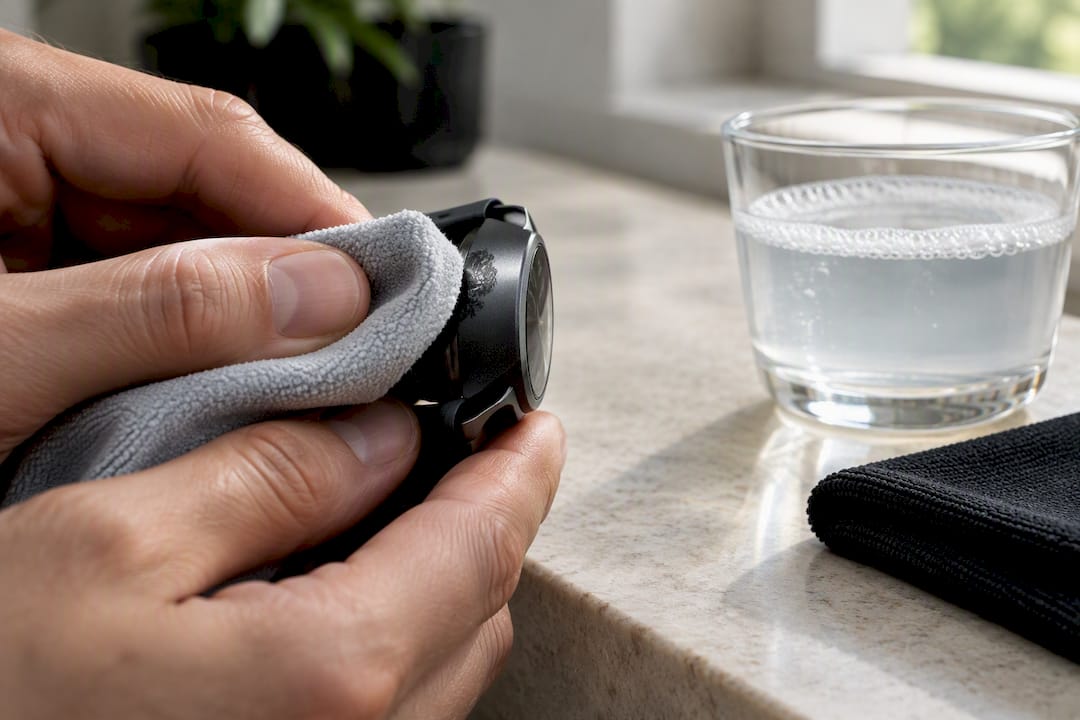
This is exactly the kind of one-off use isopropyl is good for. Making it a weekly habit is where it starts working against the gaskets instead of for the watch.
Sticker residue and adhesive gunk, often left behind from protective film on a new purchase, respond best to mechanical lifting rather than chemical dissolving:
- Press the flat edge of a pegwood stick gently against the residue and lift in one direction.
- Repeat in small sections rather than trying to remove it all in one pass.
- Finish with mild soap and a rinse to clear any remaining film.
Reach for acetone or nail polish remover and you’re not solving the problem, you’re creating a bigger one. Those solvents attack the same bonding chemistry that holds the coating to the substrate, and the damage often doesn’t show up as visible discoloration until much later.
Pro Tip: If a spot survives two gentle attempts with soap and water, that’s your signal to stop. Escalating to stronger solvents to save yourself a trip to a watchmaker almost always costs more in the end.
What Chemicals and Methods Will Ruin a DLC Coating?
Ammonia is the single worst thing you can put on a DLC-coated watch, and it’s also the one people reach for most often because it’s sitting under nearly every kitchen sink. Ammonia-based cleaners weaken the molecular bonding layer that holds DLC to the metal beneath it, and that damage is cumulative. One exposure might not show visible harm. Repeated exposure, even in small amounts, erodes the bond until the coating starts lifting at the edges.
- Never use Windex or any glass cleaner containing ammonia.
- Skip bleach-based household cleaners entirely.
- Avoid metal polishes and jewelry-dip solutions formulated for bare steel or gold.
- Don’t use anything labeled “abrasive” or “scouring,” even lightly.
Ultrasonic cleaners deserve the same caution for a mechanical reason rather than a chemical one. The high-frequency vibration these machines use is excellent at shaking loose dirt from bare metal, but on a coated surface it puts stress directly on the thinnest, most vulnerable part of the whole system: the edges.
The edge-chipping problem, explained: DLC’s coating thickness runs only 1 to 3 microns. At sharp case corners and bezel edges, that thin layer has almost no material to absorb an impact or vibration before it separates from the substrate. The two dominant failure modes for DLC are edge chipping from impact and bonding degradation from chemical exposure, and both concentrate exactly where the coating is geometrically weakest. Once a chip exposes bare metal underneath, no DIY touch-up pen or “fill” product restores it, because you’d be layering a mismatched material over a vacuum-deposited film. The repair almost always looks worse than the original chip.
If you accidentally splash ammonia cleaner on the case, rinse it off immediately under running water, then wash with the mild soap solution and dry thoroughly. A single accidental splash rinsed off fast is a very different situation than letting it sit or wiping it in.
When Should You Call a Professional Instead of Cleaning It Yourself?
Some problems are outside what soap, a brush, and patience can fix. Watch for these signs:
- Visible chipping at the case edges, bezel, or lugs that exposes a different-colored metal underneath.
- Cloudiness, haze, or a slightly rough texture near edges, which often signals micro-delamination starting beneath the surface.
- Water resistance that seems compromised, whether that’s fogging under the crystal or moisture inside the case back after a rinse.
- A crown or pusher that feels gritty or doesn’t seal the way it used to.
Strip-and-recoat is a genuine industrial process, not a polishing service. A qualified atelier disassembles the case, strips the existing coating down to bare substrate, preps that surface, and runs it back through vacuum deposition before reassembly. It’s the same category of process used to apply the coating originally, which is why it isn’t something a local jeweler with a buffing wheel can do. Costs vary widely by brand, case complexity, and whether the bracelet needs recoating too, so get a specific quote from a watchmaker rather than assuming a flat rate. Many manufacturer service centers explicitly exclude DLC and PVD cases from standard polishing or refresh services, which tells you how specialized this work actually is.
After any professional service, or after a period of heavy water exposure, it’s worth having gaskets pressure-tested and replaced on the schedule your watchmaker recommends. A recoated case with a tired old gasket is still a watch that can let water in.
What ChronoCare Knows About Keeping DLC Watches Right
Raymond Jenkins has spent years writing practical watch-care guidance for collectors who want their timepieces to actually last, and the rules for DLC surfaces come down to the same handful of non-negotiables every time:
- Mild soap and lukewarm water only, never anything ammonia-based or abrasive.
- No ultrasonic cleaning, ever, on a coated case or bracelet.
- The moment you see a chip or hazing near an edge, that’s a job for a professional, not a home fix.
ChronoCare builds its Ultimate Watch Cleaning Kit around exactly that philosophy: gentle, pH-balanced formulas and soft microfiber tools meant for regular maintenance rather than aggressive correction. For the daily wipe and the deep clean described above, a kit like this fits naturally into the routine, since the goal is always to remove grime without touching the coating chemistry itself. Restoration creams and polishing compounds belong on bare steel or gold. On DLC, they stay in the drawer.
Editorial Perspective: Wear It or Preserve It?
Collectors treat DLC like a decision they have to make once and live with forever, and that’s the wrong frame. DLC resists everyday scratching far better than bare steel, but its vulnerability sits at the edges, where impact and geometry work against a coating that’s only microns thick. Accept that a watch you actually wear will pick up some edge wear eventually. That’s the trade for using it instead of leaving it in a box.
My take: rotate watches if you own more than one, skip the coated piece for anything involving ladders, tools, or contact sports, and get a professional check on water resistance every couple of years regardless of how careful you are. If the case eventually shows real wear you can’t live with, recoating exists for exactly that reason. Chasing showroom perfection on a watch you wear daily is a losing game. Chasing reasonable care on a watch you actually enjoy is not.
— Raymond Jenkins
Keep Your DLC Watch Looking the Way It Should
Most of what damages a DLC finish isn’t a single dramatic mistake. It’s small, repeated exposure to the wrong cleaner or the wrong tool, the kind of thing that adds up over months without you noticing until the coating starts to dull.
ChronoCare’s Ultimate Watch Cleaning Kit is built for the routine this article walks through: mild formulas, soft microfiber, nothing abrasive, nothing that fights against a coated surface. If you’re weighing the larger Ultimate Watch Polishing & Cleaning Kit, know upfront that the polishing cream included in it is meant for bare metal cases, not DLC, and should stay out of your DLC routine entirely. The same goes for the standalone Watch Polishing Cream, which restores shine beautifully on steel and gold but has no place on a coated finish. Stick with the cleaning-focused items, follow the daily and deep-clean steps above, and skip anything with abrasive language on the label. Some products come with a satisfaction guarantee, so if a formula doesn’t work as expected on your specific watch, you may have options for returns or exchanges. Start with the cleaning kit, run the weekly routine for a month, and see the difference in how the case holds its finish.
Sources
- DLC Coating for Luxury Watches
- Titanium watch durability & scratch resistance: the real numbers - HonTitan
- DLC coating — CiRCULA blog
FAQ
What Is DLC Coating on Watches?
DLC, short for Diamond-Like Carbon, is a thin amorphous carbon film applied to a watch case through vacuum deposition, giving it a hardness in the 2,000 to 3,000 Vickers range. It’s prized for scratch resistance and a deep black finish, but the coating itself is only a few microns thick, so care has to focus on protecting the edges and the bond rather than assuming the surface is indestructible.
What Is a “Poor Man’s Rolex”?
The phrase refers to watches that share visual design cues with a Rolex, like a similar case shape or dial layout, at a fraction of the price, most often from brands like Seiko or Tudor. It’s a nickname collectors use casually and isn’t an official category, and it has no direct bearing on DLC coating or cleaning since the term describes styling and price positioning rather than materials.
Which President Wore the Day Date?
The Rolex Day Date earned the nickname “the President’s watch” largely because Lyndon B. Johnson, Dwight D. Eisenhower, and several other US presidents were photographed wearing it, and Rolex leaned into that association in its marketing. That watch is typically made in solid gold or platinum, not DLC, so its cleaning needs differ significantly from a coated case.
Can I Use Dawn Dish Soap to Clean My Rolex?
A small drop of neutral dish soap diluted in lukewarm water is a widely used and safe method for cleaning most watch cases, including Rolex models, when applied with a soft brush and rinsed thoroughly. The same approach works for DLC-coated watches, but skip anything ammonia-based or abrasive, and never substitute a full-strength degreasing dish soap for a diluted, mild one.
How Often Should I Deep Clean a DLC Watch?
Run the quick weekly wipe for regular wear, and reserve the full deep clean for roughly once a quarter unless you’re exposed to heavy sweat, saltwater, or dust on a regular basis. Adjust upward if you notice grime building up in the bracelet links faster than that, since buildup left too long becomes harder to remove without extra brushing.