

Watch Strap Hardware Care: What You Need to Know
Most watch owners focus on the dial, the movement, the case finish. The strap hardware? Barely a thought. That’s exactly where watches get lost. Understanding what is watch strap hardware care means recognizing that the spring bars, clasps, and lug pins holding your watch to your wrist are not permanent fixtures. They degrade. They corrode. They fail. And when they do, a $5,000 watch hits the pavement. This article covers every layer of watch strap hardware care: what the components are, how to clean and inspect them, which tools to use, when to replace, and how strap type changes the equation.
Table of Contents
- Key takeaways
- What watch strap hardware care actually means
- Routine cleaning and inspection
- Tools and techniques for safe hardware handling
- Replacement intervals and choosing quality parts
- Special considerations for different strap types
- My honest take on hardware care
- Take care of your hardware with the right products
- FAQ
Key takeaways
| Point | Details |
|---|---|
| Hardware is consumable | Spring bars degrade over time and should be replaced every 1 to 2 years, not kept indefinitely. |
| Lug holes need cleaning too | Debris buildup inside lug holes is a leading cause of spring bar failure and is almost always overlooked. |
| Right tools prevent damage | A professional spring bar tool costs around $30 and protects your lugs from the scratches cheap tools cause. |
| Strap type changes your routine | Leather needs conditioning every 2 to 3 months; rubber straps need rinsing after every workout. |
| Inspect monthly, replace proactively | Monthly visual checks for corrosion, pitting, or tension loss catch problems before they become watch losses. |
What watch strap hardware care actually means
Watch strap hardware refers to every mechanical component that connects your strap to the watch case and keeps it secured on your wrist. That includes spring bars (the small cylindrical pins that sit inside the lug holes), lug pins, quick-release mechanisms, and the clasp or buckle on the strap itself. Each of these components takes daily abuse: sweat, soap, UV exposure, and the mechanical stress of putting the watch on and taking it off.
The most common misconception is that watch hardware is permanent, but spring bars degrade with sweat and environmental exposure and are the critical failure point of any strap system. People treat spring bars like they treat watch hands. They assume they just stay there. They don’t.
Materials and what they mean for longevity
Not all hardware is made equal. Here’s how the most common materials compare:
| Material | Corrosion resistance | Strength | Best for |
|---|---|---|---|
| Stainless steel (316L) | High | High | Most watch types, everyday wear |
| Titanium | Very high | High, lightweight | Sport and dive watches |
| Generic alloy | Low | Medium | Budget straps, short-term use |
| Brass (plated) | Low | Low | Fashion watches, light use |
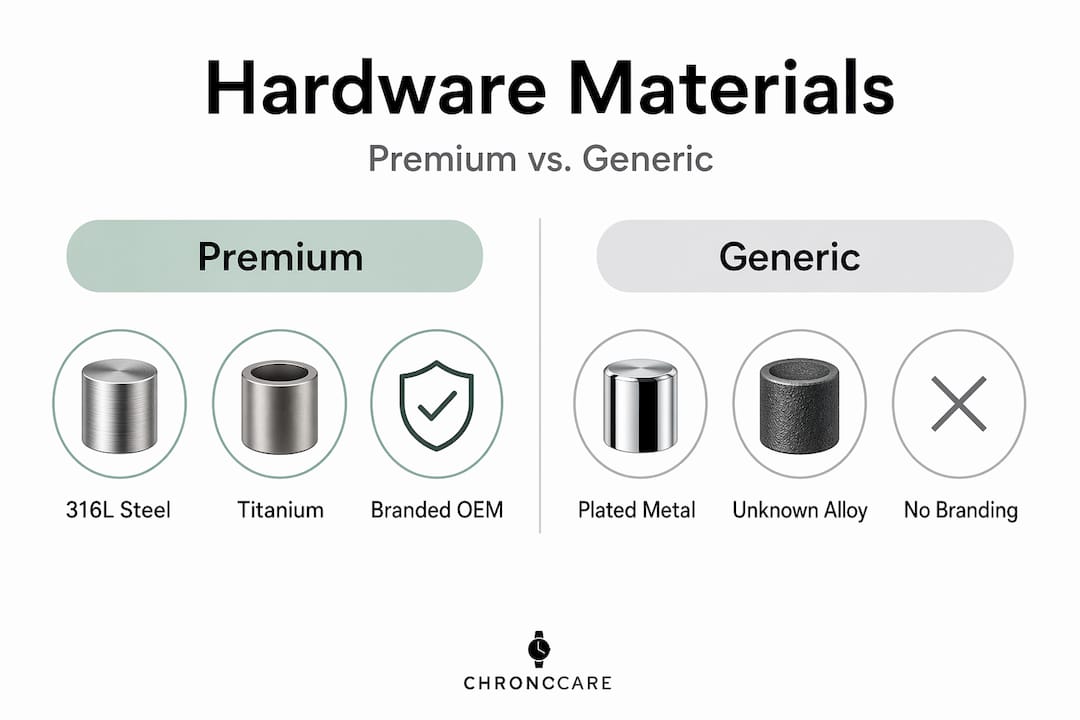
Quality stainless steel or titanium hardware offers corrosion resistance and structural strength that generic aftermarket parts simply cannot match. Choosing OEM or high-grade alloys preserves watch integrity and fit over years of use.
Size matters just as much as material. Spring bars come in diameters of 1.5mm and 1.8mm and lengths ranging from 16mm to 26mm. Using the wrong length creates a loose fit that puts lateral stress on the lug holes. Always measure your lug width before ordering replacements.
Routine cleaning and inspection
Sweat, skin oils, soap residue, and environmental grime accumulate inside lug holes faster than most people expect. Once that debris hardens, it can bind the spring bar, reduce its spring tension, and accelerate corrosion. Debris buildup in lug holes is a primary cause of spring bar failure, and cleaning those holes at every strap change is as important as cleaning the strap itself.
Here is a step-by-step cleaning process you can do at home:
- Remove the strap using a proper spring bar tool. Never skip this step and try to clean around the strap.
- Use a soft-bristle toothbrush with a small amount of mild dish soap and warm water to scrub the lug area and the strap attachment points.
- Clean inside the lug holes using a toothpick or pegwood stick. Work gently in a circular motion to dislodge dried sweat and grime.
- Rinse the case (not the movement) with clean water and dry immediately with a lint-free cloth.
- Inspect the spring bars under good light before reinstalling. Look for any visible corrosion, pitting, or deformation.
- Reinstall the strap only after both the lug holes and the spring bars are completely dry.
Pro Tip: Cleaning lug holes is the most overlooked step in watch strap maintenance tips. Watchmakers consistently flag this as a root cause of hardware failure. Make it a habit every single time you swap a strap.
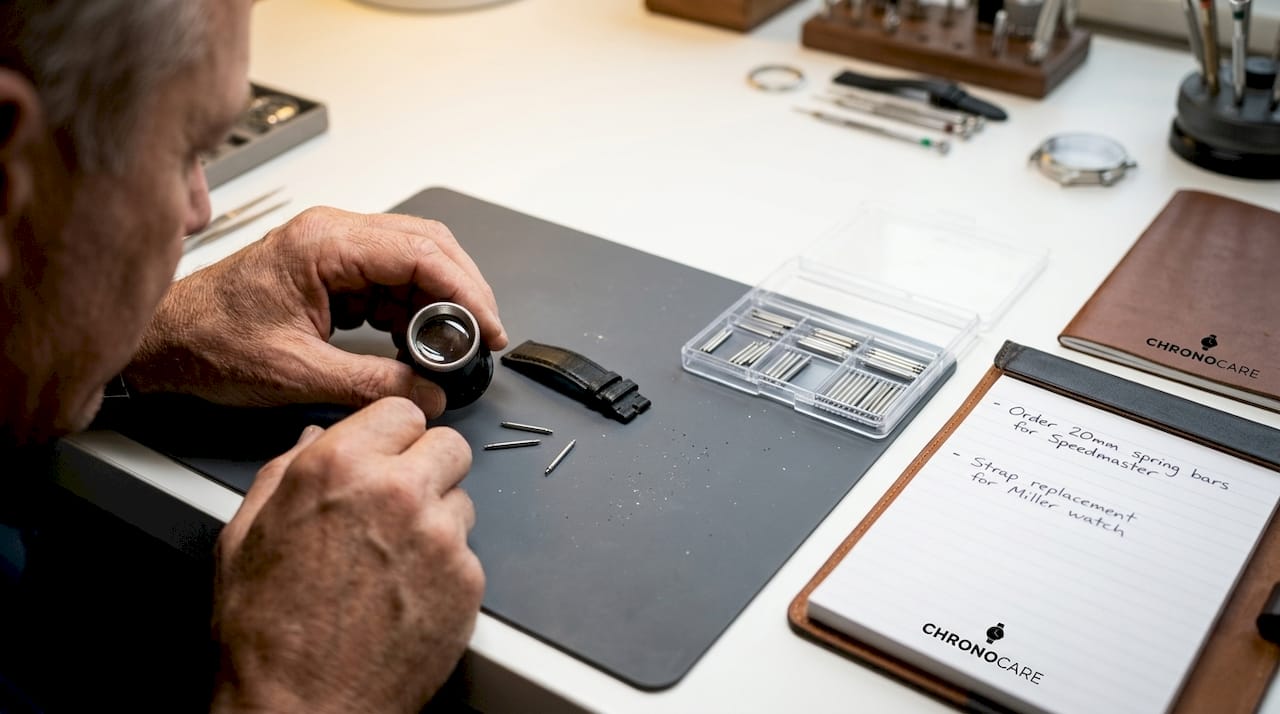
Monthly inspection is your safety net. Look for rust spots, white or green mineral deposits, any bending in the spring bar body, and reduced resistance when you compress the bar ends. Spring bars should be inspected every 1 to 2 years and replaced immediately if corrosion, pitting, or tension loss appears. Don’t wait for a failure to act.
Tools and techniques for safe hardware handling
Using the wrong tool on a spring bar is one of the fastest ways to scratch a watch case. A slipped screwdriver tip across a polished lug leaves a mark that no polishing cream fully erases. The difference between a professional result and a damaged watch often comes down to one tool.
Professional spring bar tools like the Bergeon 6767 prevent lug damage in a way that cheap tools with soft metal tips cannot. The Bergeon costs around $30. A generic tool costs $5. The math is straightforward when you consider what’s at stake.
Here is the correct technique for removing and installing spring bars:
- Apply masking tape or painter’s tape over both lugs before you start. This single step drastically reduces the risk of scratches from tool slips.
- Position the forked end of the spring bar tool inside the strap, not outside the lug. Approaching from the inside gives you better control and keeps the tool away from the case surface.
- Compress the spring bar end by pressing the fork against the shoulder of the bar while pulling the strap away. Work slowly.
- Once one end is free, angle the bar out of the lug hole carefully. Never yank.
- To install, compress one end of the spring bar, seat it in the lug hole, then use the fork to compress and guide the other end into place.
- After installation, tug the strap firmly in multiple directions to confirm the spring bar is fully seated and secure.
Pro Tip: Approaching spring bars from inside the strap rather than from the outside edge of the lug gives you far more control and dramatically reduces tool slips. It feels awkward the first time. By the third strap change, it becomes second nature.
Quick-release spring bars follow the same principles but have a push-button mechanism on one end. Never force them. Press the button fully before pulling the strap away.
Replacement intervals and choosing quality parts
Spring bars are consumable parts and should never be reused once they show any sign of bending, corrosion, or weakened tension. Failure is not gradual. It is sudden. And sudden means your watch is on the ground.
| Scenario | Recommended action |
|---|---|
| No visible damage, under 1 year | Inspect monthly, continue use |
| No visible damage, 1 to 2 years | Replace as preventive maintenance |
| Any corrosion or pitting visible | Replace immediately |
| Bent or deformed bar body | Replace immediately, do not reinstall |
| Reduced spring tension | Replace immediately |
When buying replacements, prioritize OEM parts from your watch brand or reputable aftermarket suppliers that specify 316L stainless steel. Generic spring bars from unknown sources often use softer alloys that bend under normal stress. The cost difference is negligible. A pack of quality spring bars costs $5 to $15. The cost of losing a watch is not.
Store spare spring bars in a small labeled container organized by diameter and length. When you need one at 11pm before a morning trip, you will be glad you did.
Special considerations for different strap types
Different strap materials interact with hardware differently, and your cleaning and care routine needs to reflect that.
For leather straps, the relationship between the strap and the spring bar is tight. Leather can stiffen and shrink in dry conditions, putting additional stress on the spring bar shoulders. Conditioning leather straps every 2 to 3 months keeps the material supple and reduces that mechanical stress. Use a dedicated leather strap cleaner rather than household products that can strip natural oils from the leather.
For rubber and silicone straps, the concern is chemical buildup. Sweat and chlorine from pools degrade the material and can accelerate corrosion on the spring bar shoulders where the strap contacts metal.
Key watch strap protection advice by strap type:
- Leather: Condition every 2 to 3 months with a specialized conditioner. Clean with a slightly damp cloth. Avoid soaking. Leather conditioner applied sparingly every few months keeps straps supple and prevents cracking.
- Rubber/silicone: Rinse with clean water after every workout. Use mild soap weekly if worn during exercise. Dry thoroughly before storing.
- NATO/nylon: Machine wash on a gentle cycle or hand wash with mild soap. These straps bypass the spring bar directly, so inspect the bar ends where the strap fabric sits for any wear marks.
- Tight lug spaces: Curved spring bars increase clearance and reduce friction damage in watches with tight lug-to-strap clearance. Leather straps can also be gently shaped by hand before installation to improve fit.
A poor strap fit is not just uncomfortable. It creates constant lateral stress on the spring bar shoulders, which accelerates fatigue and failure. If a strap feels forced during installation, that tension does not disappear. It stays there every time you move your wrist.
My honest take on hardware care
I’ve watched collectors spend thousands on straps and zero minutes on the hardware holding those straps to their watches. In my experience, that’s the single most common and most costly oversight in watch ownership.
The lug hole cleaning step is the one I push hardest. Most people have never done it. When you pull a spring bar that’s been in place for two years and see the dried gray paste inside that lug hole, you understand immediately why the bar was getting harder to compress. That grime is not just cosmetic. It binds the bar, reduces its travel, and creates uneven stress on the bar body.
I’ve also seen the aftermath of cheap spring bar tools. Hairline scratches across polished lugs on a watch that cost more than a car payment. The $25 you save on a tool is not worth it. Buy the Bergeon once and you’re done.
My personal inspection routine is the first of every month: remove one strap, clean the lug holes, inspect the bars, reinstall. It takes eight minutes. For professional servicing of more complex hardware or vintage pieces, I always defer to a watchmaker rather than improvise.
The best watch strap care practices are not complicated. They just require consistency. Most hardware failures I’ve seen were entirely preventable with a monthly look and a $30 tool.
— Eduardo
Take care of your hardware with the right products
Knowing the right technique matters. Having the right products makes it repeatable. Shopchronocare offers purpose-built cleaning kits and strap care solutions designed specifically for watch hardware maintenance, not repurposed household cleaners. The luxury watch cleaning kit includes everything you need to clean lug holes, polish case surfaces, and protect metal hardware between strap changes. For leather strap owners, the dedicated leather strap cleaner spray conditions and protects without stripping the material. These are the tools that make watch band hardware upkeep something you actually do, not just something you plan to do. Browse the full range of watch care kits at Shopchronocare and build a maintenance routine that matches the quality of the watches you own.
FAQ
What is watch strap hardware care?
Watch strap hardware care is the routine practice of cleaning, inspecting, and replacing the mechanical components that attach a watch strap to the case, including spring bars, lug pins, and clasps, to prevent failure and protect the watch.
How often should spring bars be replaced?
Spring bars should be replaced every 1 to 2 years under normal conditions, or immediately if you notice corrosion, pitting, bending, or reduced spring tension during a monthly inspection.
What tools do I need for safe strap changes?
A professional spring bar tool such as the Bergeon 6767 is the standard recommendation. Pair it with masking tape over the lugs to prevent scratches, and you have everything needed for safe, damage-free strap changes.
Why do lug holes need cleaning?
Debris inside lug holes binds spring bars, reduces their tension, and accelerates corrosion. Cleaning them with a toothpick or pegwood at every strap change is one of the most effective ways to extend hardware life.
Can I use household cleaners on watch strap hardware?
Mild dish soap and warm water work well for metal hardware. Avoid harsh chemicals, bleach, or alcohol-based cleaners on leather straps, as they strip natural oils and accelerate cracking. Use products formulated specifically for watch strap maintenance when possible.